
Trump Faces Powerful China After Decade Away

As Trump returns to politics, China has emerged as a formidable competitor. Experts analyze how the geopolitical landscape has shifted dramatically over the past decade.
After a decade away from the political spotlight, former President Donald Trump faces a dramatically transformed global landscape, with China emerging as an increasingly assertive and economically powerful adversary. The geopolitical dynamics between Washington and Beijing have shifted substantially since Trump's initial tenure in office, presenting new challenges and complexities that will shape foreign policy discussions in the coming years. Analysts and foreign policy experts are closely examining how the evolution of US-China relations will influence Trump's potential return to power and the broader strategic competition between the two nations.
According to leading geopolitical analysts, China's competitive position has strengthened considerably over the past ten years, making it arguably the most formidable competitor the United States has encountered throughout its history. The nation has invested heavily in technological advancement, military modernization, and economic expansion, fundamentally altering the balance of power in the Asia-Pacific region. This transformation represents a significant shift from the economic relationship that existed during Trump's first presidency, when trade tensions and tariffs dominated the headlines but China's structural capabilities were less developed than they are today.
The Chinese government has systematically pursued strategic initiatives aimed at enhancing its global influence and reducing its dependence on Western markets and technologies. Through ambitious programs like Made in China 2025, Beijing has worked to advance domestic semiconductor production, artificial intelligence capabilities, and renewable energy infrastructure. These efforts have been complemented by massive investments in infrastructure projects across Asia, Africa, and Latin America, creating economic dependencies that extend China's soft power and geopolitical influence far beyond its borders.
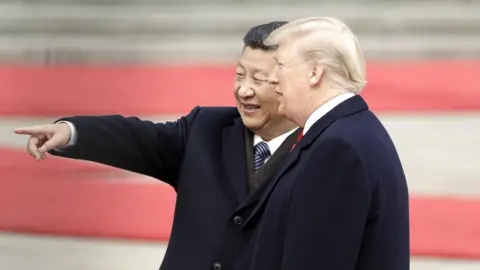
Trump's previous administration took an aggressive stance toward China trade policy, implementing tariffs and trade restrictions that were intended to rebalance the economic relationship between the two nations. However, the outcomes of these policies remain contested among economists and policymakers, with some arguing that they helped level the playing field while others contend they created market disruptions without achieving fundamental systemic change. As Trump potentially returns to office, questions loom about what trade strategy might be employed and how it would differ from or build upon the approaches taken during his first term.
The technological rivalry between the United States and China has intensified significantly in the intervening years, particularly in sectors like semiconductors, artificial intelligence, and quantum computing. China has made substantial progress in reducing technological gaps, investing billions of dollars in research and development while simultaneously acquiring foreign technology through various means. This technological competition now represents one of the most critical dimensions of US-China competition, with implications for national security, economic competitiveness, and technological dominance in the coming decades.
Military capabilities have also evolved substantially, with China modernizing its armed forces and expanding its reach through the development of advanced weapons systems, including hypersonic missiles and next-generation aircraft carriers. The Chinese military's presence in the Pacific has grown more pronounced, raising concerns among American defense officials and regional allies about freedom of navigation and stability in critical sea lanes. These military developments have prompted discussions about potential conflict scenarios and the need for strategic clarity in dealing with China's expanding military footprint.

The economic dimensions of China-US strategic competition extend beyond traditional trade metrics to include issues of supply chain vulnerability, foreign direct investment patterns, and technological espionage concerns. American policymakers have become increasingly focused on supply chain resilience, particularly after pandemic-related disruptions exposed the risks of heavy dependence on Chinese manufacturing for critical goods. This awareness has led to calls for restructuring global supply chains and developing domestic production capabilities for essential materials and components.
Regional allies of the United States, including Japan, South Korea, Australia, and several Southeast Asian nations, have watched these developments with considerable interest and concern. Many have sought to balance their relationships with both Washington and Beijing, recognizing the economic importance of trade with China while sharing security concerns about its military expansion and assertive foreign policy. The formation of strategic alliances like the Quad (comprising the United States, Japan, India, and Australia) reflects efforts to maintain a favorable regional balance of power and counter what some perceive as Chinese hegemonic ambitions.
Trump's approach to dealing with China during his first presidency was characterized by unpredictability and a transactional perspective on international relationships. His willingness to engage directly with Chinese leadership, combined with his protectionist trade policies and skepticism toward multilateral institutions, created an unconventional approach to bilateral relations that differed markedly from traditional diplomatic norms. Understanding how these dynamics might evolve in a potential second Trump administration remains a subject of intense speculation among foreign policy analysts and international observers.

The domestic political context within China has also shifted during the past decade, with President Xi Jinping consolidating power and pursuing a more nationalistic foreign policy agenda. Xi's vision for the Chinese Dream and the emphasis on restoring China to a position of primacy in world affairs has infused Chinese policy with greater strategic ambition and confidence. This ideological shift has made Chinese leadership less willing to compromise on issues deemed central to national interests and sovereignty, creating potential flashpoints in negotiations with American counterparts.
Issues surrounding Taiwan remain among the most sensitive and potentially consequential dimensions of US-China relations that any American president must navigate carefully. The island's strategic location, democratic governance, and historical significance have made it a touchstone of regional stability and American credibility with regional allies. Chinese leadership has grown increasingly assertive regarding Taiwan, viewing its political status as unfinished business of the Chinese civil war and a matter of core national interest that cannot be negotiated.
The infrastructure and technological systems underpinning global commerce have become increasingly contested terrain between Washington and Beijing. American efforts to restrict Chinese companies like Huawei and TikTok from operating freely in Western markets reflect concerns about data security, intellectual property protection, and technological dominance. Similarly, Chinese policies regarding foreign companies operating within its borders have grown more restrictive, creating a more fragmented global technological landscape than existed a decade ago.

The role of multilateral institutions in managing US-China competition has become increasingly important and contested. Organizations like the World Trade Organization, the United Nations, and various regional bodies have struggled to mediate disputes and establish frameworks for managing great power competition peacefully. Trump's skepticism toward multilateral institutions during his first presidency created complications for these diplomatic channels, and questions remain about how his potential return might affect America's commitment to international institutions and agreements.
Economic experts continue to debate the long-term implications of deepening decoupling between the American and Chinese economies, a process that has accelerated over the past decade. While some argue that reducing economic interdependence enhances national security and reduces vulnerability, others warn that complete decoupling is neither feasible nor desirable given the complexity of modern global supply chains. The balance struck between economic competition and cooperation will significantly influence the trajectory of relations between the two powers in coming years.
As Trump contemplates his political future and potential return to power, the geopolitical landscape he confronts is substantially more challenging and complex than the one he left a decade ago. A stronger, more assertive, and more technologically advanced China presents strategic challenges that will require careful calibration, consistent policy approaches, and coordination with international allies. How the former president addresses this fundamental shift in the balance of global power will likely define a significant portion of his political legacy and shape American foreign policy direction for years to come.
Quelle: BBC News


