
Cockroach Janta: India's Youth Protest Via Parody

A satirical political party born from a judge's cockroach comment has become a viral sensation, channeling young Indians' frustration with unemployment and corruption.
In a remarkable demonstration of how digital activism and absurdist humor can converge, a parody political party has captured the imagination of millions of young Indians struggling with economic hardship and political disillusionment. What started as a satirical online response to a controversial court statement has evolved into a genuine social movement, reflecting the deep-seated anger and frustration permeating India's youth demographic. The movement represents a novel form of political expression, one that weaponizes mockery and internet culture to critique systemic failures in governance and economic opportunity.
The genesis of this unusual political phenomenon traces back to a high court judge's inflammatory remarks comparing unemployed young people to cockroaches. Rather than accepting this dehumanizing comparison passively, India's digitally-savvy youth transformed the insult into a badge of honor, creating the Cockroach Janta political party as a vehicle for their collective voice. The insect, traditionally viewed with revulsion, was reclaimed as a symbol of resilience and survival—creatures capable of enduring even the harshest environments, much like young Indians navigating an increasingly difficult economic landscape.
The party's meteoric rise across social media platforms demonstrates the unprecedented power of viral content to mobilize political sentiment among younger generations. What might have seemed like a fleeting internet joke has instead crystallized into a social protest movement that resonates with legitimate grievances. Millions of followers have embraced the cockroach imagery, transforming an absurdist concept into a genuine expression of political discontent that transcends traditional forms of activism.

The memes and short videos circulating across platforms have become increasingly sophisticated in their critiques, targeting specific issues that plague India's youth population. Content creators have crafted elaborate visual jokes that deconstruct political corruption, expose the systemic failures leading to widespread unemployment, and ridicule the general dysfunction plaguing the nation's political institutions. These digital artifacts serve as both entertainment and education, allowing users to discuss serious societal problems through the safety of humor and satire.
The phenomenon reflects a generational shift in how young people engage with politics and social issues. Unlike their predecessors who might have relied on traditional protest mechanisms or established political parties, this generation has leveraged the tools of internet culture to create a protest movement that is simultaneously serious and playful. The cognitive dissonance of a parody party addressing real problems mirrors the contradictions young Indians face daily—confronted with genuine hardship yet expected to navigate an indifferent system with humor and resilience.
Joblessness and economic stagnation form the core of the movement's messaging, with countless videos highlighting the disconnect between educational achievement and employment opportunities. Young Indians, many of whom possess advanced degrees and technical skills, find themselves unable to secure meaningful employment that provides financial stability. The cockroach metaphor becomes particularly potent in this context—suggesting that despite being well-equipped to survive and thrive, these young people are treated as disposable pests by a system designed to ignore or exploit them.

The movement's viral spread has been facilitated by the organic nature of its growth, as users spontaneously contribute their own content rather than following directives from a central organization. This decentralized structure mirrors the way internet movements typically develop, but it also reflects the absence of traditional political vehicles that adequately represent youth concerns. The Cockroach Janta party fills a vacuum left by mainstream political institutions that have failed to meaningfully address the economic anxieties facing the younger generation.
Social media platforms have proven to be the ideal infrastructure for this movement, allowing rapid idea dissemination and permitting users to participate from anywhere with internet access. The anonymity afforded by digital platforms also shields participants from potential retaliation, a crucial factor in a political context where dissent can sometimes carry risks. Young people can engage with the movement at whatever level feels comfortable, from simply liking and sharing content to creating original material that pushes the boundaries of political satire.
The cockroach symbolism carries layered meaning that extends beyond the original court statement. These insects are celebrated in nature documentaries for their evolutionary success, adaptability, and resilience—qualities that India's youth clearly identify with. By reclaiming the cockroach as their emblem, young Indians are asserting that they possess these same qualities, that they will survive despite systemic adversity, and that they refuse to be diminished by condescending characterizations from those in power.
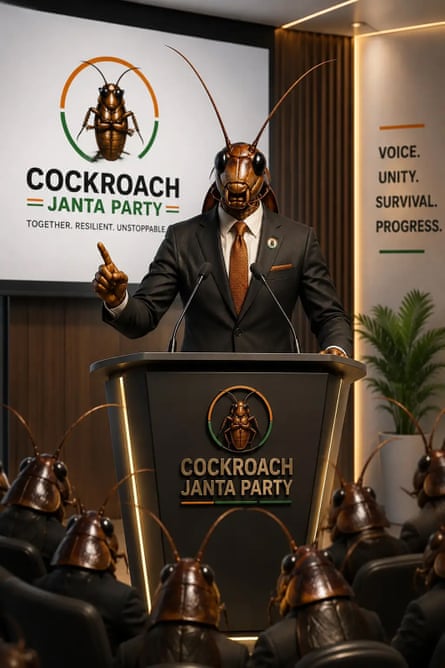
The movement also speaks to a broader crisis of political representation in India, where many young voters feel disconnected from established parties and their aging leadership structures. Neither the ruling coalition nor the opposition parties have effectively articulated a compelling vision for the country's youth, leading many to seek alternative forms of political expression. The Cockroach Janta party, despite its satirical origins, has accidentally stumbled upon a genuine political constituency hungry for authentic representation.
Content analysis of the movement reveals that participants are not simply sharing random jokes but are engaging in sophisticated political commentary. Videos dissecting government policies, exposing corruption scandals, and highlighting the lived experiences of unemployed graduates demonstrate a critical consciousness hidden beneath the absurdist humor. The comedy serves as a wrapper for serious political education, making complex issues accessible and shareable within algorithm-driven social media ecosystems.
The movement's success has prompted discussions about the changing nature of political activism and protest in the digital age. While street protests and formal political organizing remain important, this movement demonstrates that online communities can mobilize quickly around shared grievances and create meaningful change in public discourse. The viral nature of the content has ensured that issues affecting India's youth receive attention they might otherwise be denied in mainstream media outlets dominated by establishment interests.
Looking forward, observers are watching to see whether the Cockroach Janta movement will evolve beyond social media satire into more sustained forms of political organizing. While it began as a parody, the movement may be laying groundwork for genuine political alternatives that better represent youth interests. The question remains whether the momentum generated by viral memes can translate into real policy changes and structural reforms addressing the economic crises facing India's younger generation.
The movement ultimately serves as a barometer of youth sentiment in India, indicating profound dissatisfaction with the current political and economic order. By transforming an insult into a rallying cry, young Indians have demonstrated their capacity for creative resistance and their refusal to accept marginalization quietly. Whether through continued meme production, eventually formal political organizing, or some hybrid form yet to be invented, this generation appears determined to make their voices heard and demand the opportunities and representation they deserve.
Fuente: The Guardian


