
Denmark's Revolutionary CO2 Storage Project Takes Off

Discover how Denmark is transforming an abandoned North Sea oil field into a groundbreaking carbon capture and storage facility to combat climate change.
Deep beneath the turbulent waters of the North Sea, hundreds of miles from Denmark's coastline, an ambitious environmental project is quietly revolutionizing the fight against climate change. The Danish government, in collaboration with international energy companies, has launched a pioneering initiative to transform a depleted oil field into a massive carbon storage facility. This groundbreaking venture represents one of Europe's most significant attempts to combat greenhouse gas emissions through advanced geological sequestration technology.
The project, known as the Greensand initiative, involves the systematic injection of captured carbon dioxide into underground reservoirs that once held millions of barrels of crude oil. These geological formations, proven stable over millions of years, now serve as permanent repositories for industrial CO2 emissions that would otherwise contribute to global warming. The irony is not lost on environmental scientists: the same structures that helped fuel the carbon economy are now being repurposed to help reverse its effects.
Located approximately 200 kilometers offshore in the Danish sector of the North Sea, the storage site represents a technological marvel of engineering precision. Advanced drilling techniques allow operators to inject compressed CO2 into porous rock formations at depths exceeding 1,500 meters below the seabed. At these extreme depths and pressures, the carbon dioxide transforms into a supercritical fluid, dramatically increasing storage density and ensuring long-term containment within the geological formation.
The scale of this undertaking cannot be overstated. Initial projections suggest the facility could store up to 8 million tonnes of CO2 annually by 2030, equivalent to removing approximately 1.7 million cars from European roads each year. This massive storage capacity positions Denmark as a leader in carbon capture and storage technology, potentially serving as a model for similar projects across the globe.
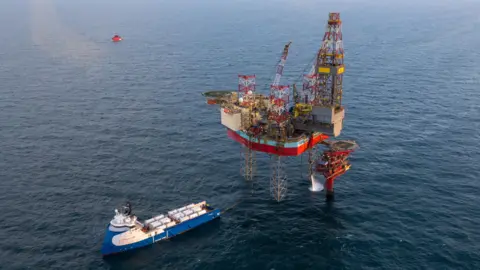
The technical complexity of the operation requires sophisticated monitoring systems to ensure both safety and environmental protection. Advanced seismic imaging technology continuously monitors the injected CO2, tracking its movement and dispersion within the underground reservoir. Multiple layers of impermeable rock formations act as natural barriers, preventing any potential leakage back to the surface or into marine ecosystems above.
International collaboration has been crucial to the project's development. Energy companies from across Europe are partnering with Danish authorities to transport captured CO2 from industrial facilities in Germany, Belgium, and the Netherlands. Specialized tanker ships and eventually dedicated pipelines will deliver the liquefied carbon dioxide to the offshore storage platform, creating an integrated carbon transport and storage network spanning multiple countries.
The economic implications extend far beyond environmental benefits. The project has created hundreds of specialized jobs in marine engineering, geological surveying, and environmental monitoring. Danish maritime industries are experiencing renewed growth as they adapt their expertise from traditional oil and gas operations to serve the emerging carbon storage industry. This transition demonstrates how fossil fuel infrastructure can be successfully repurposed for climate mitigation efforts.
Environmental groups have cautiously welcomed the initiative while emphasizing that carbon storage must complement, not replace, efforts to reduce emissions at their source. Marine biologists are closely monitoring potential impacts on North Sea ecosystems, though preliminary studies suggest minimal environmental disruption when proper protocols are followed. The project includes comprehensive environmental impact assessments and continuous marine life monitoring programs.
The geological characteristics of the selected oil field make it particularly suitable for long-term carbon storage. The reservoir rock, primarily composed of sandstone formations, offers excellent porosity and permeability for CO2 injection. Multiple caprock layers of dense clay and shale provide natural sealing mechanisms, while the field's proven history of containing hydrocarbons for millions of years offers confidence in its long-term integrity.
Advanced computer modeling and simulation technologies play a crucial role in optimizing the injection process. Sophisticated algorithms predict CO2 behavior under various pressure and temperature conditions, helping engineers maximize storage efficiency while maintaining safety margins. These predictive models incorporate decades of geological data from the field's oil production history, providing unprecedented insight into subsurface conditions.
The project faces several technical challenges that require innovative solutions. Managing injection pressures to prevent fracturing of caprock formations demands precise control systems and real-time monitoring. Preventing corrosion of injection equipment in the harsh marine environment requires specialized materials and maintenance protocols. Additionally, ensuring uniform CO2 distribution throughout the reservoir requires strategic placement of multiple injection wells.
International regulatory frameworks governing offshore carbon sequestration are evolving alongside these pioneering projects. Danish authorities work closely with European Union environmental agencies to establish safety standards and monitoring protocols that could become templates for future developments. The project operates under strict environmental permits requiring comprehensive reporting on storage volumes, pressure monitoring, and ecosystem impacts.
The timing of this initiative aligns perfectly with European Union climate targets calling for net-zero emissions by 2050. As renewable energy sources expand across Scandinavia, the integration of carbon storage technology creates a comprehensive approach to decarbonization. Wind farms dotting the Danish coastline provide clean energy to power CO2 compression and injection operations, creating a synergistic relationship between renewable generation and carbon mitigation.
Future expansion plans envision a network of interconnected storage sites across the North Sea, potentially storing hundreds of millions of tonnes of CO2 annually. Norway, the United Kingdom, and the Netherlands are developing complementary projects that could eventually link into a regional carbon storage hub. This coordinated approach maximizes efficiency while distributing costs and risks across multiple participants.
The success of Denmark's offshore CO2 storage project could accelerate similar initiatives worldwide. Depleted oil and gas fields in the Gulf of Mexico, offshore Australia, and the Mediterranean Sea represent potential sites for replication. The technical expertise and operational knowledge gained from this pioneering effort will prove invaluable for scaling carbon storage technology globally, contributing significantly to international climate change mitigation efforts.
来源: BBC News


