
AI Chatbot Now Plays Doom: Latest Tech Milestone

Discover how developers pushed AI chatbots to their limits by getting one to run the classic game Doom. The surprising answer to tech's eternal question.
Artificial intelligence and chatbot technology continue to reach unexpected milestones, with the latest achievement being one that might seem absurd at first glance: an AI chatbot that can now run Doom. This development represents another fascinating answer to technology's most enduring question: "Can it run Doom?"
For decades, the id Software classic has served as an informal benchmark for computing power and capability. From calculators to smartwatches, from pregnancy tests to the International Space Station, tech enthusiasts have demonstrated that virtually any computational device can technically execute the 1993 landmark title. Now, the gaming community and AI researchers have turned their attention to whether large language models and conversational AI systems could handle the task.
The question itself is rooted in computer culture history. When Doom was released, its revolutionary 3D graphics pushed hardware to its limits. Years later, as technology advanced exponentially, the phrase "Can it run Doom?" became a playful way to test the capabilities of any new computing device. It's a tradition that has spanned generations of technology enthusiasts and developers.
What makes this particular implementation noteworthy is that it challenges our understanding of what AI chatbots can accomplish beyond their traditional language processing functions. Rather than simply answering questions or generating text, developers managed to leverage the underlying computational architecture to execute a fully functional video game within the chatbot's environment.
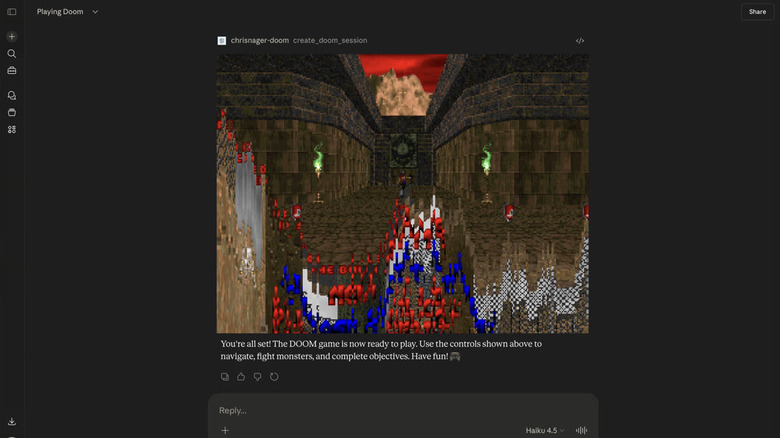
The technical requirements for running Doom are actually quite modest by modern standards. The original game required only 4MB of RAM and could run on computers from the mid-1990s. However, implementing a game within the constrained environment of an AI chatbot interface presents unique challenges that differ significantly from traditional emulation or porting efforts.
Developers working on this project had to overcome numerous obstacles inherent to chatbot architectures. These systems are typically optimized for natural language understanding and generation, not for real-time graphics rendering or game loop execution. The conversion process required creative solutions and significant engineering effort to adapt Doom's requirements to fit within the operational parameters of the chatbot system.
This achievement contributes to a broader trend in technology where developers deliberately push systems beyond their intended purposes. It's reminiscent of similar projects where enthusiasts have found ways to run complex programs on devices never designed for such tasks. The spirit of experimentation and creative problem-solving that drives these projects remains a vital part of tech culture.
The implications of getting Doom to run on an AI chatbot extend beyond mere novelty value. Such projects often reveal unexpected capabilities and limitations of modern technologies. They can inspire new approaches to system optimization and highlight how different computational paradigms can be combined creatively to achieve results that might initially seem impossible.
Large language models have demonstrated remarkable versatility in recent years, handling everything from code generation to creative writing. The ability to execute Doom represents another expansion of the boundaries of what these systems can accomplish. It showcases how the underlying computational infrastructure of modern AI systems can be leveraged for purposes beyond their primary design objectives.
The gaming community has been remarkably enthusiastic about following these developments. As artificial intelligence technology becomes increasingly sophisticated and accessible, the tradition of testing new systems with Doom has only grown stronger. Each new success in running the classic game on unexpected platforms generates excitement and curiosity about what might be possible next.
This particular milestone also raises interesting questions about the nature of computing itself. What does it mean to "run" a game? At what point does leveraging a system beyond its intended purpose cross into genuine achievement versus creative exploitation of existing features? These philosophical questions are part of what makes the Doom tradition enduring and culturally significant.
Looking forward, this achievement likely won't be the last surprising application of chatbot technology or AI systems. As researchers continue to explore the capabilities and limitations of these platforms, we can expect more creative and unexpected demonstrations. The intersection of AI development and traditional computing challenges like running legacy software continues to produce fascinating results.
The broader context of this achievement involves understanding how technology culture celebrates incremental progress and creative implementation. While running Doom on an AI chatbot might not solve pressing problems in artificial intelligence research, it serves an important cultural function. It reminds us that innovation often comes from playful experimentation and the willingness to ask unconventional questions about what systems can do.
As we continue to develop increasingly powerful and versatile AI and chatbot technologies, we'll likely see more demonstrations of their unexpected capabilities. The question "Can it run Doom?" will probably evolve along with the technology, taking on new dimensions and interpretations. For now, the answer to whether an AI chatbot can run Doom is definitively yes, representing another victory in the long and entertaining history of this technological tradition.
Source: Engadget


