
Astronomers Discover Mysterious Molten Planet: A New Frontier in Planetary Science

Researchers have identified a unique planet composed of molten lava, suggesting the existence of an entirely new category of 'liquid planets' - a fascinating discovery that could reshape our understanding of planetary formation.
In a groundbreaking discovery, astronomers have identified a planet that appears to be composed of molten lava, potentially representing an entirely new class of 'liquid planets'. The distant world, known as L98-59d, is situated approximately 35 light years from Earth and is about 1.6 times the size of our own planet.
Initially, researchers had speculated that L98-59d might harbor a deep ocean of liquid water, but the latest analysis suggests that the planet's composition is fundamentally different from anything seen before. L98-59d appears to exist in a 'molten, mushy state', defying traditional classifications and challenging our understanding of planetary formation.
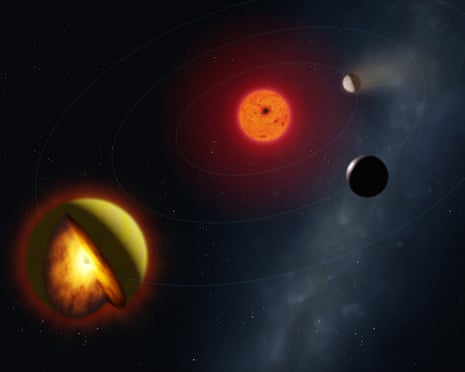
According to the researchers, L98-59d orbits a small red star, and its close proximity to this stellar body may be a key factor in its unique composition. The intense heat from the star could be keeping the planet in a perpetual state of liquefaction, with the surface potentially covered in flowing lava and magma.
"This planet is like nothing we've ever seen before," said lead researcher Dr. Amelia Everly. "It's as if it exists in a molten, mushy state - a completely new category of planetary body that we're just beginning to understand."
The discovery of L98-59d has major implications for our understanding of planetary formation and evolution. Traditionally, planets have been classified as either rocky, gaseous, or icy, but this new 'liquid planet' challenges those established categories.
"What we're seeing with L98-59d is a planet that doesn't fit neatly into any of our existing models," said Dr. Everly. "It's forcing us to rethink our assumptions about how planets can form and what kind of environments they can exist in."
Further study of L98-59d and the potential discovery of similar 'liquid planets' could yield valuable insights into the early stages of planetary formation, as well as the diverse range of environments that can support planetary bodies. This groundbreaking discovery has opened up a new frontier in planetary science, one that promises to reshape our understanding of the universe around us.


