
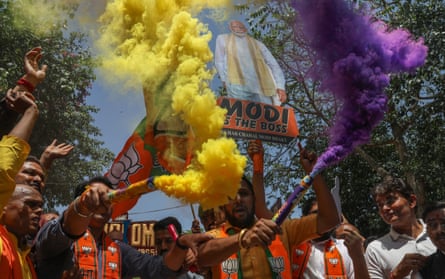
BJP Sweeps West Bengal in Historic Election Victory

Modi's BJP party achieves first-ever assembly election victory in West Bengal, a major opposition stronghold, reshaping India's political landscape.
In a watershed moment for Indian politics, Prime Minister Narendra Modi's Bharatiya Janata Party (BJP) has secured a commanding election victory in West Bengal, breaking through decades of opposition dominance in one of India's most politically influential states. This historic triumph marks the first time the BJP has won assembly elections in the eastern state, fundamentally altering the nation's political equation and consolidating Modi's unprecedented hold over Indian governance.
West Bengal has long represented a bastion of opposition politics, standing apart from the broader national trends that have favored the Modi government since 2014. The state's political significance extends beyond its regional boundaries—with a population exceeding 90 million people and a rich democratic tradition, West Bengal has historically served as a bellwether for major shifts in Indian politics. The election results in West Bengal therefore carry implications that reverberate far beyond regional borders, signaling a dramatic realignment of political forces across the country's most populous democracy.
The BJP's victory in West Bengal represents a remarkable political achievement, particularly given the entrenched nature of opposition rule in the state. For decades, various opposition coalitions had maintained control of the state assembly, resisting the saffron wave that swept through much of northern and central India. This election outcome suggests that the Modi government's political machinery has successfully penetrated even the most resistant electoral markets, employing sophisticated campaign strategies, organizational networks, and messaging that resonated with West Bengal's diverse voter base.

The significance of this electoral outcome extends well beyond mere seat counts and assembly mathematics. Winning West Bengal represents a symbolic and strategic consolidation of Modi's political power at the national level, as it removes one of the few remaining major state governments operating under opposition control. The state's loss to the opposition means that the political landscape now features vastly reduced opposition strongholds, allowing Modi's government to advance its legislative agenda with considerably less impediment from resistant state governments.
The India political landscape has undergone a dramatic transformation over the past decade, with the BJP expanding its footprint from its traditional strongholds in the Hindi heartland to previously unconquered territories. West Bengal, however, had proven particularly resistant to this expansion, with deep-rooted political traditions and strong regional political parties maintaining their grip on power. The breakthrough in West Bengal thus represents the final major frontier in Modi's political conquest of India, eliminating a crucial remaining obstacle to his government's consolidation of power across the nation.
State elections in India serve as crucial indicators of national political trends and shifting voter preferences, particularly in large and economically significant states like West Bengal. The outcome in West Bengal is likely to influence political dynamics in other major states holding elections in the coming years, as it demonstrates the continued electoral viability and organizational strength of the BJP. Opposition parties across India will need to reassess their strategies in light of this unexpected defeat in what many had considered their last major stronghold.

The implications of the West Bengal election victory extend to India's federal structure and center-state relations. With opposition state governments controlling fewer territories, the Modi government gains greater flexibility in implementing policies and directing central resources toward development priorities. This shift in the federal balance of power suggests that the coming years will see reduced friction between many state governments and the central government, potentially accelerating the pace of policy implementation at the national level.
For the opposition political parties that previously dominated West Bengal, this electoral setback represents a significant challenge to their relevance and viability as alternative centers of political power. The defeat requires them to fundamentally reconsider their political strategies, organizational structures, and messaging approaches. Opposition parties must now address questions about their capacity to resist what many observers characterize as an unstoppable political wave favoring the Modi government, while simultaneously rebuilding their bases in states where they retain influence.
The Indian election system and campaign dynamics revealed in the West Bengal contest showcase the increasing sophistication of the BJP's electoral machinery. The party's ability to penetrate into traditionally opposition-controlled territories suggests well-developed campaign infrastructure, effective use of media and communications technology, and the capacity to build political coalitions across diverse social and religious communities. These organizational strengths provide the BJP with significant advantages heading into future electoral contests.

Economically and administratively, West Bengal's shift to BJP governance will introduce new development priorities and fiscal policies shaped by the party's ideological commitments and governance philosophy. The state will likely experience changes in how resources are allocated, how industrial development is pursued, and how the state engages with the central government on major policy matters. These transitions will affect the livelihoods and economic opportunities for West Bengal's substantial population and have implications for the broader eastern Indian economy.
The BJP election success in West Bengal also carries cultural and social dimensions that extend beyond conventional political analysis. The party's victory suggests its messaging and political positioning have found resonance among West Bengal's voters across various demographic groups. Understanding this electoral shift requires examining how the BJP's campaign addressed local issues, cultural sensibilities, and regional concerns while simultaneously connecting them to broader national narratives promoted by the Modi government.
Looking forward, the West Bengal election outcome will likely encourage the BJP to pursue similar expansion strategies in other remaining opposition strongholds, with enhanced confidence in their organizational capacity and electoral appeal. Opposition parties, meanwhile, will face intensified pressure to demonstrate electoral viability and relevance to voters in their remaining strongholds. The Indian political landscape is entering a new phase where the Modi government's dominance appears even more entrenched, with profound implications for democratic competition and political pluralism in the nation's governance structures.
The historic nature of the BJP's West Bengal victory cannot be overstated—it represents the culmination of a decade-long political transformation that has fundamentally reshaped India's electoral and governance landscape. The state's transition from an opposition bastion to a BJP-governed state marks the closing of a significant chapter in Indian democratic politics and the opening of another defined by unprecedented consolidation of power under the Modi government's political leadership and vision for the nation's future.
Source: The Guardian


