
Bow and Arrow Adoption Across North America Traced in New Study

Researchers have pinpointed when the bow and arrow replaced the dart and atlatl as the weapon of choice in different regions of North America, revealing intriguing regional differences.
Bow and arrow adoption in North America occurred around 1,400 years ago, according to a new study published in the journal PNAS Nexus. However, the transition was not uniform across the continent, with southern regions adopting the new technology more quickly than their northern counterparts.
The research was conducted by Metin Eren, an experimental archaeologist at Kent State University in Ohio, where his Experimental Archaeology Laboratory reverse-engineers a wide range of ancient technologies, from stone tools and ceramics to metal, butchery, and textiles. Eren has previously gained attention for his debunking of an Inuit legend involving rudimentary knives made of frozen feces.
Eren's latest study sheds light on the adoption of the bow and arrow in North America, revealing that the transition was not a simple, uniform process. In southern regions, the bow and arrow quickly replaced the dart and atlatl (a tool used to throw darts) as the primary weapon. However, in more northern areas, the bow and arrow was initially adopted as a complement to the existing toolkit, with the atlatl and dart gradually phased out over the course of a millennium.
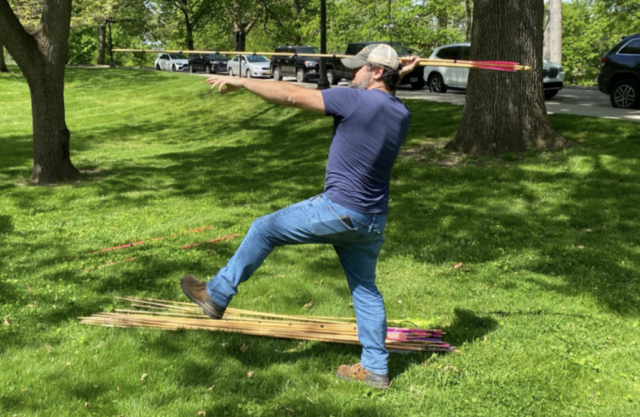
The researchers were able to piece together this timeline by analyzing archaeological evidence and recreating the technologies in Eren's lab. By reverse-engineering the performance of different weapon systems, they were able to pinpoint the advantages that the bow and arrow offered over the dart and atlatl, and how these advantages were realized at different rates in different regions of North America.

The study's findings highlight the complex and nuanced process of technological change in pre-modern societies, where the adoption of new tools was often gradual and uneven, shaped by regional factors and the specific needs of different human communities. As Eren noted, understanding these dynamics is crucial for reconstructing the past and informing our knowledge of human history.
Source: Ars Technica


