
Carlson-Huckabee Clash Exposes GOP Split on Israel

Tucker Carlson and Mike Huckabee's heated debate reveals deep divisions within the Republican party over US-Israel relations and foreign policy.
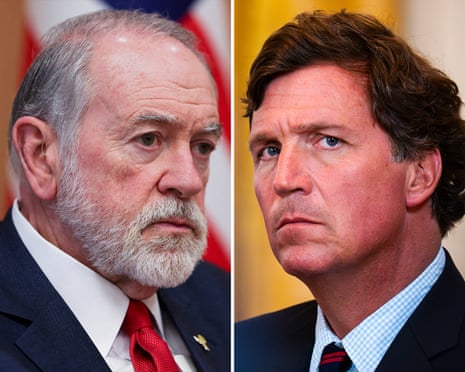
A confrontational interview between media personality Tucker Carlson and newly appointed US Ambassador to Israel Mike Huckabee has exposed significant fractures within the Republican Party regarding America's relationship with Israel. The heated exchange, filmed at Ben Gurion Airport in Israel and released on Friday, showcases the growing tension between different factions of the conservative movement over foreign policy priorities and religious convictions.
The debate illuminates a fundamental schism that has been brewing within the MAGA movement and broader Republican coalition. On one side stands a Christian nationalist wing that increasingly questions America's unwavering support for Israel, viewing the relationship through a lens of America First isolationism. This faction, which has gained considerable influence since Donald Trump's political rise, argues that extensive foreign aid and military support should be scrutinized more closely, particularly when domestic issues demand attention.
Opposing this view is the traditional Christian conservative establishment, represented by figures like Huckabee, who maintain that the US-Israel alliance represents not just strategic foreign policy but a sacred covenant rooted in biblical prophecy. This group continues to advocate for robust American support for Israel, often framing their position in theological terms that transcend typical political calculations.
During the airport confrontation, Huckabee defended what critics describe as an extreme form of Christian Zionism, articulating beliefs that extend far beyond conventional diplomatic support. His positions, which appear to align with the unofficial Trump administration policy direction, suggest that Israeli territorial claims in the Middle East carry divine legitimacy that supersedes international law or popular American opinion.
The theological underpinnings of Huckabee's worldview became particularly evident when he discussed Israeli settlement activities and territorial expansion. Unlike typical diplomatic language that acknowledges competing claims and international law, Huckabee's rhetoric suggested an absolute right derived from religious conviction rather than negotiated agreements or United Nations resolutions.
Carlson, representing the skeptical wing of the conservative movement, challenged these assumptions with pointed questions about American interests and the cost of unconditional support. His line of questioning reflected broader concerns among some Trump supporters who believe that foreign entanglements, regardless of their historical or religious significance, should be evaluated primarily through the lens of American benefit.
This ideological clash represents more than a simple policy disagreement; it reveals competing visions for America's role in the world under a second Trump presidency. The America First movement has consistently emphasized reducing foreign commitments and focusing resources on domestic priorities, creating natural tension with policies that require extensive overseas engagement and financial support.
Political analysts note that this division could have significant implications for future Republican foreign policy, particularly in the Middle East. The party's traditional hawks, many of whom have found common cause with Christian Zionist theology, may find themselves at odds with a base that increasingly questions the wisdom of extensive foreign interventions and aid packages.
The Carlson-Huckabee exchange also highlights the complex relationship between religious conviction and political pragmatism within the conservative movement. While evangelical Christians have long been a cornerstone of Republican electoral success, their specific theological interpretations of Middle Eastern politics don't always align with broader conservative principles of limited government and fiscal responsibility.
Huckabee's appointment as ambassador signals that the Christian Zionist perspective will likely maintain significant influence in Trump's second-term foreign policy apparatus. His background as a former Arkansas governor and Baptist minister positions him as a bridge between political and religious conservative constituencies, though the Carlson interview suggests that bridge may be under strain.
The broader implications of this ideological split extend beyond Israel policy to fundamental questions about American foreign engagement. The tension between traditional conservative internationalism and the newer America First isolationism continues to shape Republican party debates on everything from NATO obligations to trade relationships.
Some observers suggest that this division reflects a natural evolution within the conservative movement, as younger voters who came of age during prolonged conflicts in Iraq and Afghanistan express skepticism about foreign commitments that previous generations took for granted. This generational shift may be contributing to the ideological realignment visible in the Carlson-Huckabee confrontation.
The theological dimensions of the debate add another layer of complexity to what might otherwise be straightforward foreign policy disagreements. Huckabee's religious convictions appear to inform his diplomatic positions in ways that transcend typical strategic calculations, creating potential conflicts with more secular conservative voices who prioritize national interest over religious obligation.
Critics of Huckabee's approach argue that allowing religious prophecy to guide American foreign policy undermines the nation's ability to serve as an honest broker in Middle Eastern disputes. They contend that diplomatic effectiveness requires maintaining some distance from the theological claims of any particular party to regional conflicts.
Defenders of the Christian Zionist position, however, argue that moral clarity based on religious conviction provides a firmer foundation for foreign policy than the shifting sands of international opinion or strategic calculation. They maintain that America's historical support for Israel has been vindicated by events and serves both moral and practical American interests.
The public nature of the Carlson-Huckabee dispute suggests that these internal Republican debates will continue playing out in media venues rather than being resolved through private party channels. This dynamic could complicate Trump administration messaging on foreign policy issues, particularly when dealing with complex Middle Eastern situations that require nuanced diplomatic approaches.
Looking forward, the Republican foreign policy establishment will need to navigate between these competing visions while maintaining electoral viability and diplomatic effectiveness. The party's ability to reconcile America First principles with traditional conservative internationalism may determine its long-term success in foreign policy leadership.
The Carlson-Huckabee confrontation ultimately represents a microcosm of broader tensions within American conservatism as it grapples with changing demographics, evolving threats, and competing philosophical frameworks. The resolution of these tensions will likely shape not only Republican party politics but American foreign policy for years to come.
Source: The Guardian


