
Congo's President Hints at Potential Third Term

DR Congo President Félix Tshisekedi suggests openness to extending his mandate beyond 2028, raising concerns about democratic transitions in the Central African nation.
DR Congo President Félix Tshisekedi has sparked significant political debate by suggesting he may be open to remaining in power beyond his constitutionally mandated departure date of 2028. During a recent public address, the controversial leader stated, "If the people want me to have a third term, I will accept," a statement that has sent shockwaves through the international community and domestic opposition circles alike.
This carefully worded comment represents a notable shift in the political landscape of the Democratic Republic of Congo, a country with a complex history of contentious leadership transitions and allegations of electoral irregularities. Tshisekedi's comments come at a time when the nation faces mounting challenges related to governance, security, and economic stability in the resource-rich but economically troubled Central African nation.
The president's remarks have immediately triggered concerns among democracy advocates and international observers who closely monitor political developments in the region. Many analysts view such statements as potential precursors to constitutional amendments or other maneuvers that could circumvent term limits, a pattern that has repeated across numerous African nations in recent years.
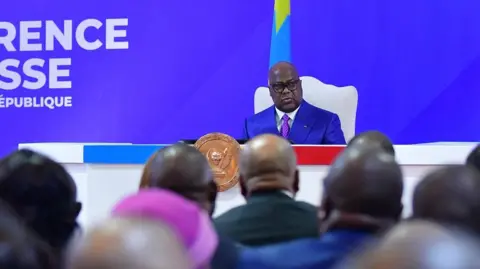
Under the current DRC Constitution, presidents are limited to two consecutive terms of five years each. This constitutional framework was established to prevent the concentration of power and ensure regular democratic transitions in leadership. Tshisekedi first assumed the presidency in 2019 following contentious elections, and his current mandate is scheduled to expire in 2028, making him eligible for one more term under existing constitutional provisions.
The possibility of term limit extension in Congo raises alarm bells for international organizations focused on human rights and democratic governance. Numerous African countries have witnessed authoritarian consolidation when leaders have successfully manipulated constitutions to extend their time in office, often through popular referenda or legislative maneuvers that face minimal domestic opposition.
Political analysts suggest that Tshisekedi's public statement may be testing domestic and international reaction to gauge the feasibility of pursuing constitutional amendments. Such trial balloons are common among leaders considering significant policy shifts that could generate substantial political controversy and resistance from opposition movements.

The statement has immediate implications for opposition parties and civil society organizations in Congo, many of which have already begun organizing to resist potential constitutional changes. These groups argue that term limits are essential safeguards against authoritarianism and that any extension would undermine democratic principles established during the country's transition away from dictatorial rule.
International diplomatic circles have also begun responding to these suggestions with measured caution. Western governments and regional organizations such as the African Union typically express concern about constitutional amendments designed to circumvent term restrictions, viewing such actions as threats to regional stability and democratic norms across the continent.
Congo's political environment remains deeply polarized, with multiple factions competing for influence and resources within the government structure. Tshisekedi's coalition government includes various political parties and movements, some of which may support constitutional changes while others remain committed to existing democratic frameworks.
The economic context surrounding these political developments cannot be ignored. The DRC economy remains heavily dependent on extractive industries, particularly mineral wealth, while large segments of the population continue to experience poverty and limited access to basic services. Political stability and institutional credibility are crucial for attracting foreign investment and maintaining economic functionality.
Security challenges in eastern Congo, particularly conflicts involving various armed groups and regional tensions, add additional complexity to the political landscape. Some observers suggest that prolonged political uncertainty regarding leadership transitions could exacerbate these security challenges by creating power vacuums or encouraging destabilizing behavior among competing factions.
Historical precedent in the region demonstrates the dangers of unchecked executive power. Congo previously endured decades of authoritarian rule under Mobutu Sese Seko, a period marked by widespread corruption, human rights abuses, and economic mismanagement. The post-Mobutu transition, though imperfect, established constitutional frameworks specifically designed to prevent such concentration of power from recurring.
The timeline for any potential constitutional amendments remains unclear. Tshisekedi's comments suggest that such changes, if pursued, would likely be framed as responses to popular demand rather than unilateral executive action. This rhetorical strategy attempts to lend legitimacy to constitutional changes that critics would undoubtedly characterize as antidemocratic regardless of the formal procedures employed.
Civil society organizations and human rights groups have already begun preparing public awareness campaigns about the importance of constitutional term limits. These organizations understand that popular mobilization will be crucial in any potential conflict over whether such amendments should be pursued or blocked.
The international community's response will likely prove significant in shaping the ultimate outcome of this political situation. Countries that provide substantial development assistance or maintain important diplomatic relationships with Congo may leverage these relationships to discourage constitutional amendments that circumvent term limits.
As Congo continues navigating these challenging political waters, the next several months will prove critical in determining whether Tshisekedi's comments represent serious intentions or merely rhetorical exploration of hypothetical scenarios. The democratic trajectory of one of Africa's most resource-rich and strategically important nations hangs in the balance.
Source: BBC News


