
Cuba Denounces Trump Sanctions as 'Collective Punishment'

Cuba's government condemns new US sanctions targeting energy, defense, and mining sectors. Large May Day protests in Havana oppose economic measures.
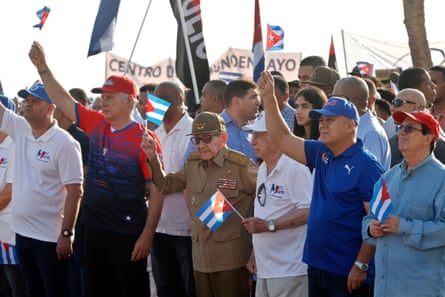
Cuba's government has officially denounced the latest round of US sanctions imposed by President Donald Trump, characterizing them as a form of "collective punishment" against the Cuban people. The declaration comes amid significant political tensions between the two nations and follows a massive May Day demonstration held outside the American embassy compound in Havana, where thousands of citizens gathered to express their defiance and reaffirm their commitment to defending their nation.
Through an executive order signed on Friday, President Trump announced sweeping sanctions on Cuba targeting individuals operating across multiple critical sectors of the island's economy. The targeted sectors include energy production and distribution, defense industries, and mining operations—core economic pillars that are essential to the country's functioning and development. This latest action represents an intensification of pressure on Havana as part of broader US foreign policy initiatives in the Latin American region.
The timing of these sanctions follows Trump's earlier successful efforts to remove Venezuelan President Nicolás Maduro from power earlier in the year, marking a significant geopolitical shift in the Western Hemisphere. Administration officials have indicated that the economic sanctions strategy is intended to compel the Cuban government to alter its policies and align more closely with US interests. However, the Cuban government has rejected these characterizations, maintaining that such measures constitute an unjust form of economic coercion against an entire population.
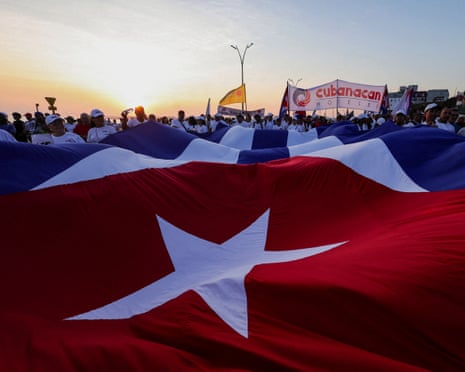
The massive May Day procession that took place outside the American embassy in Havana demonstrated the public's response to these escalating tensions. Tens of thousands of Cuban citizens participated in the demonstration, which featured traditional revolutionary imagery, patriotic speeches, and calls for national unity. Participants chanted slogans emphasizing their resolve to "defend the homeland" against what they view as external economic aggression and interference in their internal affairs.
Cuba's official position characterizes the Trump administration sanctions as a violation of international law and human rights principles. Cuban government officials argue that by targeting broad sectors of the economy rather than specific individuals engaged in wrongdoing, the sanctions inevitably harm ordinary citizens who depend on these sectors for employment and economic survival. This perspective aligns with longstanding Cuban grievances about decades of economic embargoes that have shaped the nation's development trajectory.
The Cuban economy has already faced significant challenges in recent years, including currency shortages, inflation, and structural difficulties stemming from the longstanding US embargo that has been in place since the early 1960s. Energy sector vulnerabilities have been particularly acute, with the island struggling to maintain consistent power generation and distribution. The addition of new sanctions targeting this sector threatens to exacerbate existing hardships and potentially trigger additional economic disruptions that could affect basic services and living standards for the general population.
The defense industry sanctions appear designed to limit Cuba's military capabilities and reduce its ability to serve as a counterbalance to US interests in the region. Cuba has historically maintained close military and security relationships with other nations opposed to US hegemony, particularly Russia and China. By constraining Cuba's defense sector through sanctions, the Trump administration may be attempting to weaken these strategic partnerships and reduce Cuba's geopolitical influence in the Western Hemisphere.
Mining operations represent another significant target of the new sanctions regime. Cuba possesses substantial mineral resources, including nickel deposits that are commercially valuable and sought after by international markets. The imposition of sanctions on mining operations threatens to disrupt export revenues that the Cuban government relies upon to finance essential imports and maintain foreign currency reserves necessary for international transactions.
International observers have noted that the approach taken by the Trump administration differs markedly from the brief period of warming relations under the Obama administration, when certain sanctions were lifted and diplomatic representation was restored. The current policy represents a return to a more confrontational stance reminiscent of Cold War-era hostilities. This shift reflects the administration's broader strategy of reasserting American dominance in regions it considers within its sphere of influence.
The Cuban government has indicated that it will not yield to economic pressure and remains committed to its socialist political and economic system. Official statements emphasize the nation's self-determination and sovereignty, asserting that decisions about Cuba's internal governance and economic organization belong exclusively to the Cuban people. This defiant posture serves to rally domestic support and demonstrates to the international community that Cuba will not be coerced into abandoning its principles or political orientation.
Regional governments and international organizations have responded with varying degrees of concern about the escalating sanctions regime. Some nations have expressed support for Cuba's position, viewing the sanctions as disproportionate and counterproductive to regional stability. Others have remained largely neutral, seeking to maintain balanced relationships with both the United States and Cuba while avoiding explicit criticism of either party.
The broader implications of these Cuba sanctions measures extend beyond bilateral US-Cuban relations. They reflect a wider pattern of economic statecraft being employed by the United States to advance its foreign policy objectives in Latin America and the Caribbean. The strategy assumes that economic pressure will eventually compel policy changes, though historical evidence suggests that authoritarian regimes often respond to sanctions through tighter internal control and increased nationalist messaging rather than capitulation.
Looking forward, the trajectory of US-Cuban relations remains uncertain. The Trump administration has signaled its intention to maintain and potentially expand the sanctions regime, while Cuba has demonstrated unwavering commitment to resisting external pressure. This dynamic suggests that the near-term period will likely be characterized by continued tension, with significant implications for the Cuban population struggling to cope with economic hardship resulting from both longstanding embargoes and new restrictions on key economic sectors.
Source: The Guardian


