
Dublin Spire's Mystery Palestinian Flag Defies Removal

A Palestinian flag has remained atop Dublin's 120-metre Spire for seven months. Officials deem removal too risky. The flag's origin remains unknown.
In a situation that has captivated Dublin residents and international observers alike, a Palestinian flag continues to flutter defiantly from the top of Dublin's most iconic landmark, the Spire on O'Connell Street. The flag mysteriously appeared atop the 120-metre monument in September and has managed to evade every removal attempt proposed by city authorities and concerned parties. To this day, no individual or group has come forward to claim responsibility for the flag's installation, leaving officials and the public alike puzzled about both the identity of those responsible and the method used to hoist it to such a precarious height.
The situation presents a unique urban mystery that has become increasingly controversial as months have passed. What began as a sudden appearance has transformed into an ongoing saga about access, safety, and the challenges of maintaining public monuments in a city where competing messages and statements vie for visibility. The Spire removal challenge has proven far more complicated than anyone anticipated, with each proposed solution running into obstacles that make intervention appear more dangerous than allowing the flag to remain.
Dublin's Spire, officially known as the Monument of Light, stands as one of Europe's tallest public monuments and serves as a prominent focal point in Ireland's capital city. Its sleek, minimalist design and soaring height make it instantly recognizable on the skyline and a symbol of Dublin's modern character. The monument was completed in 2003 and has become beloved by residents and tourists alike. However, its extreme height and narrow structure also make it exceptionally difficult to access and maintain, particularly when dealing with unexpected installations like the Palestinian flag.

The appearance of the flag itself represents a significant feat of climbing and installation expertise, regardless of one's views on the message it conveys. Ascending to the top of the Spire without specialized equipment and training would be extraordinarily dangerous, if not impossible. The fact that the flag was successfully placed and has remained secure through months of Dublin's variable weather conditions suggests that whoever installed it possessed considerable skill and determination. The technical accomplishment alone has earned grudging respect from many observers, even those who question the message or method.
City officials have faced mounting pressure from various quarters to remove the flag, with some viewing it as an unauthorized alteration of a public monument and others arguing that it represents an important political statement in a time of global tension. However, removal deemed too risky has become the consistent position of Dublin's authorities. The primary concern centers on the safety of any individual or team attempting to access the flag and remove it from such a great height. Standard window-cleaning equipment used on tall buildings would be inadequate for the Spire's unique conical shape, and specialized industrial climbing gear would be required.
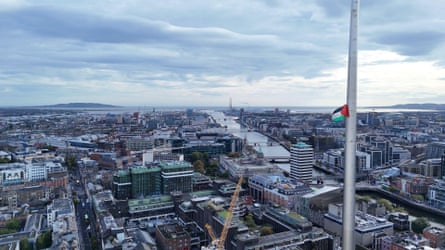
The challenge of reaching the flag extends beyond mere physical access. The Spire's design, while aesthetically striking, was not engineered with maintenance accessibility in mind. The narrow, tapering form means that traditional suspended platform systems used on other tall structures cannot be easily applied. Any removal operation would likely require custom-designed equipment and extensive planning, combined with specialized personnel trained in extreme-height operations. The cost of such an undertaking would be substantial, potentially reaching into hundreds of thousands of euros.
Beyond the practical and financial obstacles, Dublin officials have also grappled with the political dimensions of the situation. Any removal effort would inevitably draw scrutiny and potentially provoke strong reactions from supporters of Palestinian causes and their allies. The decision to allow the flag to remain, while perhaps frustrating to some, has effectively avoided escalating what could have become a contentious public dispute. This pragmatic approach reflects a recognition that sometimes inaction can be the most sensible course when other options carry greater risks or costs.
The flag's persistence has transformed it from a transient statement into a persistent symbol that has captured media attention not just in Ireland but internationally. News outlets have covered the story multiple times as the months have accumulated, each angle exploring the growing mystery of its origin and the reasons for its enduring presence. The mystery installation has sparked considerable online discussion and debate, with various theories circulating about who might have been responsible and what motivated them to take such dramatic action.
Several months have now passed since the flag first appeared, and despite the passage of time, no credible evidence has emerged about the identity of those responsible. Law enforcement and city authorities have presumably investigated the matter, but if they have identified the perpetrators, they have not made that information public. The lack of any claim of responsibility by activist groups or individuals is particularly curious and adds another layer to the mystery. In previous instances of similar flag displays or protest installations, responsible parties have typically come forward to explain their motivations and claim credit for their actions.
The situation also raises broader questions about public monument security and access control in major cities. If a Palestinian flag could be placed atop Dublin's most recognizable landmark without anyone knowing how it was accomplished, what does that say about the security measures protecting other important structures? This question has prompted discussions among city planners and security experts about how to enhance protections without fundamentally altering the monuments themselves or diminishing their accessibility to the general public who wish to view them.
Weather conditions have proven insufficient to dislodge the flag, which remains firmly attached despite Dublin's frequent rain, wind, and occasional storms. The durability of the flag demonstrates that whoever installed it took considerable care to ensure its longevity, using materials and attachment methods designed to withstand the elements. The flag shows signs of wear after seven months of exposure to the Irish climate, with fading and weathering visible, yet it continues to fly defiantly above the city.
As summer approaches and Dublin looks ahead, the Palestinian flag appears likely to remain in place for the foreseeable future. The decision by city authorities to refrain from removal efforts has effectively accepted the flag's presence as a permanent fixture, at least temporarily. Whether it will eventually be removed through some future initiative, claimed by those responsible, or simply allowed to fade further as time passes remains to be seen. What is certain is that the mystery flag has secured its place in Dublin's recent history and urban folklore.
Source: The Guardian


