
Florida Approves GOP-Favored House Map Ahead of Midterms

Florida legislature passes new congressional redistricting map designed to boost Republican advantage as Supreme Court weakens voting rights protections.
In a significant development for the 2022 midterm elections, the Florida legislature has officially approved a newly drawn congressional map designed to strengthen Republican electoral prospects across the state. The approval came with striking timing, occurring just two days after Governor Ron DeSantis unveiled his redistricting proposal and on the same day the United States Supreme Court issued a landmark decision that would fundamentally alter voting rights protections in America.
The newly approved map represents a critical battle in the larger national redistricting effort that Donald Trump and Republican leaders initiated to maximize their party's advantage heading into the crucial midterm elections. This congressional redistricting process, which occurs once every decade following the decennial census, has become increasingly contentious as both political parties compete aggressively to redraw district lines in ways that favor their candidates and electoral outcomes.
Governor DeSantis's proposal had been fast-tracked through the legislative process with remarkable speed, receiving approval from the Florida House and Senate in record time. The expedited timeline raised questions among voting rights advocates and Democratic officials who expressed concern about the lack of public input and deliberate consideration typically afforded to such consequential decisions regarding electoral representation and district composition.
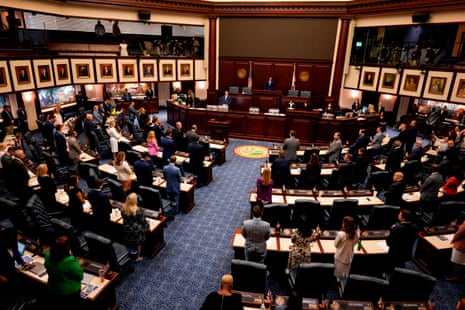
The timing of Florida's map approval coincided with a pivotal Supreme Court ruling that fundamentally reshaped the landscape of voting rights protections in the United States. The high court's decision to roll back a key provision of the Voting Rights Act has generated significant concern among civil rights organizations and Democratic lawmakers who argue it weakens federal oversight of electoral changes in jurisdictions with histories of racial discrimination in voting practices.
The particular Voting Rights Act provision eliminated by the Supreme Court had previously required certain states and counties with documented histories of voter discrimination to obtain federal approval—a process known as preclearance—before implementing any changes to their voting procedures or electoral district lines. Without this crucial protection, states like Florida can now alter their congressional boundaries with significantly less federal scrutiny, making it substantially more difficult for Democratic opponents to challenge potentially discriminatory redistricting maps in court.
Legal experts and civil rights advocates have pointed out that the timing of these two events—the Supreme Court's decision and Florida's rapid approval of the partisan map—highlights the interconnected nature of voting rights and electoral fairness in contemporary American politics. The removal of preclearance requirements, they argue, provides an ideal opportunity for Republican-controlled legislatures to pursue aggressive redistricting strategies that might previously have faced federal regulatory barriers.
Florida's new congressional map represents the latest chapter in what has become an increasingly heated national battle over gerrymandering and electoral district manipulation. Both major political parties have engaged in aggressive redistricting efforts following the 2020 census, though Republicans have generally moved faster and more decisively to lock in electoral advantages through carefully drawn district lines that concentrate opposition voters in uncompetitive districts while spreading favorable voters across multiple districts to maximize Republican wins.
The Florida redistricting process has been particularly consequential because the state is a perennial political battleground and possesses 28 congressional seats, making it a crucial prize in national elections. Any gain or loss of favorable districts in Florida can significantly impact the overall composition of the House of Representatives and influence which party maintains control of that chamber following the midterm elections.
Democratic officials in Florida have vehemently opposed the new map, arguing that it dilutes the voting power of Democratic-leaning communities and communities of color throughout the state. They contend that the redistricting process lacked genuine public participation and was designed primarily to serve partisan interests rather than to create fair and representative electoral districts that genuinely reflect the state's population and political diversity.
The Supreme Court's decision to eliminate the preclearance requirement significantly complicates Democratic efforts to legally challenge the new congressional districts. Without preclearance protections, challenging the map through federal courts becomes a lengthier and more resource-intensive process that requires Democratic organizations to prove intentional racial discrimination—a much higher legal threshold than the previous preclearance standard, which placed the burden on states to demonstrate that changes did not have a discriminatory impact.
Civil rights organizations have characterized the Supreme Court's voting rights decision as a devastating blow to minority voters and democratic representation. These groups argue that the elimination of preclearance removes a crucial safeguard that had helped prevent jurisdictions from implementing voting changes that could systematically disadvantage voters of color, even when such disadvantage resulted from neutral-sounding policies that had discriminatory effects in practice.
The broader context of Florida's redistricting battle reflects the intense polarization surrounding electoral politics and voting rights in contemporary America. What was once considered a technical administrative task—redrawing congressional boundaries to account for population changes—has become a high-stakes partisan struggle that shapes which party controls representation and legislative power for the entire decade between censuses.
Looking ahead to the 2022 midterm elections, Florida's newly approved map is expected to provide Republicans with favorable conditions to maintain or potentially expand their representation in Congress from the state. Election analysts suggest that the map could result in several additional Republican seats compared to the previous district configuration, fundamentally altering the balance of power in the House of Representatives and potentially influencing which party controls the chamber following the midterms.
The convergence of these political and legal developments in Florida serves as a microcosm of broader national tensions regarding voting rights, electoral fairness, and partisan competition in American democracy. As other states continue their own redistricting processes and the Supreme Court's weakened voting rights protections take effect, the Florida example demonstrates how interconnected decisions about judicial authority, federal oversight, and state legislative power have become in determining electoral outcomes and democratic representation across the nation.
Source: The Guardian


