
Gaza's Yellow Line Shifts: Israeli Control Zone Expands

Israeli forces advancing westward in Gaza, moving agreed ceasefire line and expanding military control zone amid stalled truce negotiations and Hamas disarmament disputes.
Palestinians across Gaza are waking to an unsettling reality: the yellow line marking the boundary of Israeli military control has shifted overnight once again. What was meant to be a temporary demarcation in the US-brokered ceasefire agreement has become a constantly moving frontier, with residents discovering they now inhabit a newly designated free-fire zone as Israeli forces methodically expand their territorial footprint across the devastated enclave.
Since the ceasefire was formally established in October following intensive diplomatic negotiations, Israeli military units have been systematically repositioning this critical boundary westward across Gaza's landscape. The incremental nature of these movements—often occurring under cover of darkness—means that civilians have little warning before finding themselves in areas reclassified as active conflict zones. The zone of control expansion represents a fundamental shift in the on-the-ground reality, even as international observers and negotiators work behind closed doors on broader peace arrangements.
The temporary nature of the yellow line was always acknowledged in the ceasefire agreement, which was explicitly designed as a first phase pending further Israeli military withdrawals. However, the subsequent phases of the agreement have stalled significantly as both parties remain locked in disputes over critical implementation details. The primary sticking point centers on the complete disarmament of Hamas and other Palestinian militant organizations—a condition Israel views as non-negotiable for any permanent settlement, while Palestinian negotiators argue for sequenced implementation tied to broader political reforms.

Complicating matters further, despite the official ceasefire agreement, Israeli military operations have not entirely ceased throughout Gaza. Continued bombardment in various sectors of the enclave has undermined trust between the parties and contributed to the breakdown in negotiations that should have enabled the transition to subsequent ceasefire phases. International organizations documenting these activities have reported that the bombardment continues in areas ostensibly covered by the ceasefire, raising questions about the agreement's enforceability and the commitment of all parties to its terms.
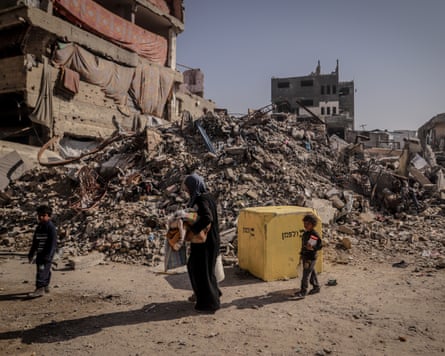
The expansion of Israeli military control through the westward movement of the yellow line has created a precarious humanitarian situation for displaced Palestinian populations. Residents who had tentatively begun to rebuild lives and return to damaged homes now face the prospect of once again being classified as inhabitants of active war zones. This cyclical displacement, repeated numerous times over the past months, has compounded the psychological and physical trauma experienced by Gaza's civilian population.
Military strategists and international observers have noted that the gradual expansion strategy serves multiple purposes from an Israeli perspective. By moving the boundary incrementally rather than in one dramatic shift, the Israeli military can assess security conditions in newly controlled territory and maintain operational flexibility. The slow advance also allows for the systematic consolidation of military infrastructure and the establishment of permanent positions rather than temporary encampments, suggesting long-term intentions regarding territorial control.
The role of the United States in brokering the initial ceasefire agreement has become increasingly complicated as the agreement's implementation falters. American diplomats have found themselves in the delicate position of attempting to pressure both parties toward compromise while maintaining support for Israel's stated security objectives. The Trump administration's approach to Middle Eastern peace initiatives has differed significantly from previous diplomatic frameworks, though the fundamental challenges of achieving a durable settlement remain consistent.
Palestinian resistance to the expanding Israeli military control has taken various forms, from formal complaints through diplomatic channels to popular demonstrations in areas still under Palestinian governance. Civil society organizations operating in Gaza have documented the impact of the shifting control zone boundaries on humanitarian access, economic activity, and the psychological well-being of residents already traumatized by years of conflict. These reports paint a picture of deepening desperation as the promised reconstruction and normalization fail to materialize.
The disarmament of Hamas remains the central issue preventing progress toward the subsequent phases of the ceasefire. Israeli negotiators have insisted on comprehensive verifiable disarmament as a prerequisite for permanent Israeli withdrawal, while Hamas leadership has argued that maintaining some defensive capability is essential for Palestinian security. This fundamental disagreement has proven difficult to bridge, with international mediators struggling to identify creative compromises that might satisfy both sides' core security concerns.
Economic implications of the shifting boundaries cannot be overlooked. Palestinian businesses and agricultural communities that had begun operations in areas now reclassified as Israeli military zones face sudden displacement and loss of livelihoods. The unpredictability created by the moving yellow line has deterred investment and reconstruction efforts that would otherwise help stabilize the humanitarian situation and provide Palestinians with hope for economic recovery.
The international community's response to the boundary shifts has been mixed. Some nations have issued formal protests and warnings about violations of the ceasefire agreement, while others have maintained silence or tacitly accepted the Israeli military's interpretation of security requirements. The fracturing of international consensus on the matter has weakened pressure on Israel to halt the boundary movements and has diminished the credibility of the ceasefire framework itself.
Looking forward, the trajectory of the conflict will likely depend on whether diplomatic efforts can break the current deadlock. If the ceasefire continues to deteriorate without progress on phase two and beyond, the risk of renewed full-scale conflict increases substantially. The window for salvaging the agreement through negotiated compromise appears to be narrowing as positions harden and trust erodes further with each incremental shift of the yellow line westward across Gaza's increasingly fragmented landscape.
For the residents of Gaza, the practical implications of these territorial and diplomatic developments are immediate and devastating. Each shift of the boundary represents not merely a change in administrative control but a fundamental alteration in daily existence, access to resources, and prospects for recovery. Until the fundamental disagreements between the parties can be resolved through sustained diplomatic engagement, the unstable situation is likely to persist, leaving Palestinians in a prolonged state of uncertainty and vulnerability.
Source: The Guardian


