
How to Talk to Google's Gemini AI

Explore Google's new Gemini AI features leveraging voice dictation and conversational AI technology. Learn how users interact with advanced AI assistants.
Google's latest Gemini AI assistant represents a significant shift in how users interact with artificial intelligence, tapping into the growing popularity of voice-based AI interaction and the widespread desire to delegate complex thinking tasks to intelligent machines. The tech giant has engineered these new features to make conversations with AI feel more natural and intuitive, fundamentally changing the way people communicate with technology in their daily lives.
The rise of voice dictation technology has fundamentally transformed user expectations around AI interaction. As smartphones and smart speakers became ubiquitous, consumers grew accustomed to speaking commands rather than typing them. Google recognized this trend early and invested heavily in developing voice recognition systems that could understand context, nuance, and follow-up questions. This evolution laid the groundwork for Gemini, which builds upon decades of speech recognition research to create a more conversational experience.
What makes Gemini particularly noteworthy is its ability to understand complex queries without requiring users to speak in stilted, formal language. Unlike earlier voice assistants that demanded precise command structures, conversational AI like Gemini can interpret casual speech patterns, recognize implied context, and maintain coherence across multiple exchanges. Users can speak to Gemini as they would to another person, using contractions, idioms, and casual phrasing without losing comprehension.
The philosophy behind Gemini's design centers on reducing cognitive load for users. Rather than forcing people to formulate perfectly structured questions or break complex tasks into digestible steps, the AI handles the intellectual heavy lifting. Whether users need help brainstorming ideas, analyzing information, or working through problems, AI-powered assistance can augment human decision-making and creative processes.
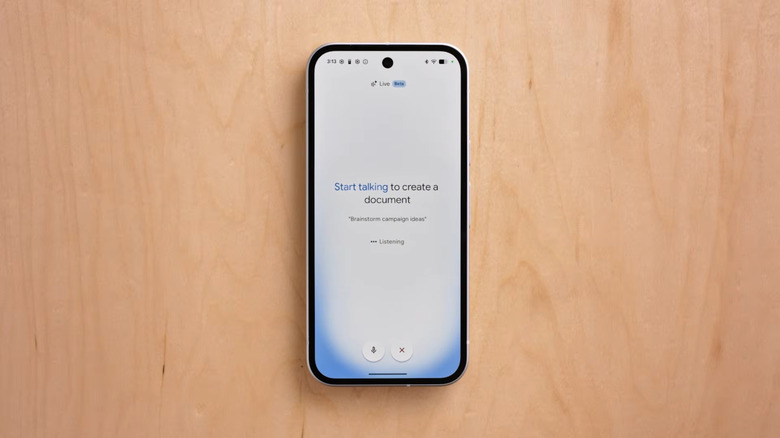
Google's implementation of these features reflects broader industry trends toward more accessible artificial intelligence. The company understands that not everyone wants to learn specialized syntax or technical commands to harness AI capabilities. By making Gemini responsive to natural language patterns, Google democratizes access to advanced computational thinking. This approach aligns with the company's long-standing mission to organize and make information universally accessible and useful.
The voice interaction with Gemini extends beyond simple queries. Users can engage in extended conversations where the AI remembers previous context, asks clarifying questions, and provides increasingly refined responses based on feedback. This creates a collaborative dynamic where human intuition and AI processing combine synergistically. Whether crafting written content, solving mathematical problems, or exploring hypothetical scenarios, users can work with Gemini iteratively.
Integration across Google's ecosystem amplifies Gemini's utility. The AI seamlessly connects to Gmail, Google Drive, Maps, Search, and other services, enabling it to pull relevant information and take action on behalf of users. Someone might ask Gemini to summarize emails about a specific project, draft responses, and schedule follow-up meetings—all through conversational commands. This interconnectedness transforms Gemini from a standalone chatbot into a comprehensive productivity assistant.
Privacy and security considerations remain paramount in Google's deployment of these conversational AI features. The company emphasizes that voice data undergoes encryption and that users retain control over what information Gemini can access. Clear privacy controls allow people to delete voice recordings and restrict data retention policies. These safeguards address legitimate concerns about recording conversations and storing personal information.
The psychology behind human-AI communication reveals interesting patterns in how people adapt to interacting with machines. Research shows that when AI responds naturally and conversationally, users feel more comfortable asking questions and exploring capabilities. They're more likely to return to an assistant that understands them intuitively. This positive user experience cycle drives adoption and encourages deeper engagement with AI tools.
Competitors have noted Google's progress in this space, with OpenAI's ChatGPT, Microsoft's Copilot, and other systems similarly emphasizing conversational interfaces. The industry consensus suggests that natural language interaction will become the dominant paradigm for human-computer communication. Voice-enabled AI represents just one manifestation of this broader trend toward more intuitive, less technically demanding interfaces.
Training data and machine learning models underlying Gemini enable the sophistication users experience. Google invested enormous computational resources in language models that can process billions of parameters, understand semantic relationships, and generate contextually appropriate responses. The models learn patterns from vast text corpora, allowing them to recognize intent and provide helpful information across virtually any domain.
Real-world applications of Gemini voice capabilities span numerous scenarios. Students use the assistant to understand complex concepts and prepare for exams. Professionals leverage it to draft emails, analyze reports, and brainstorm solutions. Creative individuals employ it to overcome writer's block and explore artistic directions. Accessibility features particularly benefit users with mobility limitations, dyslexia, or other conditions that make traditional text input challenging.
The conversation around AI ethics and responsible development grows increasingly important as these tools become mainstream. Google acknowledges concerns about misinformation, bias, and over-reliance on AI decision-making. The company incorporates safeguards designed to prevent Gemini from generating harmful content or providing dangerous advice. Transparency about AI limitations helps users maintain appropriate skepticism and critical thinking.
Looking forward, Google continues refining Gemini based on user feedback and technological advances. Updates promise improved accuracy, expanded language support, and deeper integration with emerging applications. The company explores multimodal capabilities combining voice, text, and image recognition to provide even richer AI interactions. Future versions may anticipate user needs with greater precision and offer proactive suggestions before being asked.
The broader implications of widespread AI assistants extend beyond individual productivity. As artificial intelligence becomes increasingly conversational and accessible, society faces questions about work transformation, educational approaches, and human-machine collaboration models. These tools promise tremendous benefits but also demand thoughtful governance ensuring equitable access and ethical deployment. Google's Gemini represents both tremendous opportunity and significant responsibility as AI technology matures.
Source: Engadget


