
Humanoid Robot Smashes Half-Marathon Record in Beijing

Honor's humanoid robot beats human world record at Beijing half-marathon, completing 21km in 50:26. A breakthrough moment for China's robotic technology industry.
In a stunning display of technological advancement, humanoid robots have achieved what many thought impossible—outpacing the world's fastest human runners in a competitive half-marathon event. During an exhibition held in Beijing on April 19, these cutting-edge machines not only surpassed human competitors but also shattered the official half-marathon world record, marking a significant milestone in the evolution of autonomous robotic systems. The remarkable achievement underscores the rapid progress China's tech sector is making in developing practical applications for robot technology at scale, signaling a potential shift in how we think about athletic performance and machine capabilities.
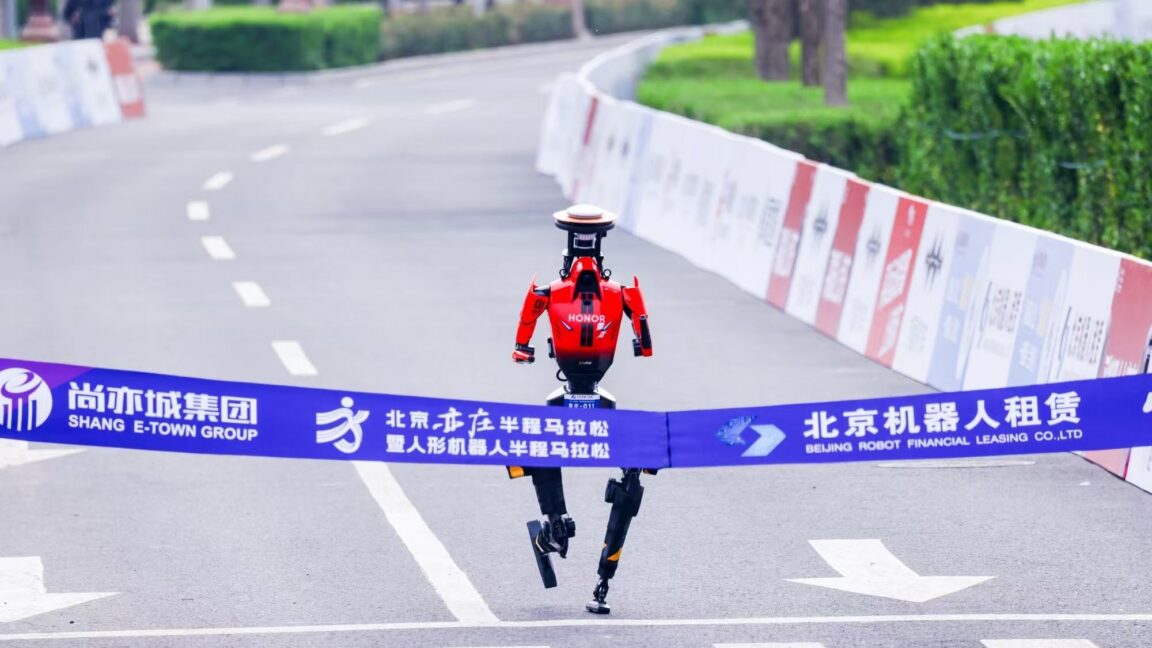
The standout performer from Chinese smartphone manufacturer Honor completed the challenging 13-mile (21-kilometer) course in an impressive 50 minutes and 26 seconds while operating entirely autonomously throughout the race. This time decisively eclipsed the human world record of 57 minutes and 20 seconds, which was recently established by Ugandan distance running sensation Jacob Kiplimo during the prestigious Lisbon Half Marathon in 2024. The Victory represents not merely a numerical achievement but a fundamental demonstration that robotic speed and autonomy have reached levels that rival and exceed peak human athletic performance in endurance events. The fact that the robot navigated the entire route without human intervention showcases the sophistication of its autonomous navigation systems and decision-making algorithms.
According to Du Xiaodi, a test development engineer for Honor who participated in the winning team's announcement, the robot's exceptional performance stems from biomimetic design principles carefully adapted from elite human athletes. The machine was engineered with exceptionally long legs measuring approximately 37 inches (95 centimeters) in length, a physical characteristic directly inspired by analyzing the proportions and mechanics of top-performing marathon runners. This design choice reflects a broader trend in robotics development where engineers study biological systems to create more efficient mechanical counterparts. By understanding and replicating the physical attributes that give elite runners their competitive edge, the Honor team created a platform that could theoretically maintain optimal running mechanics over extended distances.
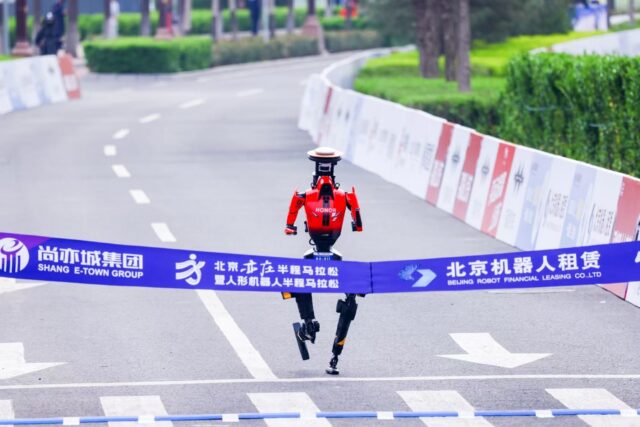
Beyond its impressive physical design, the winning robot incorporates a sophisticated custom liquid-cooling system that manages the intense thermal demands of sustained high-performance operation. Du Xiaodi explained that this cooling technology was derived and adapted from the proven cooling solutions already implemented in Honor's consumer electronics products, particularly smartphones and laptops that require thermal management during intensive processing tasks. The application of this consumer-grade cooling technology to humanoid robotics demonstrates an innovative cross-pollination of engineering solutions across different product categories. Such thermal management is crucial for robots operating at near-maximal performance levels, as electronic systems can experience degradation or failure if internal temperatures exceed safe operating ranges during extended physical exertion.
The successful demonstration in Beijing reflects China's strategic commitment to becoming a global leader in humanoid robot manufacturing and deployment. Chinese technology companies are aggressively pursuing mass production capabilities and real-world applications for these sophisticated machines, viewing robotics as a critical frontier in the competition for technological dominance. Companies like Honor are not merely building showcase machines for exhibitions but are actively developing platforms with genuine practical utility. The investment in humanoid robotics extends beyond athletic performances; manufacturers are exploring deployment in manufacturing, logistics, service industries, and other sectors where the combination of human-like dexterity and tireless operation could provide substantial economic advantages.
The implications of this achievement extend far beyond the realm of competitive running. The successful navigation of a complex half-marathon course while maintaining optimal performance demonstrates that autonomous robots have progressed to the point where they can handle unpredictable, real-world environments with variable terrain, changing conditions, and unforeseen obstacles. This capability represents a substantial leap forward from controlled laboratory environments where robots have traditionally been tested. The ability to continuously process environmental data, make split-second decisions about pace and direction, and maintain performance consistency over an extended period reveals the maturity of the underlying artificial intelligence and sensor systems powering these machines.
Jacob Kiplimo's previous world record of 57 minutes and 20 seconds had represented the absolute pinnacle of human endurance running performance, achieved through years of dedicated training, optimal biomechanics, and peak physical conditioning. The robot's time of 50 minutes and 26 seconds surpasses this benchmark by nearly seven minutes—a margin that would place the robot nearly two full kilometers ahead of the world's best human runner over the same distance. This performance gap illuminates the different advantages that robotic systems possess: they never tire, they don't experience pain, they maintain consistent pacing, and they can operate at maximum capacity for the entire duration without the physiological limitations that constrain human athletes. However, the achievement also raises interesting questions about how we define athletic achievement and what it means when machines surpass organic life in domains previously considered uniquely human.
The Honor robot's victory in Beijing is merely the latest indication of how rapidly the robotics industry is advancing. Over the past several years, we've witnessed consistent breakthroughs in machine learning, materials science, battery technology, and mechanical design that have gradually shifted what's possible in robotics. What seemed like science fiction a decade ago—robots capable of autonomous navigation through complex environments, fluid movement that mimics human locomotion, and decision-making systems sophisticated enough to handle unpredictable scenarios—has become demonstrable reality. These technological advances don't occur in isolation; they're the cumulative result of massive research investments, talent recruitment from around the world, and the sharing of innovations across academic institutions and commercial enterprises.
Looking ahead, the success of this demonstration will likely accelerate investment and development efforts in humanoid robotics throughout China and internationally. Companies and investors will view this achievement as validation that the technology has matured sufficiently for serious commercial deployment. We can expect to see increased announcements regarding practical applications, expanded production capacity, and new use cases for humanoid robots across various industries. The competition to advance robotic capabilities will intensify, as multiple companies vie to establish themselves as leaders in this emerging market. Whether in manufacturing, hospitality, healthcare, or entertainment, humanoid robots that combine impressive physical capabilities with sophisticated autonomous decision-making represent a transformative technology that could reshape multiple economic sectors.
The Beijing half-marathon event serves as a powerful symbol of how far robotic technology has advanced and a tantalizing glimpse of what may be possible in the not-too-distant future. As robot technology continues its rapid evolution, we'll likely see similar demonstrations and achievements that push the boundaries of what machines can accomplish. The Honor robot didn't just win a race; it demonstrated that the era of robots operating at elite human performance levels has genuinely arrived. Whether this represents progress to celebrate or concerns to address remains a subject of active debate among technologists, ethicists, and policymakers, but there's no denying that the capability itself is now a demonstrated reality that will shape the trajectory of technology and society for decades to come.
Source: Ars Technica


