
Infantino's Peace Gesture Crumbles at FIFA Congress

FIFA President Gianni Infantino's attempt to broker a symbolic handshake between Palestinian and Israeli delegates at the 76th FIFA Congress in Vancouver ends in rejection.
FIFA President Gianni Infantino has officially announced his candidacy for a third consecutive full term as the governing body's leader, following an incident at the organization's 76th congress that drew international attention. The announcement came in the wake of an unsuccessful attempt to orchestrate what many observers interpreted as a symbolic gesture of peace between representatives of two nations with deeply rooted political tensions.
During the proceedings in Vancouver, Palestinian Football Federation president Jibril Rajoub declined to participate in what appeared to be a carefully choreographed moment designed to promote unity and dialogue within the international football community. The moment unfolded when Infantino invited both Rajoub and Israel Football Association vice-president Basim Sheikh Suliman to approach the stage simultaneously, seemingly intending for the two officials to shake hands in front of the assembled delegates and media representatives.
The refusal by Rajoub to engage in the proposed handshake represented a significant diplomatic setback for the FIFA president, whose attempts to position himself as a bridge-builder on the global stage have been a hallmark of his leadership style. This incident occurred towards the conclusion of the congress proceedings, making the awkward moment particularly conspicuous given the formal nature of the event and the presence of hundreds of football officials from around the world.
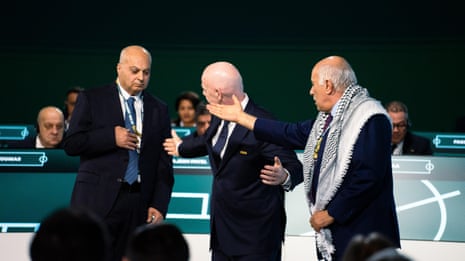
The context surrounding this exchange highlights the complex geopolitical dynamics that continue to influence international sports governance. The relationship between Palestinian and Israeli football federations has long reflected broader regional tensions, with various attempts by international organizations to promote dialogue and cooperation frequently encountering resistance from one or both parties. Infantino's diplomatic initiative, whether explicitly framed as a peace gesture or simply as a routine introduction, was perceived by Rajoub as either inappropriate or premature given the current political climate.
Rajoub's decision to refuse the handshake must be understood within the broader context of Palestinian representation at international sporting bodies. The Palestinian Football Federation has consistently advocated for greater recognition and support within FIFA's structures, and Palestinian officials have used international sports forums as platforms to draw attention to their political grievances. By declining to participate in what could be interpreted as a performative gesture of reconciliation, Rajoub may have been signaling that substantive political changes must precede symbolic sporting moments.
The incident raises important questions about the appropriate role of international sports organizations in addressing geopolitical conflicts. Many observers have criticized FIFA's attempts to position itself as a venue for diplomacy, arguing that such efforts can trivialize serious political issues or create false impressions of progress when underlying disputes remain unresolved. Others contend that international sports provide valuable opportunities for dialogue and incremental steps toward understanding between adversaries.
Infantino's leadership tenure has been characterized by an ambitious agenda that extends beyond traditional football governance. Since assuming office in 2016, he has pursued numerous initiatives aimed at expanding FIFA's global influence and promoting various social and political objectives through the platform of international football. His announcement regarding the bid for a third full term suggests confidence in his vision and achievements, despite controversies that have marked his presidency.
The timing of Infantino's re-election announcement is strategically significant, coming during the congress where he would have the opportunity to consolidate support among member federations. His continued tenure as FIFA president would require approval from the federation's member nations, and maintaining broad coalitional support remains essential for his political survival within the organization. The Vancouver congress provided an ideal venue for reaffirming his commitment and showcasing his diplomatic engagement efforts.
Previous attempts by FIFA officials to facilitate interactions between delegations from nations with contentious relationships have produced mixed results. Sports diplomacy, while occasionally successful in creating moments of brief rapprochement, often struggles against the weight of underlying political realities. The handball or refusal to engage in such moments frequently generates more attention and scrutiny than successful interactions, as they draw focus to the fundamental divisions that international sports forums attempt to bridge.
The response from various stakeholders to this incident has been notably mixed. Some observers expressed sympathy for Rajoub's position, noting that accepting a handshake could be interpreted as conferring legitimacy or conceding important political ground. Others suggested that missed opportunities for dialogue, regardless of their symbolic nature, ultimately harm efforts toward peaceful coexistence and mutual understanding. The incident thus became emblematic of broader disagreements about strategy and tactics in addressing the Israeli-Palestinian conflict.
FIFA's role in international politics continues to evolve, with the organization increasingly navigating complex geopolitical terrain. As the global governing body for association football, FIFA wields considerable soft power and exercises influence over international delegations and public discourse. However, the organization's attempts to leverage this influence toward political objectives remain controversial and frequently encounter resistance from member federations or individual officials.
Looking forward, Infantino's campaign for re-election will likely attract scrutiny regarding his approach to diplomatic initiatives and his balance between FIFA's sporting mission and broader global political engagement. The Vancouver congress incident serves as a reminder of the challenges inherent in attempting to broker peace or promote dialogue through international sports frameworks, particularly when addressing deeply entrenched conflicts with decades of history behind them.
The refusal of the handshake ultimately underscores the limitations of symbolic gestures in addressing substantive political disagreements. While international sporting events can provide valuable platforms for dialogue and incremental progress, they cannot substitute for genuine diplomatic efforts and political negotiations at higher governmental levels. The incident in Vancouver thus reflects broader tensions between sports and politics, idealism and pragmatism, and the challenge of leveraging international forums toward peace-building objectives without oversimplifying complex historical and political realities.
Source: The Guardian


