
JWST Reveals Dramatic Weather Shifts on Distant Hot Gas Giant

James Webb Space Telescope maps daily weather patterns on WASP-94A b, a tidally locked gas giant 690 light-years away, discovering cloudy mornings and clear evenings.
The James Webb Space Telescope has provided humanity with an unprecedented glimpse into the atmospheric conditions of an exotic world located roughly 690 light-years from Earth. WASP-94A b, a hot gas giant locked in a tight orbital dance with its star within a binary system, has become the subject of groundbreaking meteorological research. This distant exoplanet represents a crucial case study for understanding how extreme atmospheric systems function in environments radically different from anything in our own solar system. A team of researchers led by Sagnick Mukherjee, an accomplished astrophysicist at Johns Hopkins University, has published their remarkable findings in the prestigious journal Science, revealing atmospheric dynamics that challenge our existing models of exoplanet climate systems.
The phenomenon of tidal locking makes WASP-94A b particularly intriguing to atmospheric scientists. Unlike Earth, which rotates and experiences day-night cycles that redistribute heat across its surface, tidally locked planets present one face perpetually toward their host star. This means traditional temperature gradients that sweep across planetary surfaces become impossible—the day-side remains eternally scorched while the night-side experiences perpetual darkness. Mukherjee and his colleagues set out to investigate the fundamental nature of this world's atmosphere. Their central research questions were deceptively simple yet profound: Are these atmospheres static and unchanging, or do they display dynamic behavior? Do winds circulate through these alien skies? Do clouds form and dissipate as they do on Earth? The answers they uncovered would reshape our understanding of exoplanet atmospheres.
The observational data gathered by JWST revealed something truly remarkable about WASP-94A b's atmospheric patterns. The research team discovered that the planet experiences distinct weather variations throughout its rotation period, despite being tidally locked. Most remarkably, the atmosphere exhibits a surprising daily cycle: mornings over the substellar point are characterized by extensive cloud coverage, while evenings bring clear skies and better visibility through the atmospheric layers. This discovery fundamentally contradicts assumptions that had long dominated exoplanet science. If our previous models were incorrect for this relatively well-studied world, Mukherjee and his colleagues reasoned, we might have fundamentally misunderstood the chemistry of not just WASP-94A b, but potentially many other exoplanets in the wider universe.

Understanding why our previous assumptions about exoplanet atmospheres proved inadequate requires examining how scientists traditionally study these distant worlds. WASP-94A b possesses intriguing physical characteristics that make it an ideal subject for detailed atmospheric analysis. The planet's mass falls slightly below half that of Jupiter, yet its diameter extends over 70 percent wider than Jupiter's. This seemingly paradoxical combination—less massive but substantially larger—indicates that WASP-94A b has exceptionally low density. The implications of this property cascade through atmospheric science: a lower-density planet necessarily has an atmosphere that extends much further into space compared to denser worlds. This extended atmosphere creates a more pronounced signature when analyzed through spectroscopic observations, making it substantially easier for telescopes like JWST to detect subtle atmospheric features and chemical compositions.
The primary technique that astronomers have traditionally employed to study distant planetary atmospheres is called transmission spectroscopy. This elegant method relies on a straightforward principle: when a planet transits in front of its host star from Earth's perspective, some of the starlight must pass through the planet's atmospheric layers before reaching our telescopes. The various gases and suspended particles in the atmosphere selectively absorb specific wavelengths of light, creating a distinctive absorption spectrum. By carefully analyzing which wavelengths disappear and which remain, scientists can determine which chemical compounds populate the atmosphere. The technique has proven remarkably effective for characterizing atmospheres across the exoplanet population, yet it does have important limitations. Traditional transmission spectroscopy provides an integrated view—essentially an average composition as the planet rotates. This averaging approach inherently obscures dynamic processes and temporal variations.
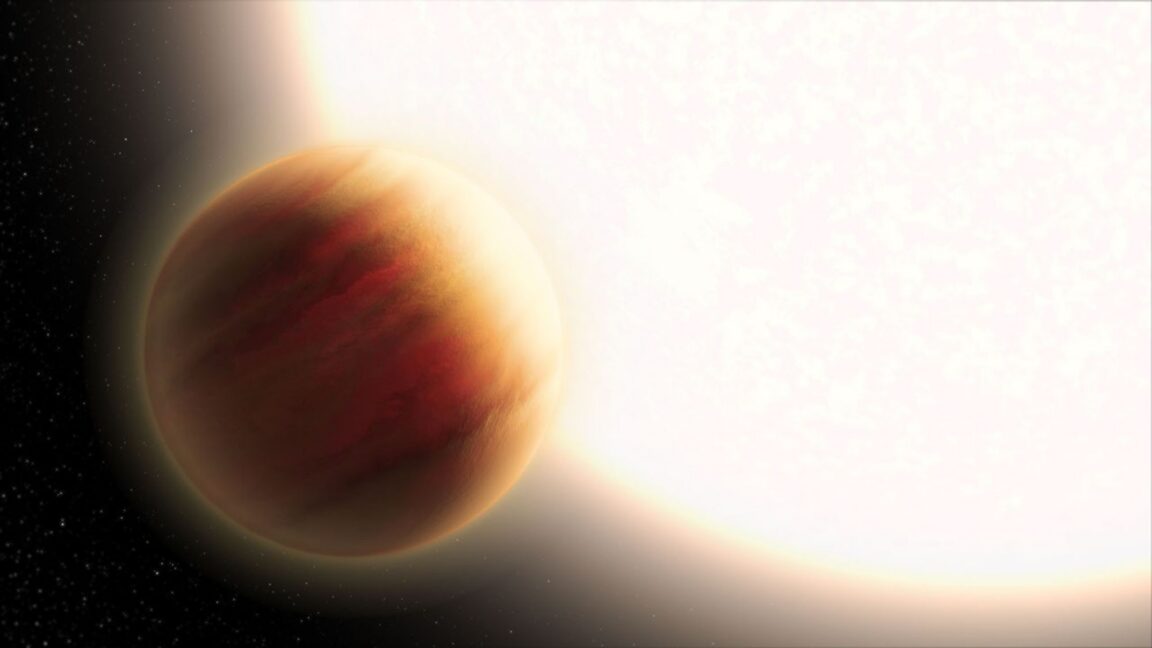
The revolutionary capability of JWST's infrared spectroscopy lies in its unprecedented sensitivity and resolution capabilities. Unlike previous space telescopes, JWST can detect subtle variations in atmospheric properties with spatial and temporal resolution that approaches what planetary scientists have long desired. The telescope's sophisticated infrared instruments can distinguish between atmospheric conditions at different locations on the planet's surface and even detect changes that occur over relatively short timescales. This enhanced capability allowed Mukherjee's team to move beyond simple averaged atmospheric compositions and begin mapping actual weather patterns across the planet's visible hemisphere. The discovery of morning cloud formations that clear by evening represents the first detailed weather map of any exoplanet atmosphere—a watershed moment in atmospheric science.
The implications of discovering dynamic, time-varying atmospheric conditions on WASP-94A b extend far beyond this single world. If our previous models incorrectly predicted static, unchanging conditions for tidally locked planets, then our understanding of chemical equilibrium in these extreme atmospheres requires revision. Cloud formation processes, chemical reaction rates, and the vertical mixing of atmospheric layers all depend sensitively on wind patterns and atmospheric circulation. When we measure transmission spectra that average across all these dynamic processes, we implicitly assume that our measurements represent a true equilibrium state. The Mukherjee study reveals that this assumption may frequently be violated. Atmospheric circulation patterns and cloud formation processes on tidally locked planets may operate according to principles quite different from those governing Earth's atmosphere.

The specific characteristics of WASP-94A b's host star system further illuminate why this world proves so valuable for atmospheric research. WASP-94A exists as part of a binary star system, meaning it orbits alongside a companion star. The presence of this secondary star actually enhances certain observational capabilities, as the system's particular geometry can create favorable conditions for detailed spectroscopic analysis. Additionally, the fact that WASP-94A b orbits so extremely close to its primary star—much closer than Mercury orbits our Sun—means the planet experiences intense stellar radiation that drives vigorous atmospheric circulation. The hot gas giant classification applies because surface temperatures likely exceed 1,000 Kelvin. Under such extreme conditions, atmospheric chemistry becomes highly active, with rapid chemical reactions occurring throughout the atmospheric layers.
Future observations using JWST and potentially other next-generation telescopes promise to expand this emerging field of exoplanet weather mapping. Scientists now recognize that the dynamic behavior Mukherjee's team discovered on WASP-94A b may represent a common feature of tidally locked atmospheres rather than an anomaly. Systematic surveys of multiple exoplanet atmospheres could reveal previously hidden patterns in how wind circulation, cloud formation, and chemical processes interact across diverse planetary systems. Each discovery adds crucial data points that refine our theoretical models of atmospheric dynamics under extreme conditions found nowhere in our solar system. The broader lesson from this research extends beyond mere curiosity about distant worlds; it demonstrates how observational capabilities continue to reshape fundamental scientific understanding and reveal nature's complexity in unexpected ways.
The Mukherjee study ultimately highlights a crucial principle in modern astronomy: our telescopes and instruments often reveal that previous assumptions, however well-intentioned, frequently miss important aspects of planetary behavior. The morning-to-evening cloud transition on WASP-94A b serves as a humbling reminder that even well-studied exoplanets can surprise us when observed with sufficiently sophisticated equipment. As JWST continues its groundbreaking observations across the cosmic distance scale, we can expect many more such surprises. Each discovery enriches our understanding of planetary diversity and the fundamental processes that shape atmospheres under radically different conditions than those found on Earth or any world in our solar system.
Source: Ars Technica


