
Kim Jong Un Opens Memorial for North Korean Soldiers in Ukraine

North Korean leader Kim Jong Un inaugurates memorial honoring soldiers killed in Ukraine conflict alongside Russian Defence Minister Andrey Belousov in Pyongyang.
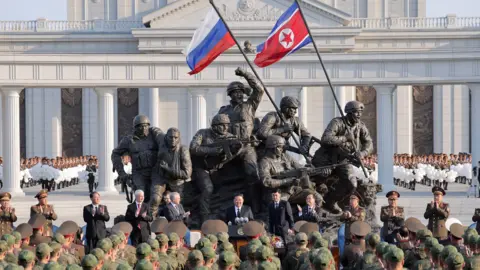
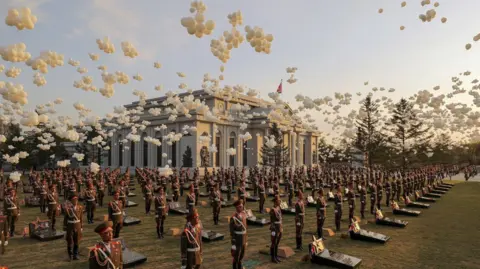
Kim Jong Un, the supreme leader of North Korea, has officially opened a memorial dedicated to North Korean soldiers who lost their lives during the ongoing conflict in Ukraine. The ceremonial unveiling took place in Pyongyang, the capital of North Korea, marking a significant acknowledgment of the country's military involvement in the European war. This event represents a notable moment in North Korea-Russia military cooperation, as it publicly honors the sacrifice of North Korean personnel engaged in combat operations far from their homeland.
Russian Defence Minister Andrey Belousov attended the ceremony alongside Kim Jong Un, underscoring the strategic partnership between Russia and North Korea. The presence of Russia's top military official at this dedication ceremony demonstrates Moscow's appreciation for Pyongyang's military support during its conflict with Ukraine. This high-level diplomatic engagement signals the deepening military alliance between the two nations, particularly in the context of the broader geopolitical tensions that have shaped the current global landscape.
The memorial itself stands as a physical testament to the involvement of North Korean troops in the Ukraine war, a topic that had been subject to considerable speculation and diplomatic denials before its official confirmation. International observers have noted the growing military cooperation between Russia and North Korea as the conflict in Ukraine has prolonged, with reports suggesting thousands of North Korean soldiers have been deployed to support Russian military operations. The opening of this memorial provides concrete evidence of this commitment and represents a willingness by the North Korean government to publicly acknowledge its role in the conflict.
The deployment of North Korean soldiers to Ukraine emerged as a controversial and significant development in the ongoing war. Intelligence agencies and military analysts from multiple countries have confirmed the presence of North Korean military personnel on the battlefield, fighting alongside Russian forces against Ukrainian military units. These deployments represent some of the first large-scale combat operations by North Korean troops outside their immediate region in decades, marking a substantial shift in the country's military posture and international engagement strategy.
The timing of this memorial ceremony carries significant geopolitical implications. By formally honoring fallen North Korean soldiers, Kim Jong Un's government is making an explicit statement about its commitment to the Russian-led military effort in Ukraine. This public acknowledgment also serves to legitimize the sacrifices made by North Korean military personnel and their families back home. Additionally, the ceremony reinforces the narrative within North Korea that the country is standing alongside Russia against what Pyongyang characterizes as Western aggression and imperialism.
Defence Minister Belousov's participation in the ceremony reflects Russia's gratitude for North Korea's military contributions. The Russian military has reportedly incorporated North Korean troops into its command structures, deploying them primarily to frontline positions in areas of intense fighting. This integration of North Korean forces into Russian military operations represents an unprecedented level of military cooperation between Moscow and Pyongyang, born out of Russia's strategic needs following the initial phases of its invasion of Ukraine.
International analysts have extensively documented the motivations behind North Korea's military support for Russia. The arrangement benefits both nations: Russia gains access to additional military manpower to sustain its operations in Ukraine, while North Korea receives military technology, economic assistance, and strengthened strategic positioning against its adversaries. This mutually beneficial arrangement has become increasingly important to both governments as the conflict has evolved and external pressures have mounted on each nation individually.
The memorial dedication also highlights the information control strategies employed by the North Korean government. By officially acknowledging the presence of troops in Ukraine and their casualties, the regime is managing public narrative in a way that presents military cooperation with Russia as honorable and necessary. This contrasts with earlier denials and ambiguity, suggesting a shift in how Pyongyang communicates its foreign policy decisions to both its domestic audience and the international community.
For Ukrainian officials and their Western allies, the opening of this memorial served as further confirmation of direct North Korean military involvement in the conflict. The ceremony provided undeniable evidence that challenged any remaining diplomatic claims about the nature and extent of North Korean participation. This public acknowledgment has influenced international assessments of the conflict's trajectory and the coalition of forces aligned with Russia against Ukraine's resistance efforts.
The broader context of this memorial opening reveals the evolving security dynamics in Northeast Asia and Eastern Europe. North Korea's willingness to deploy troops to Ukraine reflects its assessment that supporting Russia serves its long-term strategic interests. The country faces significant international isolation due to its nuclear weapons program and human rights record, making Russia a crucial ally for economic survival and military security. In return, Russia benefits from access to North Korea's military manufacturing capabilities and personnel reserves.
Looking forward, the memorial stands as a permanent landmark symbolizing the human cost of the Russia-Ukraine conflict through the lens of North Korean sacrifice. Families of fallen North Korean soldiers now have an official space to commemorate their relatives' deaths, a recognition that carries profound meaning in North Korean society where state narratives heavily shape public consciousness. The monument will likely become a site of state-sponsored remembrance ceremonies and a focal point for North Korean propaganda emphasizing national sacrifice and international solidarity.
The ceremony between Kim Jong Un and Andrey Belousov represents more than a simple memorial dedication; it encapsulates the complex web of military cooperation and strategic alignment that has emerged from the Ukraine conflict. As the war continues to evolve, such public gestures of solidarity between Russia and North Korea may become more frequent, serving both nations' propaganda needs while reinforcing their commitment to the military alliance. The opening of this memorial marks a historical moment when two of the world's most isolated and heavily sanctioned states formalized their military partnership through public ceremony and mutual recognition of sacrifice.
Source: BBC News


