
Marathon Heroes: Runners Unite to Help Struggling Competitor

Two Boston Marathon runners demonstrated remarkable sportsmanship by assisting a struggling competitor across the finish line. A heartwarming tale of athletic compassion.
The Boston Marathon has long been celebrated as one of the most prestigious and grueling endurance events in the world, testing the limits of human perseverance and determination. Yet on a recent Monday, the event became the backdrop for a touching display of athletic camaraderie that transcended competition and reminded spectators why sportsmanship remains at the heart of distance running. When one runner's body began to fail him in the final stretch, two complete strangers stepped in without hesitation, proving that Boston Marathon values extend far beyond personal achievement.
Ajay Haridasse, a 21-year-old university student hailing from Wakefield, Massachusetts, had trained extensively for this moment, dedicating months to preparing his body and mind for the 26.2-mile journey through Boston's most iconic streets. The young runner had maintained a respectable pace throughout most of the race, drawing energy from the enthusiastic crowds and the electric atmosphere that only the Boston Marathon can provide. However, as the brutality of the final miles began to settle into his muscles and bones, Haridasse discovered that even the most rigorous training couldn't fully prepare him for the unprecedented physical breakdown he was about to experience.
As Haridasse approached the 26-mile mark—tantalizingly close to the finish line yet still a considerable distance for a body pushed to its absolute limits—his legs began to betray him. What started as occasional stumbling quickly escalated into repeated falls, each one more concerning than the last. After hitting the ground for the fourth time, exhaustion and despair began to set in as the reality of his situation became clear. According to Haridasse's own account shared with the Boston Herald, he had begun mentally preparing himself to literally crawl across the finish line, unwilling to accept defeat despite his body's obvious distress.

It was at this critical moment, when Haridasse's determination was being tested in ways both physical and psychological, that two remarkable individuals stepped into his story. Aaron Beggs and Robson De Oliveira, both experienced marathon runners who were competing in their own right, noticed the struggling athlete and made an instantaneous decision that would define their race day experience in ways far more meaningful than any personal record ever could. Rather than focusing solely on their own performance, these two runners recognized a human being in genuine distress and chose compassion over competition.
The decision by Beggs and De Oliveira to stop their own races and assist Haridasse demonstrated a profound understanding of what it truly means to be part of the running community. Running culture is built on mutual respect and understanding of the incredible difficulty inherent in covering such vast distances at speed. These two runners understood intimately the wall that distance runners hit, the moment when the body seems to have nothing left to give, and they recognized that Haridasse needed more than encouragement—he needed physical support to achieve something he had trained so hard to accomplish.
What unfolded next became a powerful illustration of human connection and solidarity. Beggs and De Oliveira flanked Haridasse, providing crucial physical support while simultaneously offering emotional encouragement. They helped steady the young runner on his feet, preventing additional falls while propelling him forward toward the finish line. The image of three runners moving together as one unit, united by a common purpose that transcended individual achievement, captured the attention of spectators and other participants alike.
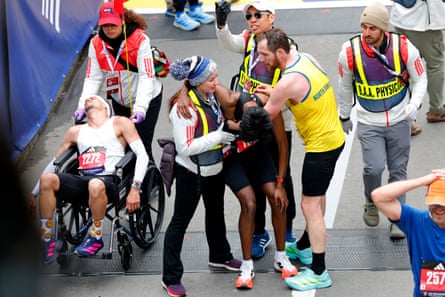
The moment has since been widely praised by the running community and beyond as a beautiful display of sportsmanship that encapsulates everything positive about athletic competition. Social media exploded with messages of appreciation and admiration for Beggs and De Oliveira, with many commenters noting that this act of kindness represented the true spirit of the Boston Marathon tradition. The race has a storied history dating back to 1897, and incidents like this one serve to reinforce why the event remains so meaningful to runners and spectators around the world.
Haridasse himself has expressed profound gratitude toward his unlikely saviors, recognizing that without their intervention, he may not have been able to complete the race in the manner he had envisioned. The experience has become a defining moment in his running journey, one that he will carry with him throughout his athletic career. Rather than remembering only personal accomplishment, Haridasse's Boston Marathon experience will forever be intertwined with the kindness and generosity of two strangers who chose to lift him up rather than pass him by.
The significance of this moment extends beyond the immediate circumstances of race day. In an era often characterized by intense competition and individual achievement, the actions of Beggs and De Oliveira serve as a powerful reminder that athletic competition can coexist with genuine human compassion. They demonstrated that helping another person achieve their goals does not diminish one's own accomplishment, but rather adds profound meaning to the entire experience. Their decision to pause their own competitive efforts and assist Haridasse speaks volumes about their character and values.
The running community has historically been known for its inclusive and supportive nature, with experienced runners often mentoring newcomers and established marathoners cheering on age-group competitors they've never met. However, moments like this one—where helping someone else becomes more important than personal performance—remain exceptional and noteworthy. This is precisely why the story of Haridasse, Beggs, and De Oliveira has resonated so deeply with people far beyond the sport of distance running.
As Haridasse crossed the finish line with support from his two helpers, he achieved far more than just completion of a marathon. He received a tangible reminder that humanity and kindness still exist in competitive environments, that strangers can become allies, and that true victory sometimes means helping someone else achieve their dreams. This experience will likely shape his perspective on running and competition for years to come, and may inspire him to extend the same compassion to other struggling athletes he encounters in future races.
The actions of Aaron Beggs and Robson De Oliveira exemplify the best qualities of sportsmanship and human decency. In choosing to help a fellow runner rather than compete against him in those final critical moments, they proved that two determined individuals working together are indeed stronger than one struggling alone. Their story serves as an inspiring testament to the power of community, compassion, and the unbreakable bond that connects all distance runners who understand the true meaning of pushing through adversity. The Boston Marathon may award prizes to the fastest, but on this particular Monday, the real victory belonged to those who stopped to help another human being reach their goal.
Source: The Guardian


