
Mendoza Drafted No. 1 as Rams Shock with QB Simpson Pick

Fernando Mendoza goes first overall to the Raiders while the Rams surprise everyone by selecting Alabama's Ty Simpson at No. 13 in the 2026 NFL Draft.
The 2026 NFL draft delivered plenty of intrigue during Thursday's first round, with quarterback selections dominating the conversation and reshaping the landscape of several franchises looking to build their futures around the signal-calling position. While many had anticipated which teams would be aggressive in pursuing quarterback talent, the specific choices and timing of those moves generated significant debate among analysts and fans alike, setting the stage for what many believe could be a transformative class of players at the position.
As widely expected, the Las Vegas Raiders demonstrated their commitment to quarterback development by selecting Fernando Mendoza with the coveted first overall pick. Mendoza, who led Indiana University to an impressive national championship victory last season, has been identified as a potential franchise cornerstone with elite arm talent, decision-making ability, and the intangible qualities that scouts believe will translate well to the professional game. His path to Indianapolis and subsequent dominance at the college level had made him the consensus top choice heading into draft day.
However, the most compelling narrative of the evening emerged from an unexpected quarter: the Los Angeles Rams made a bold and surprising move by selecting Alabama quarterback Ty Simpson with the 13th overall pick. This selection caught many in the NFL community off guard, as Simpson had been projected by the majority of draft analysts to be available well into the second round. The decision to invest an early first-round selection in a quarterback prospect widely considered to be outside the traditional top-10 quarterback tier demonstrated the Rams' willingness to think unconventionally about their roster construction.
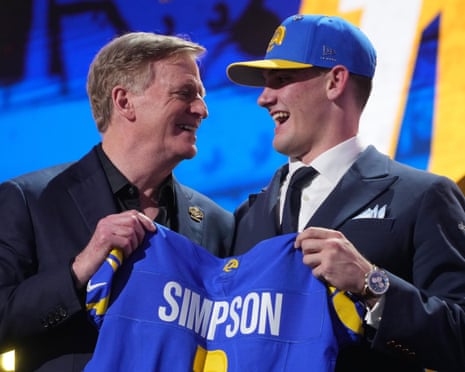
The timing and reasoning behind the Rams' move become clearer when examining their current quarterback situation and long-term franchise planning. Matthew Stafford, the team's current starting quarterback, was recently honored with the NFL MVP award following an outstanding 2025 season in which he led the Rams to significant regular-season success. His performance at the highest level has validated the organization's decision to acquire him in a trade several years prior, and he remains one of the league's most capable signal-callers when healthy and operating within an effective system.
Nevertheless, Stafford's age presents a realistic consideration for the Rams' front office as they think strategically about the franchise's future. Having recently turned 38 years old in February, Stafford's career trajectory naturally enters a period where teams must begin contemplating succession planning and preparing for the eventual transition away from their established veteran quarterback. While Stafford has indicated his intention to continue playing and has vowed to return for the upcoming season, the Rams appear to be adopting a prudent approach by securing a young quarterback prospect who can develop in the background and eventually assume the starting responsibilities.
The selection of Simpson represents a calculated investment in the Rams' future organizational structure. By acquiring a quarterback with significant college pedigree and potential, the Rams create an optimal scenario where Stafford can mentor a talented young player while continuing to lead the franchise on the field. This approach has proven successful for various NFL organizations throughout history, allowing established veterans to pass along invaluable knowledge to their successors while maintaining competitive excellence in the present.
Simpson's college profile at Alabama showcased exceptional talent and the ability to execute complex offensive schemes at the highest level of college football. His combination of physical attributes, including arm strength and mobility, along with his experience in a championship-caliber program under immense pressure situations, provided the foundation for the Rams to justify investing premium draft capital in his selection. Despite not being universally projected as an elite prospect, Simpson demonstrated flashes of brilliance that persuaded the Rams' personnel evaluators that he possessed the upside necessary to develop into a capable NFL starter.
The 2026 NFL draft first round featured only two quarterbacks selected overall, a notably restrained approach compared to previous years when quarterback-needy franchises aggressively pursued options at the position early in the proceedings. This deliberate pacing suggested that the overall quarterback talent in the class, while certainly present with prospects like Mendoza, may have been perceived as having notable depth rather than a crowded group of consensus elite prospects. Teams appeared willing to wait longer or explore alternative strategies rather than engage in the traditional quarterback run that has characterized recent drafts.
The Raiders' selection of Mendoza addressed their well-documented need for a franchise quarterback who could serve as the centerpiece of their organizational rebuild. Indianapolis' national championship run provided vivid evidence of Mendoza's ability to elevate the players around him and make winning plays when circumstances demanded his best performance. For Las Vegas, acquiring Mendoza represented a significant step toward establishing quarterback stability after years of uncertainty and transition at the position.
As the draft progressed through its first round, the impact of the Rams' unconventional selection would likely generate considerable discussion in the coming weeks and months. Some observers praised the organization for taking a patient, long-term view of building their quarterback room, while skeptics questioned whether investing such premium draft capital in a prospect projected for the second round represented an optimal allocation of resources. Regardless of perspective, the Rams had clearly signaled their intention to remain competitive in the present while simultaneously preparing intelligently for their future beyond the Stafford era.
Source: The Guardian


