
MP's Jamaican Dialect Speech Ignites Parliament Language Debate

A Jamaican MP's maiden speech in Patois sparks controversy over Westminster rules requiring English-only debate, raising questions about colonial legacy and linguistic identity.
The parliamentary tradition of conducting all proceedings exclusively in English language has once again become the focal point of a heated debate about cultural identity, postcolonial sovereignty, and the legitimacy of linguistic diversity within governmental institutions. When Jamaican Member of Parliament Nekeisha Burchell rose to deliver her inaugural address to the chamber, she carried with her not only the weight of representing her constituents but also the symbolic burden of challenging long-established parliamentary conventions that many argue are remnants of colonial rule.
Jamaica's parliament, much like its counterpart in Westminster, operates within a framework of strict ceremonial protocols and formal procedures that echo the structures imposed during the British colonial period. On May 12, the parliamentary session commenced in the traditional manner, with the arrival of the ceremonial mace—an imposing 1.7-metre ornamented silver staff that represents the British monarch's authority over the legislative body. This mace was ceremoniously placed on the table that separates the government benches from the opposition, a symbolic physical representation of parliamentary authority that has persisted for generations.
Despite the sweltering heat outside the parliamentary chambers, proceedings continued under the watchful eye of the speaker, who presided over debates while dressed in elaborate ceremonial robes—yet another throwback to Westminster traditions. These visual and procedural elements serve as constant reminders of Jamaica's colonial past and the institutional structures that were transplanted wholesale from Britain to the Caribbean island following colonization. The pageantry and formality, while intended to lend gravitas and respectability to parliamentary proceedings, also function as everyday manifestations of continuing British influence over Jamaica's political institutions.

When Burchell stood to deliver her maiden speech, she made a deliberate choice that would ignite widespread debate across the island and beyond. Rather than adhering to the unwritten but strictly enforced expectation that all parliamentary discourse occur in standard English, she chose to incorporate elements of Jamaican Patois—the creole language spoken by millions of Jamaicans in their daily lives and a crucial component of the nation's cultural heritage. Her decision to blend standard English with Patois was not accidental; it was a conscious act of linguistic and cultural assertion within an institution that has historically demanded conformity to colonial norms.
The response from various quarters was immediate and polarized. Critics argued that Burchell's use of Patois constituted a breach of parliamentary decorum and linguistic standards, dismissing it as "broken English" and suggesting it had no place in formal legislative discourse. These detractors maintained that parliamentary proceedings require the precision, formality, and universal comprehensibility that only standard English can provide, and that allowing vernacular language in parliament would undermine the dignity of the institution. This perspective reflects a longstanding prejudice against Patois, which has historically been stigmatized as an inferior dialect rather than recognized as a legitimate language with its own grammatical structure and cultural significance.
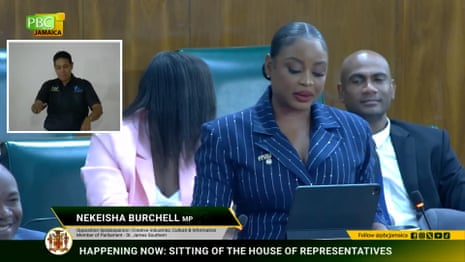
Conversely, supporters of Burchell's linguistic choice argued that her use of Patois represented an important reclamation of Jamaican identity and a rejection of postcolonial hierarchies that have long privileged European linguistic norms over indigenous Caribbean expression. They contended that in a nation that gained independence from British rule in 1962, continuing to insist on English-only parliamentary discourse perpetuates a form of cultural imperialism that devalues the lived experiences and authentic voice of ordinary Jamaicans. For these advocates, Burchell's maiden speech became a symbolic moment of decolonization—an assertion that Jamaica's political institutions must reflect the authentic linguistic reality of Jamaica itself.
The controversy has sparked broader conversations about language policy and institutional reform across Jamaica and the wider Caribbean region. Linguists and cultural scholars have pointed out that Patois is not simply a colloquial variation of English but rather a distinct creole language with its own syntax, phonology, and lexicon—the product of centuries of cultural synthesis in the Caribbean. Educational experts have also noted that excluding Patois from formal institutional settings sends a damaging message to young Jamaicans that their native language is inferior to the colonial language of their former rulers, potentially affecting educational outcomes and cultural self-esteem.
This incident must be understood within the context of Jamaica's ongoing negotiation with its colonial legacy. Although Jamaica achieved political independence nearly sixty years ago, many of its institutions, practices, and value systems remain fundamentally shaped by British colonial administration. The parliamentary system, the legal framework, the educational curriculum, and countless social conventions all bear the imprint of colonial rule. The insistence on English-only parliamentary proceedings represents just one manifestation of a broader pattern in which colonial norms continue to be upheld as the standard of legitimacy and propriety.
The question of language in parliament touches on deeper issues of national identity and sovereignty. If a nation's elected representatives cannot speak in the language of their constituents—the language spoken in homes, on streets, in markets, and in everyday life—what does this say about whose voices are valued and heard within governmental institutions? Proponents of linguistic inclusion argue that parliamentary representation becomes meaningless if it occurs in a language that distances legislators from the authentic concerns and expressions of those they represent. They suggest that true decolonization requires examining and potentially reforming institutional practices that privilege colonial languages over national linguistic diversity.
The debate also raises practical considerations about comprehensibility and communication. While standard English may theoretically be understood by a broader audience, in reality, most Jamaicans are far more fluent in Patois than in formal English, particularly among working-class populations. Some observers argue that if parliamentary representatives cannot communicate authentically in the language their constituents understand, the entire democratic process is compromised. Others have suggested that a compromise position—allowing the use of Patois while maintaining English as the official language of the record—might be a path forward that respects both institutional continuity and linguistic authenticity.
As Jamaica continues to grapple with questions of postcolonial identity and institutional reform, the language row sparked by Burchell's maiden speech serves as a catalyst for broader examination of whether the nation's governing structures truly reflect Jamaica's independence and character. The controversy demonstrates that decolonization is not merely a historical process completed at the moment of political independence; it is an ongoing project that requires continuous interrogation of inherited institutions and the assumptions embedded within them. Whether Jamaica's parliament will ultimately revise its language policies remains to be seen, but Nekeisha Burchell's courageous linguistic choice has ensured that the conversation about language, identity, and postcolonial governance will continue to resonate throughout the Caribbean and beyond.


