
NASA's Psyche Spacecraft Gets Mars Gravity Boost

NASA's Psyche spacecraft received a crucial gravity assist from Mars during its journey to the metallic asteroid. The mission could reveal secrets about Earth's core formation.
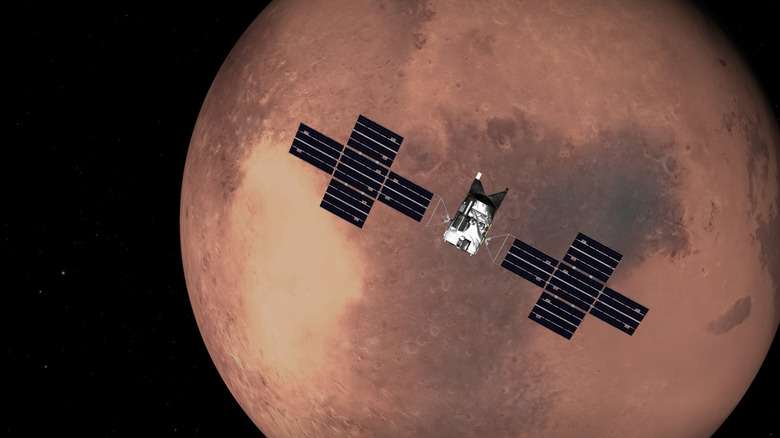
In a significant milestone for one of NASA's most ambitious deep space missions, the Psyche spacecraft successfully executed a gravity assist maneuver using Mars to propel itself further toward its distant destination. This strategic planetary encounter represents a critical phase in the spacecraft's multi-year journey through the solar system, demonstrating the precision and complexity required for modern space exploration.
The Psyche spacecraft is on an extraordinary mission to explore a unique celestial body unlike anything currently visited by human-operated robotic probes. Its destination is the asteroid Psyche, a massive metallic world located in the main asteroid belt between Mars and Jupiter. Scientists believe this unusual asteroid may be the exposed iron core of a protoplanet, making it an invaluable laboratory for understanding planetary formation and the composition of planetary cores throughout the universe.
Mars flyby maneuvers like the one executed by Psyche have long been a cornerstone of interplanetary mission planning. By passing near a massive gravitational body, spacecraft can gain additional velocity without expending precious fuel. This technique, known as a gravity assist or gravitational slingshot, allows missions to reach distant destinations more efficiently and cost-effectively than would otherwise be possible. The Mars encounter was carefully calculated to give Psyche exactly the trajectory needed for its continued journey outward into the solar system.
The timing and execution of such gravitational assists require extraordinary precision from mission planners and engineers. Even minor miscalculations can result in significant trajectory deviations that would require fuel-consuming course corrections. NASA's navigation team spent months preparing for this critical maneuver, utilizing advanced computational models and real-time tracking data to ensure the spacecraft would pass Mars at precisely the right distance and angle.
The asteroid Psyche mission has captured the imagination of scientists and space enthusiasts alike because of what it promises to reveal about planetary formation. Earth's core, like those of other terrestrial planets, is believed to have formed through a process of planetary accretion and differentiation occurring billions of years ago. By studying the composition and structure of Psyche, scientists hope to gain direct evidence about the material and processes that created planetary cores, including our own.
The asteroid Psyche is particularly interesting because it appears to be composed largely of iron and nickel, with an estimated metallic content that rivals Earth's own core composition. Some research suggests that Psyche may be all that remains of a protoplanet that lost its rocky outer layers due to giant impacts during the chaotic early period of solar system formation. If true, this makes Psyche a window into the violent processes that shaped our solar system billions of years ago.
The Psyche spacecraft carries sophisticated scientific instruments designed to thoroughly characterize this metallic world. These instruments include magnetometers to measure any residual magnetic fields, multispectral imagers to analyze the asteroid's surface composition, and gravity measurement systems to determine its internal density distribution. The comprehensive data collected during the mission will allow scientists to construct detailed models of Psyche's internal structure and evolutionary history.
Mission planners selected Mars for this gravity assist because of its favorable orbital geometry relative to both Earth and the asteroid Psyche's location. The encounter was scheduled for a time when Mars would be positioned such that the spacecraft's trajectory would be bent in exactly the right direction. This kind of three-body orbital mechanics problem represents one of the most complex challenges in space mission design, requiring sophisticated software and years of planning.
The successful completion of the Mars gravity assist represents a validation of NASA's mission planning and navigation capabilities. Despite the inherent risks and complexities involved, the spacecraft achieved the precise trajectory needed to continue its journey. This success builds confidence in the team's ability to execute the subsequent course corrections and orbital maneuvers that will be necessary as Psyche approaches its target asteroid.
The Psyche mission is part of NASA's broader planetary science research program, which aims to expand human understanding of the solar system through robotic exploration. By visiting asteroids, comets, and other small bodies, scientists can access materials and environments that provide clues to the processes that occurred during the earliest stages of solar system formation. The insights gained from these missions inform our understanding of planetary evolution across the entire universe.
The journey to asteroid Psyche will take several more years, with the spacecraft scheduled to reach its destination in 2029. During this extended cruise phase, the spacecraft will continue to operate its scientific instruments and conduct calibration activities to prepare for the detailed observations that will begin once it reaches the asteroid. The long journey also provides an opportunity for mission controllers to monitor spacecraft health and make any necessary adjustments to systems or trajectories.
The gravitational assist from Mars exemplifies how modern space missions leverage the geometry and physics of the solar system to accomplish ambitious scientific goals. Rather than relying solely on onboard propulsion systems, which would require enormous fuel reserves, spacecraft use the orbital mechanics of planets and moons to achieve the necessary velocities and trajectories. This approach has enabled the exploration of distant worlds that would otherwise remain beyond the reach of current propulsion technology.
As the Psyche spacecraft continues its voyage through the inner solar system, it carries with it the hopes of the international scientific community. The data it will eventually collect from asteroid Psyche promises to answer fundamental questions about planetary core formation and the violent processes that shaped our solar system. The successful Mars gravity assist is one step closer to achieving these ambitious scientific objectives and expanding humanity's understanding of our cosmic neighborhood.
Source: Engadget


