
OpenAI Breaks Free: Ends Microsoft Exclusive Partnership

OpenAI and Microsoft announce amended partnership allowing OpenAI to serve products across any cloud provider, not just Azure, while maintaining licensing through 2032.
OpenAI and Microsoft have fundamentally restructured their partnership, marking a significant shift in one of artificial intelligence's most influential collaborations. Since Microsoft's landmark $1 billion investment in OpenAI in 2019, the two companies have maintained an exclusive partnership that reshaped the AI landscape and accelerated the development of cutting-edge language models. However, both organizations jointly announced today an amended agreement that transforms the nature of their relationship, granting OpenAI substantially greater freedom to distribute its products and services across multiple cloud infrastructure providers beyond Microsoft's Azure platform.
The restructured deal represents a pivotal moment for OpenAI's growth strategy and independence. Rather than remaining bound exclusively to Microsoft's cloud services, OpenAI can now expand its offerings to customers utilizing competing cloud providers such as Amazon Web Services, Google Cloud Platform, and others. This change reflects OpenAI's maturation as a business and its desire to maximize market reach without the constraints of a single-provider arrangement. The announcement clarifies that while Microsoft will retain a non-exclusive license for OpenAI's intellectual property and models through 2032, the company no longer holds exclusive rights to these valuable technological assets.
Despite the shift toward non-exclusivity, Microsoft has secured important protections within the amended partnership terms. Azure will maintain its position as OpenAI's "primary cloud partner" throughout the licensing period, provided that Microsoft continues to meet the financial and operational commitments outlined in the agreement. This designation ensures that Microsoft remains deeply integrated with OpenAI's infrastructure and operations, even as OpenAI pursues relationships with other cloud providers. The primary partnership status suggests that Azure will likely continue to host the majority of OpenAI's computational operations and serve as the default cloud infrastructure for new initiatives.
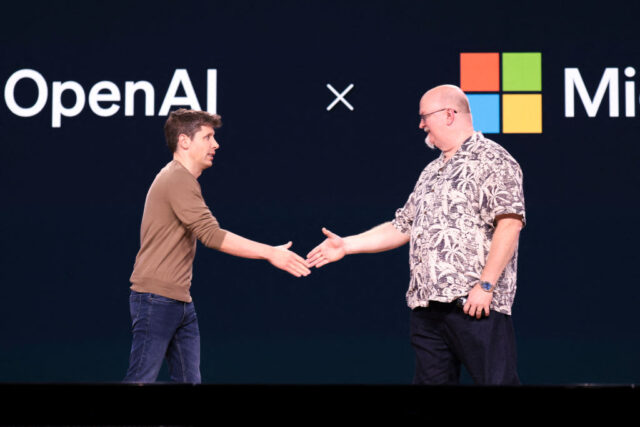
Financial terms of the amended agreement maintain certain continuities with the original partnership while introducing significant modifications. OpenAI will continue making 20 percent revenue share payments to Microsoft, acknowledging the substantial value of the original investment and ongoing collaboration. However, this payment structure now operates under fundamentally different conditions than existed previously. The total amount of these revenue sharing obligations is now subject to an unspecified financial cap, preventing Microsoft from receiving unlimited revenue benefits as OpenAI scales. Additionally, these guaranteed payments are limited to a timeframe extending through 2030, providing both parties with clear financial boundaries and planning horizons.
One of the most consequential changes involves the famous "AGI clause" that characterized the original partnership. Under the amended agreement, OpenAI's revenue share with Microsoft is now independent of the company's technology progress, effectively decoupling financial obligations from breakthroughs in artificial general intelligence. The original partnership included provisions that would substantially change Microsoft's rights and benefits if OpenAI achieved AGI, creating complexity and potential conflict. By removing this dependency, both parties reduce future uncertainty and establish a more straightforward business relationship. This modification suggests that OpenAI faced mounting pressure to distance itself from arrangements that could restrict its ability to pursue ambitious AI development goals.
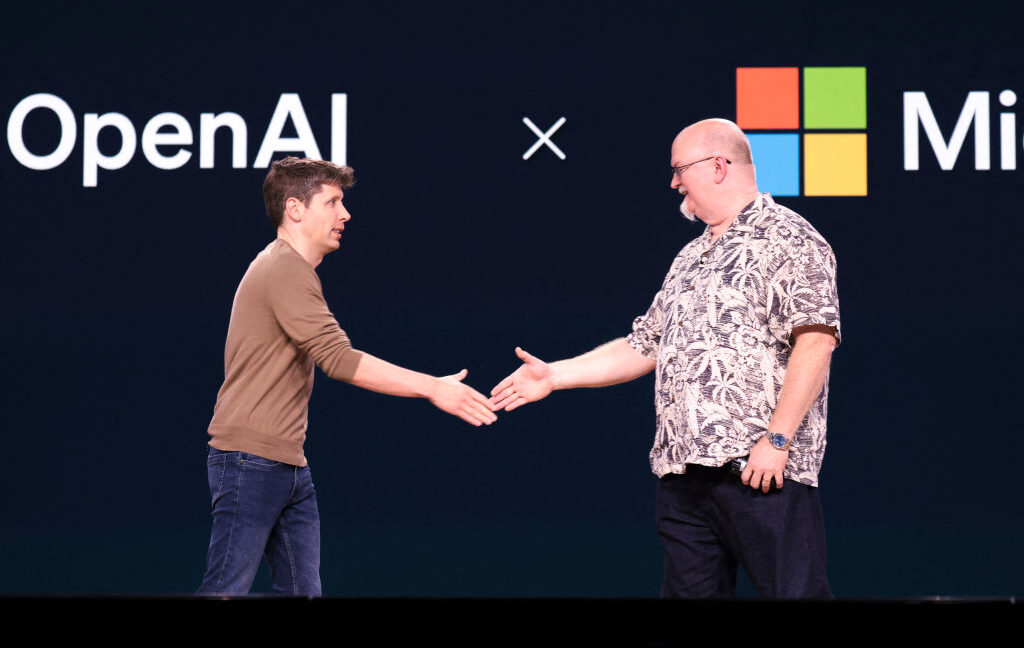
The timing and context of this partnership restructuring reveal broader dynamics within the artificial intelligence industry and competitive cloud provider landscape. OpenAI's success with ChatGPT and other models has created enormous demand for its services, with customers and organizations worldwide seeking to integrate OpenAI's capabilities into their operations. Many enterprises maintain multi-cloud strategies, dividing workloads between different providers to optimize costs, manage risk, and maintain vendor independence. By restricting OpenAI to Azure, Microsoft risked losing customers who wanted to work with OpenAI but preferred or required alternative cloud infrastructure providers.
The amended partnership also reflects the rapid evolution of competitive dynamics in the AI market. Numerous organizations have emerged as significant players in the generative AI space, including Google, Anthropic, Meta, and others. Microsoft's exclusive arrangement with OpenAI provided significant competitive advantages when ChatGPT first launched, but as the market matures and competition intensifies, maintaining exclusivity becomes increasingly difficult to sustain. Other companies are developing their own powerful language models and offering them across multiple cloud platforms, creating pressure on OpenAI to do likewise.

OpenAI's ability to serve customers across multiple cloud providers positions the company for accelerated growth and market penetration. Organizations that have standardized on AWS, Google Cloud, or other platforms can now integrate OpenAI's models and services without requiring architectural changes or Azure adoption. This flexibility should substantially expand OpenAI's potential customer base and revenue opportunities. The company can market its offerings to cloud-agnostic enterprises and organizations that deliberately avoid dependence on single vendors for critical infrastructure and services.
Microsoft's position within this restructured arrangement remains formidable despite the loss of exclusivity. Azure's designation as the primary cloud partner ensures continued deep integration with OpenAI's operations and ongoing access to large portions of OpenAI's computational workloads. Additionally, Microsoft has integrated OpenAI's technology throughout its product portfolio, including Copilot AI assistants across Office applications, Windows, and other services. These product integrations and the primary partnership status provide Microsoft with sustained competitive advantages and revenue streams that extend well beyond the 2032 licensing horizon.
The amended agreement's structure suggests that both organizations negotiated extensively to balance OpenAI's desire for independence with Microsoft's need to protect its substantial investment. The removal of the AGI clause from financial obligations indicates that OpenAI successfully argued for the ability to pursue unfettered artificial intelligence development without worrying that breakthroughs might trigger unfavorable contractual changes. Meanwhile, Microsoft secured continued revenue sharing, primary partnership status, and extended licensing rights that preserve the company's access to OpenAI's technological capabilities and market position.
Looking forward, this restructured partnership has significant implications for the broader AI ecosystem and cloud infrastructure market. Other AI companies may seek similar non-exclusive arrangements with cloud providers, potentially fragmenting the cloud market further and creating more complex vendor relationships. Enterprise customers may now face choices about where to deploy different AI workloads based on cloud provider features, pricing, and capabilities rather than being forced toward a single ecosystem. The announcement signals that even partnerships between industry giants must evolve to accommodate market realities and competitive pressures.
The amended partnership between OpenAI and Microsoft represents a maturation of both organizations and the artificial intelligence industry more broadly. While their exclusive arrangement provided significant benefits to both parties in OpenAI's early stages, the new non-exclusive structure better serves the needs of OpenAI's rapidly expanding customer base and the diverse infrastructure preferences of enterprises worldwide. Microsoft retains substantial benefits through primary partnership status, continued licensing rights, and deep product integrations. OpenAI gains the freedom to pursue customers and opportunities unconstrained by platform exclusivity. This balanced restructuring demonstrates how major technology partnerships must adapt as companies, industries, and markets evolve.
Source: Ars Technica


