
Police Launch New High Street Crime Unit to Combat Gang-Run Shops

Following BBC investigation exposing drug gangs and money laundering operations, authorities establish dedicated unit targeting criminal enterprises using retail fronts.
In a significant response to investigative journalism that exposed widespread criminal activity across UK retail establishments, law enforcement agencies have announced the creation of a specialized high street crime unit dedicated to dismantling gang operations disguised as legitimate businesses. This strategic initiative represents a major escalation in efforts to combat organized crime that has infiltrated shopping districts nationwide, using seemingly ordinary storefronts as covers for illicit activities ranging from drug trafficking to financial crimes.
The establishment of this dedicated unit follows a comprehensive BBC investigation that revealed the extent to which criminal organizations have exploited high street retail locations. The groundbreaking reporting exposed networks of drug gangs operating behind legitimate business facades, uncovering sophisticated schemes that have enabled these criminal enterprises to launder proceeds and expand their operations with relative impunity. The investigation's findings prompted immediate action from government officials and law enforcement leadership who recognized the urgent need for a coordinated, specialized response.
Among the most alarming discoveries detailed in the BBC's investigation was the prevalence of money laundering operations conducted through retail establishments. These criminal networks have developed complex financial schemes that funnel illicit proceeds through seemingly legitimate retail transactions, making it extraordinarily difficult for traditional financial authorities to detect the criminal origins of the funds. By creating shell companies and employing ghost directors—individuals who hold official corporate positions while having no genuine involvement in business operations—these gangs have effectively obscured their criminal activities from regulatory oversight.
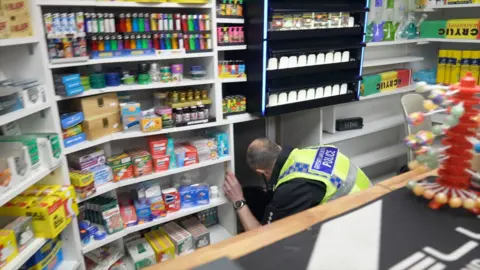
The BBC's investigation also highlighted the immigration crime dimension of these high street criminal enterprises. Gangs have established retail fronts that facilitate human trafficking, document fraud, and exploitation of vulnerable migrant populations seeking employment and housing. These operations often target individuals from overseas who possess limited knowledge of UK law and social systems, making them easy prey for exploitation and coercion. The investigation documented numerous cases where individuals discovered working in such establishments had their documents confiscated and were subjected to labor exploitation and debt bondage.
A particularly troubling aspect of the criminal ecosystem exposed by the BBC involved the use of ghost directors to maintain plausible deniability and legal separation from actual gang operations. These nominees, often individuals with limited criminal histories themselves, serve as the official faces of businesses in corporate records while real operational control remains with gang leadership operating behind the scenes. This structural arrangement has created significant challenges for law enforcement attempting to establish direct links between retail operations and organized crime networks, requiring sophisticated investigative techniques and cross-agency collaboration to penetrate.
The newly established high street crime unit is expected to employ intelligence-led policing strategies that combine traditional detective work with advanced financial analysis and data-sharing protocols. Officers assigned to the unit will receive specialized training in identifying the hallmarks of gang-controlled retail operations, including unusual transaction patterns, excessive cash handling, limited actual retail inventory, and suspicious staffing arrangements. The unit will also coordinate closely with financial intelligence teams, immigration enforcement, and business regulatory authorities to build comprehensive cases against criminal enterprises.

Authorities have emphasized that this enforcement action represents not merely a response to the BBC's revelations but rather a fundamental shift in how law enforcement approaches organized crime operating within civilian retail environments. Rather than treating each reported incident in isolation, the new unit will adopt a network-mapping approach that identifies connections between seemingly disparate business locations and reveals the organizational structures controlling multiple retail fronts simultaneously. This comprehensive strategy acknowledges that individual shop investigations, while important, fail to address the broader criminal networks orchestrating activities across numerous locations.
The initiative also reflects growing recognition that gang activity in retail spaces creates significant externalities affecting community safety, local legitimate businesses, and the integrity of commercial districts. Neighborhoods hosting gang-controlled retail operations experience increased violence as different criminal organizations compete for territorial control, heightened street-level drug dealing that attracts users and associated crime, and general degradation that drives away legitimate retailers and pushes residents away from once-vibrant shopping areas. By targeting the retail operations themselves rather than only street-level dealers, authorities hope to disrupt the infrastructure supporting organized crime networks.
The BBC investigation that prompted this enforcement response involved months of undercover reporting, interviews with former gang members and individuals exploited by these operations, and examination of corporate records and financial transactions. Journalists documented the specific mechanisms through which gangs recruit ghost directors, often targeting individuals facing financial difficulties or those with existing connections to organized crime. The investigation revealed that compensation for serving as a ghost director typically ranges from modest sums to explicit threats and coercion, depending on the individual's circumstances and relationship to gang leadership.
The money laundering schemes documented in the investigation employed techniques ranging from the relatively simple to the highly sophisticated. Some operations merely used retail sales to convert drug proceeds into apparently legitimate income, filing tax returns and maintaining business accounts that provided legal explanations for sudden wealth accumulation. More elaborate schemes involved round-tripping transactions between multiple businesses, creating complex transaction chains that made it nearly impossible to trace illicit funds back to their criminal origins. Some networks even partnered with corrupt accountants and financial advisors who actively assisted in disguising criminal proceeds as legitimate business income.
Law enforcement officials responding to the BBC investigation have indicated that the specialized new unit will incorporate lessons learned from successful prosecutions of organized crime networks in other jurisdictions. Authorities plan to invest in advanced financial forensics capabilities, expand partnerships with financial intelligence units and banking regulators, and develop information-sharing protocols that enable rapid communication between local police and national organized crime task forces. Additionally, the unit will establish direct liaison relationships with business registration authorities and company house officials to improve the detection of suspicious corporate formations.
The announcement of this dedicated high street crime unit has received support from local government officials, legitimate retailers' associations, and community organizations concerned about organized crime's corrosive effects on neighborhood commercial centers. Business improvement districts and retail trade associations have pledged cooperation with the new unit, committing to share information about suspicious retail operations and supporting law enforcement investigative efforts. Community leaders have emphasized that eliminating gang-controlled retail operations represents a crucial step toward revitalizing struggling commercial districts and restoring public confidence in local shopping areas.
Moving forward, authorities indicate that the new unit will prioritize identifying and prosecuting the criminal leadership directing multiple retail operations rather than focusing exclusively on individual shop-level staff. This leadership-focused approach aims to dismantle the organizational structures sustaining gang networks, making it significantly more difficult and costly for criminals to reconstitute operations following arrests and convictions. Prosecutors are expected to pursue enhanced charges against leadership figures, including money laundering conspiracies, organized crime statutes, and human trafficking charges, leveraging the comprehensive evidence developed through the specialized unit's investigations.
The establishment of this dedicated enforcement unit signals a recognition that combating modern organized crime requires specialized expertise, sustained commitment, and coordination across multiple law enforcement and regulatory agencies. The BBC investigation's exposure of systemic criminal exploitation of retail establishments has created political momentum for increased resources, expanded investigative authorities, and enhanced inter-agency cooperation. As the new unit commences operations, its effectiveness in disrupting gang-controlled retail networks will likely influence law enforcement strategies in other jurisdictions similarly affected by organized crime penetrating commercial sectors.
Source: BBC News


