
Porsche Exits Bugatti: End of VW's Luxury Supercar Era

Porsche divests its stake in Bugatti to investor consortium, marking the end of Volkswagen Group's 28-year ownership of the legendary luxury automaker.
A significant milestone has arrived for one of the automotive world's most storied marques. After nearly three decades of stewardship, Porsche has announced the sale of its stake in Bugatti to a consortium of external investors, effectively ending Volkswagen Group's ownership of the iconic luxury brand. This pivotal transaction marks the conclusion of an ambitious chapter that began in 1998 when Ferdinand Piech, then-chief of the VW Group, orchestrated the brand's resurrection as part of his grand vision to showcase the corporation's engineering prowess to the world.
The history of Bugatti extends far deeper than most modern automotive enthusiasts realize, reaching back to the early 20th century. Founded in 1909 by the visionary Ettore Bugatti, the company established its manufacturing operations in the Alsace region, an area historically contested between France and Germany. Throughout the tumultuous decades of the World Wars, Bugatti persevered as a purveyor of exceptional automobiles, though the original company ultimately ceased operations by 1963, unable to survive the dramatic shifts in the global automotive landscape and changing consumer preferences of the post-war era.
The supercar renaissance of the late 1980s provided the catalyst for Bugatti's triumphant return to the automotive stage. The company's reintroduction came through the revolutionary EB110, a technological marvel that exemplified cutting-edge automotive engineering. This extraordinary vehicle featured a carbon fiber monocoque chassis constructed through an innovative partnership with Aérospatiale, the French aerospace firm that would later evolve into Airbus. Powering the EB110 was a quad-turbocharged V12 engine comparable in sophistication to contemporary Formula One power plants, complemented by sophisticated all-wheel-drive technology that set new standards for supercar capability and performance.
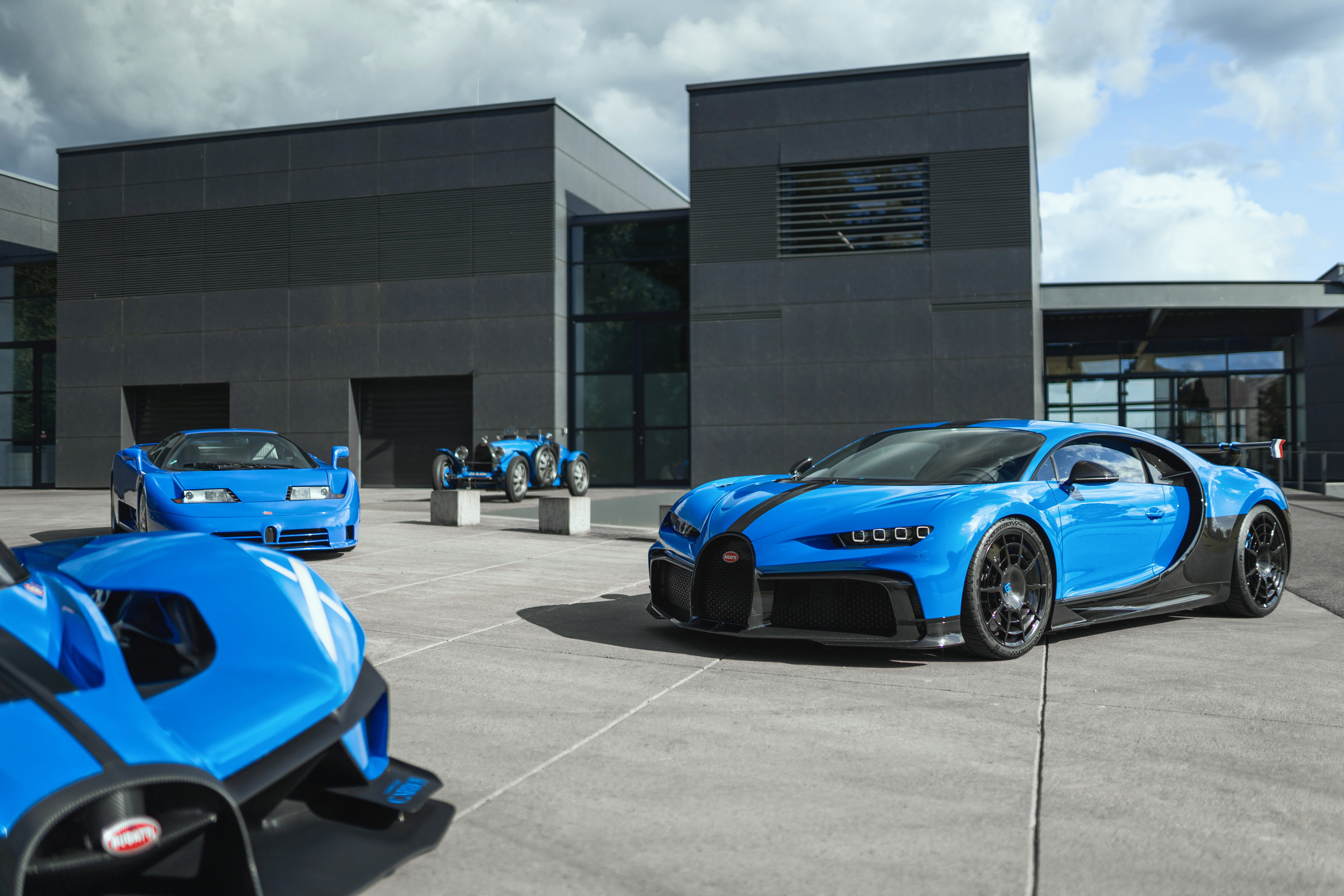
Despite its technical brilliance and spectacular capabilities, the EB110's market tenure proved disappointingly brief. The emergence of the even more extraordinary McLaren F1 and a significant economic downturn in the mid-1990s combined to undermine the EB110's commercial viability. The supercar market contracted sharply, leaving this automotive masterpiece struggling to find sufficient buyers willing to invest in such an exclusive and expensive proposition. By the mid-1990s, this iteration of Bugatti had effectively disappeared from production, leaving enthusiasts with only memories of its technological achievement.
The contemporary Bugatti brand that captured global imagination emerged in 1998 under dramatically different circumstances. This resurrection represented one of numerous ambitious projects undertaken by Ferdinand Piech during his influential tenure as Volkswagen Group's chief executive. Piech's vision transcended simple profit motives; he sought to leverage Bugatti as a powerful instrument for demonstrating the Volkswagen Group's unparalleled engineering capabilities and technological innovation. In Piech's estimation, creating the world's most exclusive and powerful production automobile would serve as the ultimate validation of the corporation's collective engineering talent.
Under Piech's direction and subsequent leadership, Bugatti developed the legendary Veyron supercar, which would become synonymous with the brand's modern identity and aspirations. The Veyron represented an unprecedented engineering achievement, combining quad-turbocharged power with sophisticated aerodynamics, active suspension systems, and luxury appointments that redefined expectations for ultra-high-performance automobiles. This engineering flagship attracted wealthy collectors, celebrities, and automotive enthusiasts willing to invest millions in owning one of the world's fastest and most exclusive production vehicles, establishing Bugatti as an undisputed leader in the luxury hypercar segment.
Throughout the 2000s and 2010s, Bugatti maintained its position as the aspirational pinnacle of automotive excess and performance. The brand developed an increasingly devoted global clientele among ultra-high-net-worth individuals who viewed Bugatti ownership as both a statement of wealth and an appreciation for engineering excellence. However, the automotive industry's dramatic transformation in recent years—particularly the accelerating shift toward electric vehicle technology and sustainability—has fundamentally altered the landscape in which luxury automakers operate.
The transition toward electric propulsion has proven particularly challenging for manufacturers positioned at the ultra-luxury, high-performance end of the market. While electric vehicles have demonstrated impressive acceleration capabilities and environmental benefits, they face significant obstacles in meeting the expectations of customers who have traditionally valued the raw visceral experience of powerful internal combustion engines and the distinctive acoustic signatures that distinguish true performance automobiles. The prospect of transitioning Bugatti toward electric power presented a fundamental conflict with the brand's historical identity and customer expectations.
In 2021, Porsche assumed stewardship of Bugatti through a strategic partnership with Rimac, an emerging Croatian electric vehicle specialist known for developing advanced battery and electric drivetrain technologies. This collaboration was explicitly intended to navigate Bugatti's transition into the electric vehicle era while preserving the brand's performance heritage and luxury positioning. However, the challenges inherent in this transition—balancing environmental imperatives with customer desires for traditional supercar experiences—have ultimately proven more complex than anticipated.
The decision to divest from Bugatti reflects the sobering reality that electric vehicle aspirations have become increasingly difficult to reconcile with the brand's core positioning and customer expectations. Manufacturing an electric hypercar capable of meeting traditional Bugatti performance standards while achieving acceptable range and charging infrastructure compatibility remains technically feasible but economically challenging. The specialized customer base that historically supported Bugatti ownership has shown limited enthusiasm for fully electric alternatives, preferring to maintain the traditional characteristics that defined the brand's mystique and allure.
The sale to an investor consortium represents a pragmatic recognition that Bugatti's future may lie outside the traditional corporate structures that have defined the brand for the past three decades. Independent investors, potentially including new automotive entrepreneurs or existing collectors, may possess greater flexibility in determining Bugatti's strategic direction without the constraints imposed by larger corporate sustainability and profitability targets. This transition opens possibilities for alternative ownership models that might better serve the brand's unique positioning within the ultra-luxury supercar market.
This transaction underscores the broader uncertainties facing the luxury automotive sector as the industry undergoes unprecedented transformation. Even the world's most prestigious and technologically advanced manufacturers cannot guarantee that their established brand identities and customer relationships will successfully transition into an entirely new technological paradigm. Bugatti's departure from Volkswagen Group ownership serves as a cautionary tale about the challenges that legacy automakers face in adapting to electric vehicle dominance, particularly when traditional customer bases resist transformative change.
The future trajectory of Bugatti under new ownership remains to be determined, but this pivotal moment marks the definitive end of Volkswagen Group's ambitious three-decade experiment in resurrecting and reinventing one of automotive history's most legendary names. As the automotive industry continues its inexorable shift toward electrification and sustainability, Bugatti's story will serve as an important case study in how heritage brands navigate the collision between tradition and technological revolution. The next chapter of Bugatti's history will ultimately be written by investors willing to embrace the uncertainties and opportunities that characterize the contemporary automotive landscape.
Source: Ars Technica


