
Prediction Markets Raise Security Concerns

Analysis reveals over 52% success rate for high-stakes military bets on Polymarket, raising national security questions about information disclosure.
A groundbreaking analysis has uncovered a troubling pattern in prediction markets that could have significant implications for national security. More than half of all "long-shot" bets placed on military action through Polymarket are proving successful, according to research conducted by the Anti-Corruption Data Collective, a prominent non-profit research and advocacy organization focused on government transparency and accountability.
The findings suggest that prediction market platforms like Polymarket may pose a substantially greater threat to the confidentiality of sensitive defense information than previously understood by policymakers and security experts. The data raises important questions about how classified or sensitive information might be leaking into public betting markets, potentially revealing advance knowledge of military operations or defense initiatives.
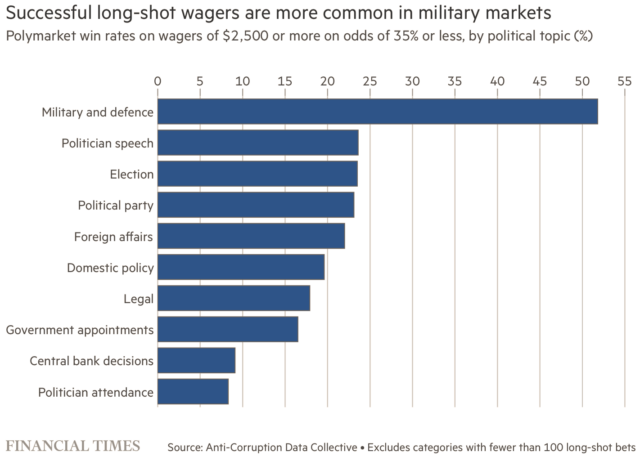
The Anti-Corruption Data Collective's comprehensive analysis specifically focused on what researchers define as "long-shot" bets—high-stakes wagers of $2,500 or more placed at extremely low odds of 35 percent or less. These types of bets are particularly notable because they typically indicate contrarian positions, suggesting that investors possess non-public information or superior predictive insight into outcomes that the broader market considers unlikely.

The research uncovered a remarkable statistic that distinguishes military and defense-related betting from other categories on the platform. Long-shot bets specifically targeting military action and defense initiatives achieved an average win rate of approximately 52 percent, demonstrating a level of predictive accuracy that far exceeds what would be expected from chance or public information alone.
To contextualize these findings, the comparative win rates across different betting categories on Polymarket reveal a dramatic disparity. Long-shot bets on politics-focused markets demonstrated a significantly lower average win rate of roughly 25 percent, suggesting that military markets operate with substantially different information dynamics. Even more telling, long-shot bets across all markets on the Polymarket platform as a whole achieved just 14 percent average win rates, underscoring just how exceptional the military and defense category performs.
This 52 percent success rate for high-stakes military bets stands in stark contrast to the platform-wide baseline, suggesting that certain categories of information may be more susceptible to leakage or that specific market participants possess advance knowledge about defense-related events. The implications of these statistics extend far beyond simple betting outcomes and venture into serious national security territory.

The betting markets phenomenon has emerged as a significant area of concern for government officials and security analysts in recent years. As decentralized prediction platforms have grown in prominence and transaction volume, they have increasingly become venues where individuals with specialized knowledge or advance information can monetize that knowledge through betting activities. The relatively minimal regulatory oversight of these platforms compared to traditional financial markets has made them particularly appealing for such activities.
The Anti-Corruption Data Collective's report serves as a wake-up call regarding the potential national security vulnerabilities created by modern prediction market platforms. The organization's research methodology involved analyzing historical betting patterns and outcomes across multiple categories of markets on Polymarket, comparing win rates to assess which categories showed anomalously high success rates that might indicate information leakage or insider knowledge.
Military and defense betting markets have historically been less scrutinized than they should be, according to security experts and policy analysts. Many government agencies have only recently begun to recognize the potential risks posed by prediction markets as they relate to operational security and the protection of sensitive defense information. The research published by the Anti-Corruption Data Collective provides quantifiable evidence that these concerns are not merely theoretical but represent a real and measurable phenomenon.
The implications of this research extend to broader questions about information security and compartmentalization within government agencies. If individuals with access to sensitive defense information are systematically profitable when making high-confidence bets on military outcomes, this suggests either that information is leaking from government sources or that specific individuals have developed exceptional predictive capabilities regarding classified military planning.
Policy experts and security officials are now grappling with how to address the risks posed by decentralized betting platforms without infringing upon the freedoms associated with open markets and financial innovation. The challenge lies in balancing legitimate concerns about national security with the broader principles of market freedom and individual liberty. Some experts have called for enhanced monitoring and reporting requirements, while others advocate for more direct restrictions on certain categories of bets.
The Polymarket platform itself operates with minimal geographic restrictions, allowing international participants to engage in betting on military and defense-related outcomes. This global accessibility potentially expands the pool of individuals who might possess valuable information or seek to profit from military developments, further complicating efforts to secure sensitive information.
The research conducted by the Anti-Corruption Data Collective represents a significant step toward understanding the magnitude and scope of risks posed by prediction markets to national security infrastructure. However, the organization's findings also raise additional questions that require further investigation and analysis by government agencies, academic researchers, and security professionals.
Moving forward, policymakers must consider whether existing regulatory frameworks adequately address the unique challenges posed by decentralized prediction markets. The success rates documented in military betting markets suggest that current oversight mechanisms may be insufficient to prevent information leakage or to detect when market participants possess non-public information about sensitive defense matters.
As prediction markets continue to evolve and expand in scope and transaction volume, the security concerns identified in this analysis are likely to become increasingly urgent. The convergence of financial innovation, decentralized platforms, and sensitive national security information creates a complex landscape that will require coordinated efforts across government, industry, and the research community to properly address and mitigate.
Source: Ars Technica


