
Putin Claims Ukraine Conflict Nearing End

Russian President Vladimir Putin suggests the Ukraine conflict may be approaching conclusion while criticizing Western support for President Zelensky's government.
Russian President Vladimir Putin has expressed his belief that the ongoing conflict in Ukraine is moving toward a conclusion, signaling a potential shift in the Kremlin's perspective on the prolonged military engagement. During recent remarks, the Russian leader indicated that he perceives openings for diplomatic negotiations that could facilitate an end to the hostilities that have devastated the region since Russia's initial invasion in February 2022. Putin's statement represents a significant rhetorical development in how Moscow frames the conflict to both domestic and international audiences.
The Russian president's comments suggest that Moscow may be considering a shift toward diplomatic channels, though he simultaneously leveled sharp criticism at the Western nations supporting Ukraine. Putin condemned what he characterized as the West's sustained backing of President Volodymyr Zelensky's government, arguing that continued military aid prolongs the suffering of Ukrainian civilians and perpetuates an unwinnable situation for Kyiv. This dual messaging—presenting oneself as open to negotiations while blaming external actors for the conflict's continuation—has become a hallmark of Kremlin communications strategy throughout the war.
The statement comes amid ongoing military operations and mounting casualties on both sides of the Ukraine-Russia conflict. International observers have noted that Putin's framing of the situation has evolved considerably since the early stages of the invasion, when Russian officials expressed confidence in rapid military victory. The acknowledgment that the conflict might be ending reflects the complex reality on the ground, where neither side has achieved decisive military supremacy despite nearly two years of intense fighting.
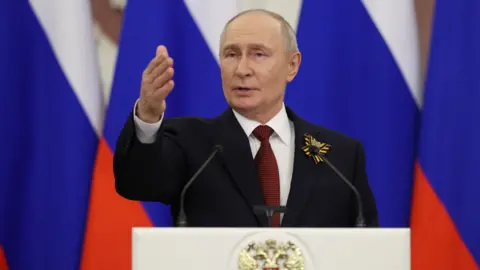
Analysts have pointed out that Putin's recent rhetoric about Ukraine negotiations may be designed to appeal to war-weary populations within Russia, where casualties have mounted substantially and economic sanctions have created widespread hardship. The statement could also be an attempt to drive a wedge between Western allies supporting Ukraine, suggesting that their assistance is futile and that Kyiv should instead accept negotiations on terms favorable to Moscow. Such messaging has become increasingly important to the Kremlin as international support for Ukraine's defense continues to face domestic political challenges in some Western nations.
The Russian leader's comments about the conflict coming to an end must be contextualized within the broader landscape of the war. Despite claims about diplomatic openings, Russia has continued aggressive military operations across multiple fronts in Ukraine, particularly in the eastern Donbas region. The apparent contradiction between suggesting the conflict is ending while maintaining military pressure suggests that Putin may be attempting to negotiate from a position he believes strengthens Russia's hand in future talks.
President Zelensky and his government have largely dismissed Russian overtures for negotiation that do not guarantee Ukraine's territorial integrity and sovereignty. The Ukrainian leadership has consistently maintained that any peace agreement must restore Ukraine's borders and include mechanisms for accountability for alleged war crimes. This fundamental disagreement over the basic parameters of potential negotiations has remained a persistent obstacle to diplomatic progress throughout the conflict.
Western governments supporting Ukraine have emphasized their commitment to backing Kyiv for as long as the country continues to resist Russian aggression. The United States, European Union member states, and other allied nations have provided substantial military and financial assistance to Ukraine, viewing the conflict as a critical test of the international order and the principle of respecting national sovereignty. These nations argue that supporting Ukraine's defense against invasion is both a moral imperative and a strategic necessity to deter further Russian aggression in Europe.
The broader geopolitical implications of Putin's statement extend beyond immediate peace negotiations to encompass questions about the future security architecture of Europe and Russia's place within it. The conflict has fundamentally reshaped European security dynamics, leading to NATO expansion discussions and increased military spending among European nations previously hesitant about such measures. Russia's invasion of Ukraine has been widely interpreted as an attempt to prevent Ukraine from joining NATO, yet the conflict has effectively accelerated NATO's eastward expansion and strengthened the alliance's commitment to collective defense.
Humanitarian concerns remain paramount throughout the ongoing conflict, with millions of Ukrainians displaced internally and millions more having fled to neighboring countries and beyond. The humanitarian crisis in Ukraine has created substantial burdens on neighboring nations and international organizations responsible for coordinating relief efforts. Reconstruction needs are already staggering, with estimates of damage to infrastructure running into hundreds of billions of dollars.
Intelligence assessments from Western nations have suggested that Russian military capabilities have been significantly degraded by the conflict, despite initial advantages in manpower and equipment. The quality of Russian forces committed to the war in recent phases of fighting has declined notably, with reports indicating increased reliance on poorly trained conscripts and private military contractors. This degradation of military capacity has raised questions about Russia's ability to sustain the conflict at current intensity levels indefinitely.
Putin's suggestion that the conflict is coming to an end may also reflect internal pressures within Russia itself. Economic sanctions have impacted Russia's economy, though less catastrophically than some Western analysts predicted. Nevertheless, the fiscal burden of maintaining an extended military operation in Ukraine, combined with the costs of mitigating sanctions, has created budgetary pressures that some Russian observers have highlighted as unsustainable over the long term.
The international community continues to monitor developments in the Russia-Ukraine war closely, recognizing that how this conflict concludes will have ramifications for global security, the viability of international law, and the rules-based international order. Any genuine movement toward negotiations would likely require both sides to moderate their maximum demands and find compromise positions that, while satisfying neither side completely, would allow for a cessation of hostilities and beginning of reconstruction.
For now, Putin's statement remains largely rhetorical, and the military situation on the ground continues to evolve dynamically. Whether the Russian president's comments represent a genuine shift toward seeking an end to the conflict or merely a tactical communication strategy aimed at advancing Russian interests remains unclear. The coming months will likely provide greater clarity regarding Russian intentions and whether meaningful diplomatic progress becomes possible in resolving this devastating regional conflict.
Source: BBC News


