
Romanian PM Ilie Bolojan Ousted in Shock No-Confidence Vote

Romanian Prime Minister Ilie Bolojan loses no-confidence vote after largest coalition party sides with far-right opposition to remove him from office.
Romanian Prime Minister Ilie Bolojan has been removed from office following a decisive no-confidence vote in parliament, marking a significant political upheaval in the Eastern European nation. The vote came as a shock to observers, as the largest party within Bolojan's governing coalition unexpectedly joined forces with far-right opposition parties to secure his ouster. This dramatic political realignment has sent ripples through Romania's government and raised questions about the stability of the current administration and future coalition negotiations.
The no-confidence motion against Bolojan gained surprising traction when the coalition's dominant party made the strategic decision to abandon the prime minister and align with opposition forces. This defection proved decisive, providing sufficient parliamentary support to reach the threshold needed for removal. The move represents a striking reversal of political alliances and underscores the fragile nature of Romania's current governing arrangement. The unexpected alliance between the ruling coalition's largest member and far-right opposition groups demonstrates how quickly political partnerships can dissolve when competing interests emerge.
Bolojan's tenure as Prime Minister of Romania has been characterized by attempts to implement economic reforms and address fiscal challenges facing the nation. His government had been working on various policy initiatives aimed at modernizing Romania's economy and improving administrative efficiency. However, internal tensions within the coalition and disagreements over key policy directions appear to have contributed to his political vulnerability. The loss of confidence from his largest coalition partner suggests that fundamental disagreements had emerged regarding the government's strategic direction and policy priorities.
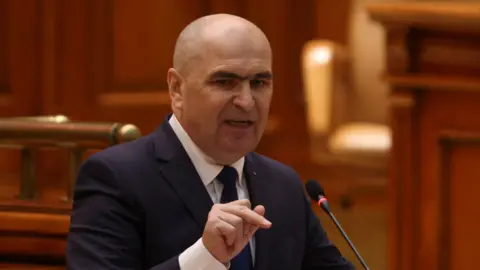
The political dynamics within Romania's parliament have become increasingly complex in recent months, with various factions maneuvering for influence and leverage. The decision by the largest coalition party to pivot toward far-right opposition members indicates a significant shift in parliamentary calculations and power distribution. This realignment raises questions about what concessions or agreements may have been negotiated between these previously opposing political forces. The emergence of such cross-party alliances often signals underlying dissatisfaction with current governance and reflects deeper ideological or strategic divergences.
Romania's political landscape has been marked by considerable fragmentation in recent years, with multiple parties competing for parliamentary representation and governmental influence. The country's electoral system has produced coalition governments that require careful management and consensus-building among diverse political actors. Bolojan's removal demonstrates how quickly support can erode when coalition partners perceive that their interests are not being adequately served. The instability created by his ouster will likely necessitate complex negotiations to form a new governing arrangement that can command parliamentary support.
The implications of this political transition extend beyond the immediate question of who will serve as the next prime minister. The involvement of far-right parties in securing a change of government raises important questions about Romania's democratic institutions and the ideological direction of the nation's politics. The ability of centrist or moderate parties to maintain stable governing coalitions without relying on extremist political forces has become increasingly uncertain. This development may influence Romania's ongoing relationships with European Union institutions and NATO allies, given international concerns about the influence of far-right political movements in Eastern Europe.
The background to this government crisis likely involves disagreements over economic policy, EU relations, or social issues that have proven sufficiently contentious to break apart the ruling coalition. Romania faces significant economic challenges, including inflation concerns and fiscal sustainability issues that any government must address. Different coalition parties may have divergent views on how aggressively to pursue austerity measures, implement reforms, or negotiate with European authorities. These substantive policy differences, combined with the natural friction inherent in multi-party governments, created conditions ripe for the coalition's collapse.
Bolojan's removal through a no-confidence vote represents a formal constitutional mechanism for removing a prime minister when parliamentary support evaporates. This process reflects democratic procedures designed to ensure that governments maintain the confidence of their legislative bodies. However, the manner in which this particular no-confidence vote succeeded—through an unexpected alliance between ruling coalition members and far-right opposition—suggests that procedural regularity may be masking more troubling underlying political trends. The willingness of mainstream parties to cooperate with far-right forces to achieve short-term political objectives may have longer-term consequences for Romania's political culture and institutional stability.
Looking ahead, Romania faces a period of political uncertainty as new governmental arrangements must be negotiated and a new Prime Minister selected. The emerging pattern of cross-party alliances involving far-right groups may shape the composition and direction of the next government. International observers, including EU and NATO officials, will be watching closely to assess whether Romania's political transitions remain grounded in democratic principles and commitment to liberal democratic values. The country's experience in navigating this political crisis may provide important lessons about coalition stability, party discipline, and the risks of democratic erosion in contemporary Europe.
The events surrounding Ilie Bolojan's ouster highlight broader challenges facing coalition governments in fragmented parliaments where no single party commands an absolute majority. Building and maintaining stable governing coalitions requires careful attention to the diverse interests and ideological commitments of member parties. When these differences become irreconcilable, or when political incentives favor realignment, governments can unravel surprisingly quickly despite theoretical commitments to coalition partnerships. Romania's experience demonstrates that even significant political upheavals can occur through formal constitutional procedures, but the underlying instability they reveal warrants serious consideration.
Source: BBC News


