
Science Explains Haunted Houses: Infrasound is the Culprit

New study reveals infrasound from pipes, HVAC systems, and traffic may explain alleged hauntings. Scientists uncover the science behind ghostly feelings.
The inexplicable sensations experienced within allegedly haunted houses may have nothing to do with supernatural entities and everything to do with physics. A groundbreaking new study published in the prestigious journal Frontiers in Behavioral Neuroscience proposes that everyday sources of infrasound—particularly vibrating pipes, mechanical systems, climate control equipment, traffic vibrations, and wind turbines—could be responsible for the eerie feelings people report in supposedly paranormal locations. Rather than ghostly apparitions, the phenomenon appears rooted in acoustic science and human physiology.
Infrasound, which refers to sound frequencies below the threshold of human hearing (typically below 20 Hz), has emerged as a leading scientific explanation for alleged hauntings and paranormal experiences. These low-frequency vibrations, imperceptible to conscious awareness, can trigger profound psychological and physiological responses in individuals exposed to them. The sensations people describe—feelings of dread, unease, or an unseen presence—may actually be their bodies' automatic responses to these invisible acoustic phenomena rather than evidence of supernatural activity.
The scientific pursuit of rational explanations for ghost sightings and hauntings is not new. Researchers have spent decades investigating the psychological and environmental mechanisms that underlie reported paranormal experiences. The work of University of Hertfordshire psychologist Richard Wiseman in 2003 represents a pivotal moment in this research, when he designed comprehensive studies to examine the psychological basis of supposed ghostly encounters. His pioneering work established a methodological framework that continues to influence paranormal research today.

Wiseman's landmark research involved controlled investigations at two historically significant locations with strong paranormal reputations. Hampton Court Palace in Surrey, England, and the South Bridge Vaults in Edinburgh, Scotland, both sites famous for reported supernatural phenomena, served as ideal testing grounds for his hypothesis. Participants were asked to walk through these locations and identify specific areas where they experienced unusual sensations or ghostly presences, then report their findings in detail.
The results of Wiseman's studies revealed a fascinating finding: participants consistently reported experiencing odd phenomena in areas that local folklore and historical accounts had identified as particularly haunted. What made this discovery even more intriguing was that these experiences occurred regardless of whether participants were consciously aware of the sites' haunted reputations. This suggested that something more fundamental than psychological expectation was at work in generating these experiences.
Careful environmental analysis of the locations where participants reported the most intense paranormal sensations uncovered significant variations in physical conditions. These areas exhibited measurable differences in local magnetic fields, fluctuating humidity levels, and inconsistent lighting patterns. Such environmental variables, while subtle, could potentially trigger physiological responses that the human brain interprets as paranormal encounters. The findings pointed toward a complex interplay between environmental physics and human perception.

Building upon decades of research into environmental factors and their psychological effects, scientists have increasingly focused on infrasound as a primary culprit in haunting experiences. Infrasound's ability to create visceral responses without conscious auditory perception makes it an ideal explanation for the mysterious sensations reported in supposedly haunted locations. Unlike visible phenomena or audible sounds, infrasound operates below human sensory thresholds, making it difficult for people to consciously identify or attribute their experiences to a specific cause.
The sources of infrasound in purportedly haunted buildings are often mundane and entirely explainable through mechanical and environmental engineering. Aging pipes that vibrate as water flows through plumbing systems can generate infrasonic frequencies. HVAC units and mechanical ventilation systems, particularly in older buildings, commonly produce low-frequency oscillations. Heavy traffic passing near buildings creates ground vibrations that propagate through structures as infrasound. Even modern wind turbines at considerable distances can produce infrasound that travels miles from their sources.
The psychological and physiological responses triggered by infrasound are well-documented in scientific literature. Research has shown that exposure to infrasound can produce feelings of awe, unease, anxiety, and a sense of an unseen presence—sensations strikingly similar to those reported in haunted locations. The human body appears to have evolved sensitivity to these frequencies, perhaps as an evolutionary adaptation to detect distant hazards like severe weather or geological events. This sensitivity, while potentially protective in ancestral environments, may now cause false alarm responses in modern buildings containing mechanical systems.
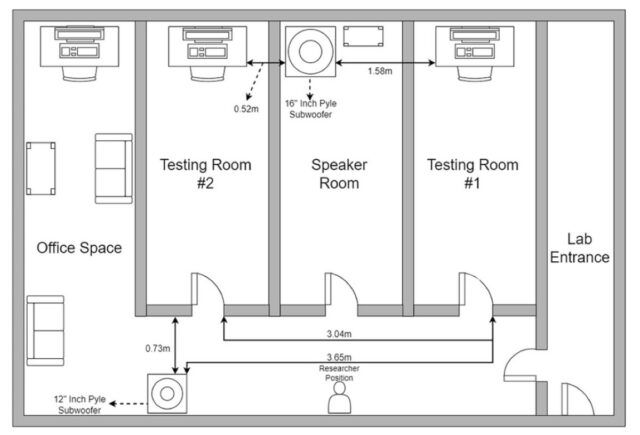
The new comprehensive analysis published in Frontiers in Behavioral Neuroscience synthesizes existing research and presents compelling evidence that infrasound represents the most plausible explanation for the majority of reported haunting experiences. Rather than dismissing people's experiences as purely imaginary or psychological hallucinations, this scientific framework validates their genuine sensations while providing a natural, testable explanation grounded in physics and neuroscience. The study demonstrates that rational science can explain seemingly inexplicable phenomena without invoking supernatural causes.
This research carries important implications for architecture, building design, and occupant health. Understanding the infrasonic characteristics of buildings allows engineers to identify and mitigate problematic low-frequency vibrations through improved insulation, vibration dampening systems, and mechanical equipment placement. For residents and visitors to older buildings with poor acoustic properties, these findings offer reassurance that unsettling sensations are likely caused by environmental factors rather than paranormal presence, potentially reducing anxiety and improving overall well-being.
The convergence of evidence from multiple scientific disciplines—acoustics, neuroscience, psychology, and physics—provides a robust framework for understanding allegedly haunted locations. As scientists continue to investigate the intersection of environmental factors and human perception, the role of infrasound becomes increasingly clear as a primary mechanism underlying paranormal reports. This research exemplifies how rigorous scientific investigation can illuminate mysteries that once seemed supernatural, transforming our understanding of both human perception and the physical world we inhabit.

Looking forward, these findings suggest promising research directions for further investigation. Future studies could employ advanced acoustic monitoring equipment in purportedly haunted locations to directly measure infrasound levels and correlate them with visitor reports of paranormal experiences. Longitudinal studies examining the health effects of chronic infrasound exposure in buildings could provide additional insights into how these low-frequency vibrations affect human physiology and psychology. Additionally, controlled laboratory experiments exposing participants to calibrated infrasound could definitively establish the causal mechanisms by which these vibrations produce the sensation of paranormal presence. Such investigations would further strengthen the scientific foundation for understanding these intriguing phenomena.
Source: Ars Technica

