
Sea Foam on British Coasts: Natural Phenomenon Explained

Discover why sea foam appears along Britain's coastlines. Learn about the natural causes behind this seasonal occurrence and why it's mostly harmless.
During spring and early summer months, beachgoers and coastal residents across Britain frequently encounter an unusual and visually striking phenomenon: thick, frothy foam that accumulates along shorelines or drifts offshore in distinctive ribbons and clusters. At first glance, this peculiar substance often triggers concern among observers, who frequently jump to conclusions about its origins. Many assume the foam must be the result of industrial pollution, untreated sewage discharge, or other forms of environmental contamination. However, marine scientists and environmental experts have long confirmed that this sea foam is actually a completely natural occurrence that plays an important role in coastal ecosystems.
The scientific explanation behind this seasonal phenomenon is rooted in basic marine biology and chemistry. As water temperatures begin to rise in April and May, vast colonies of marine algae initiate their growth cycle, taking advantage of warmer conditions and increased sunlight penetration. The most prevalent species responsible for this phenomenon is phaeocystis, a type of algae that produces considerable quantities of organic material. Despite its somewhat ominous appearance when concentrated in foam, phaeocystis algae is entirely non-toxic and serves as a vital component of the marine food chain, providing essential nutrients for numerous species of fish, crustaceans, and other marine organisms.
Understanding the chemistry behind foam formation is essential to comprehending why this natural process occurs so reliably each year. When algal blooms reach their peak and eventually begin to decline, the decaying organic material releases compounds with unique surfactant properties—these are substances that function similarly to household soap or detergent. These natural surfactants work by fundamentally altering the surface tension of seawater, making it easier for the water to form bubbles and foam. The combination of wave action, wind energy, and these surfactant-rich organic compounds creates the characteristic accumulations of foam that wash ashore or remain suspended in offshore waters.
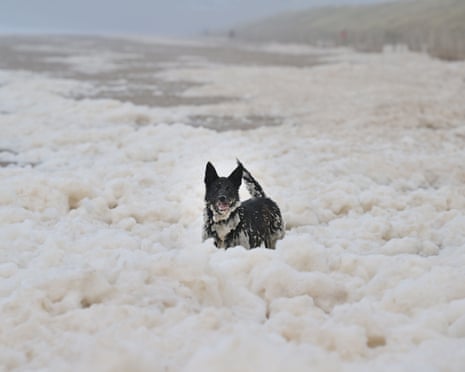
The timing of this phenomenon is remarkably consistent and predictable, occurring primarily during the warmer months when conditions are most favorable for algal growth. Coastal areas throughout Britain, from the English Channel to the North Sea and beyond, experience these seasonal foam events with regularity. The coastal foam events are often most pronounced during periods of calm weather or moderate wave action, as these conditions allow the foam to accumulate and concentrate rather than dissipate rapidly. Various beaches and harbors have developed something of a reputation for particularly impressive displays, with some locations seeing more substantial accumulations than others depending on local current patterns and bathymetry.
Environmental and public health authorities have conducted extensive research into the composition and safety of sea foam to address public concerns. These investigations have consistently demonstrated that the foam poses minimal risk to human health or the marine environment. The foam does not contain harmful pathogens, toxic chemicals, or dangerous pollutants that would warrant public health warnings or beach closures. This scientific consensus has helped educate the public about the distinction between this natural phenomenon and genuine pollution events that do occasionally occur and require immediate environmental response.
The ecological importance of this annual event extends far beyond its aesthetic properties. The algal bloom phenomenon serves several critical functions within coastal marine ecosystems. The organic compounds released during bloom decay provide essential energy sources for microscopic organisms that form the foundation of marine food webs. These microorganisms, in turn, support larger creatures including fish populations that are important both for ecological balance and for commercial and recreational fishing industries. The nutrient cycling that occurs during these events helps maintain the overall health and productivity of coastal waters.
Different coastal regions may experience variations in the intensity and frequency of sea foam events based on local environmental conditions. Water temperature, nutrient levels, salinity, and prevailing current patterns all influence how vigorously algal blooms develop in any particular location. Some areas with particularly nutrient-rich waters or favorable temperature regimes may experience more dramatic blooms than others. These regional variations have been documented by marine researchers who monitor algal activity and foam development throughout the year as part of their environmental assessment work.
Public perception and education regarding natural coastal phenomena remain important priorities for environmental organizations and government agencies. Distinguishing between natural sea foam and foam resulting from genuine pollution requires public awareness and understanding of marine science. When unusual foam events do occur—whether truly unusual in composition or simply unexpected in scale—reporting mechanisms allow concerned citizens to inform authorities while reducing unnecessary alarm about benign natural processes. This collaborative approach between the public and environmental professionals helps ensure that genuine pollution events receive prompt attention while harmless phenomena are properly understood.
The appearance of this seasonal phenomenon continues to fascinate both scientists and casual observers alike. The dramatic visual effect created by masses of white foam against dark water or sand provides compelling photographic opportunities and serves as a visible reminder of the dynamic natural processes constantly occurring in coastal environments. Many people who initially found the foam appearance unsettling have come to appreciate it as an interesting natural spectacle once they understand its origins and harmless nature. This shift in perspective demonstrates the value of scientific communication in reducing unnecessary public anxiety about environmental occurrences.
Looking forward, continued monitoring of coastal algal blooms and foam events will provide valuable data about how climate change and other environmental factors influence these natural cycles. Scientists remain interested in tracking whether the timing, intensity, or composition of seasonal blooms is shifting over time. Understanding these long-term trends helps researchers better comprehend how marine ecosystems respond to environmental changes and how these responses might cascade through interconnected biological systems. This ongoing research contributes to broader efforts to understand and protect coastal marine environments.
For coastal residents and visitors who encounter sea foam on beaches during warmer months, the appropriate response is one of scientific curiosity rather than alarm. These natural displays of coastal ecology serve as visible demonstrations of the living systems that sustain marine life and support human communities that depend on healthy seas. Rather than representing environmental degradation, this seasonal phenomenon actually represents normal, healthy ecosystem functioning. With proper understanding of the science behind this striking natural occurrence, what once appeared sinister becomes recognizable as simply another fascinating aspect of the natural world that surrounds Britain's extensive coastlines.
Source: The Guardian


