
Supreme Court Weighs In on Mail-In Ballots Ahead of Midterms

The U.S. Supreme Court is hearing arguments on a case that could impact how late-arriving mail-in ballots are counted in over a dozen states during the upcoming midterm elections.
The U.S. Supreme Court is hearing a pivotal case that could have significant implications for the upcoming midterm elections. The case, Watson v. Republican National Committee, focuses on a Mississippi state law that allows mail-in ballots to be counted if they arrive within five business days of election day, as long as they were postmarked by election day.
This law is similar to those in 14 other states, Washington D.C., and three U.S. territories, which also permit late-arriving mail-in ballots to be counted. The Republican National Committee (RNC) has challenged the Mississippi law, arguing that it creates an unfair advantage for Democrats who may be more likely to use mail-in voting.
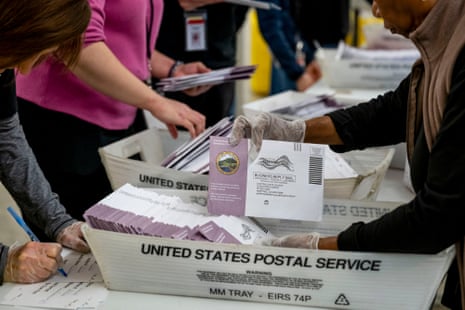
The Supreme Court's decision in this case could have far-reaching consequences for the midterm elections, where control of Congress hangs in the balance. Voter turnout and the integrity of the electoral process are at the heart of the debate, as the justices weigh the balance between accessibility and security in the voting system.
The case highlights the ongoing political divisions and partisan battles over mail-in voting, which became a prominent issue during the 2020 presidential election due to the COVID-19 pandemic. Proponents of the late-arriving ballot laws argue they help ensure all eligible votes are counted, while opponents contend they open the door to potential fraud and irregularities.
As the Supreme Court considers its ruling, the outcome could have significant implications for the midterm elections and the future of mail-in voting in the United States. The case has drawn intense interest from both political parties, as well as election experts and advocacy groups, who are closely watching the proceedings and awaiting the Court's decision.
Regardless of the Supreme Court's ruling, the issue of mail-in voting is likely to remain a contentious and divisive topic in the political landscape. The integrity of the electoral process and the ability of all eligible voters to participate will continue to be at the forefront of the debate, as the nation grapples with the evolving landscape of voting in the digital age.


