
Surprising Medical Miracle: Woman Sneezes Out Maggots From Trapped Fly Larvae

A 58-year-old woman in Greece developed a rare parasitic infestation, growing a sheep bot fly larvae in her nose for an unusually long period of time.
A 58-year-old woman in Greece appears to hold the record for growing a parasitic sheep bot fly in her nose the longest, almost creating a snot rocket that could literally fly. Usually, when the sheep bot fly accidentally nosedives into a human's schnoz, the first-stage larvae they deliver don't actually develop. In contrast, in its normal target—a sheep's nose— the larvae would move up into the sinuses, feed, grow, and molt into second- and third-stage larvae. From there, the flies (Oestrus ovis) drip from the nose onto the ground, burrow into the soil, pupate, and emerge as adult flies.
For a long time, experts thought that the flies couldn't complete their development in humans beyond the first larval stage. But a few human cases have been reported in recent decades involving the second- and third-stage larvae. The woman's case, reported in the Journal of Emerging Infectious Diseases by a medical entomologist and colleagues, goes the furthest yet, finding pupa and a puparium—the hard casing of a pupa—in the woman's nose.

The unusual case highlights how, in rare instances, these parasitic flies can complete their full life cycle within a human host, rather than their typical sheep targets. The woman's deviated septum likely played a role, trapping the larvae and allowing them to continue developing inside her nasal cavity.
Fortunately, the woman eventually sneezed out the maggots and puparium, marking the end of her unexpected parasitic infestation. This remarkable medical case serves as a reminder of the surprising and adaptable nature of some parasites, as well as the importance of seeking prompt medical attention for any unusual nasal symptoms.

The sheep bot fly, known scientifically as Oestrus ovis, is a common parasite of sheep and goats across the Mediterranean region, the Middle East, and parts of Asia. While humans are an accidental host, cases of nasal myiasis (the medical term for a parasitic fly infestation in the nose) have been reported worldwide, though they remain quite rare.
In the woman's case, the medical team hypothesized that her deviated septum may have played a role in trapping the first-stage larvae and allowing them to continue developing, rather than being expelled. This anatomical quirk provided the ideal environment for the parasites to thrive, something that doesn't typically occur in humans.
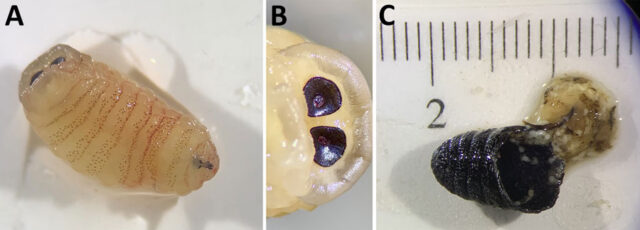
The case highlights the need for prompt medical attention and thorough examination whenever individuals experience unusual nasal symptoms, as parasitic infestations, though rare, can have serious health consequences if left untreated. By seeking medical care and undergoing appropriate diagnostic tests, the woman was able to successfully resolve her unexpected and unsettling parasitic infestation.
Source: Ars Technica


