
Swinney Plans Alliance With Nationalist Devolved Leaders

SNP leader John Swinney aims to coordinate with Wales and Northern Ireland nationalist leaders to challenge Labour's cost of living and spending policies.
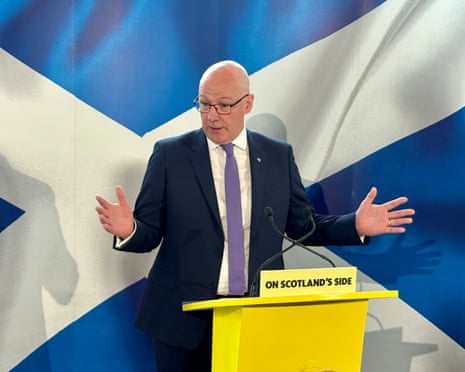
John Swinney, the newly confirmed leader of the Scottish National Party, has announced his intention to forge a strategic partnership with nationalist first ministers across the United Kingdom's devolved administrations. This coordinated approach represents a significant development in how devolved governments in Scotland, Wales, and Northern Ireland plan to challenge the Labour government's policies regarding the cost of living crisis and overall UK government spending priorities.
The SNP leader emphasized that this collaboration aims to ensure the collective voices of Scotland, Wales, and Northern Ireland are heard with unmistakable clarity in Westminster debates and policy discussions. Swinney's commitment to this partnership underscores the growing importance of nationalist movements within the devolved administrations and their desire to present a unified front when advocating for their respective nations' interests.
In a significant gesture of goodwill and political alignment, Swinney spoke directly with Michelle O'Neill, the Sinn Féin first minister of Northern Ireland, on Friday evening. O'Neill had reached out to congratulate the SNP on achieving what many observers characterized as an "emphatic" victory in the recent Holyrood elections, which solidified the party's dominant position in the Scottish Parliament.
The timing of this coordination is particularly noteworthy given the broader political landscape in the UK. With Labour's recent ascent to power at Westminster, devolved nationalist parties perceive both challenges and opportunities in the current political environment. The Scottish National Party, which has long championed Scottish independence while operating within the devolved settlement, sees value in demonstrating how devolved nationalism can create practical alliances across different regions.
O'Neill's outreach to Swinney reflects a recognition among nationalist leaders that their electoral successes can be leveraged more effectively through coordinated action. Sinn Féin's significant political position in Northern Ireland, combined with the SNP's dominance in Scotland, creates a formidable coalition that cannot be easily ignored by any Westminster government. This partnership also serves to reinforce the distinctiveness of each nation's political priorities within the broader UK context.
The focus on cost of living policies and UK government spending represents areas where nationalist parties believe Labour's approach may diverge from the needs and expectations of their constituents. The energy crisis, healthcare funding, education investment, and social welfare provisions have all become flashpoints where devolved administrations argue they have distinct needs that reflect their specific demographic and economic circumstances.
Swinney's approach signals a shift toward more proactive engagement from the devolved nationalist parties in shaping UK-wide policy discussions. Rather than remaining on the periphery of Westminster politics, the SNP leader is positioning nationalist parties as essential stakeholders whose perspectives deserve consideration when the Labour government formulates major policy initiatives. This assertiveness reflects confidence gained from recent electoral performances and a clearer strategic vision for how devolved nationalism can influence UK politics.
The relationship between the SNP and Sinn Féin has historically been cordial, with both parties sharing ideological commitments to their respective nations' self-determination, though through different constitutional pathways. The SNP pursues Scottish independence within a framework of constitutional referendums and parliamentary sovereignty, while Sinn Féin advocates for Irish reunification through a combination of electoral strength and constitutional mechanisms. Despite these differences in approach, common cause can be found in resisting what they perceive as Westminster-centric policymaking.
Wales, represented by Plaid Cymru as another key nationalist party in the devolved landscape, represents the third pillar of this proposed partnership. Plaid Cymru, which has seen variable electoral fortunes compared to its Scottish and Northern Irish counterparts, nonetheless represents a significant voice for Welsh interests and independence aspirations. The inclusion of all three nationalist parties in this coordination framework demonstrates ambition to create a truly comprehensive alternative to both Labour and Conservative approaches to devolved governance.
From a practical standpoint, this coordination among devolved nationalist leaders can manifest in several ways. Joint statements on policy positions, coordinated parliamentary responses, shared policy development initiatives, and unified media campaigns all become possible when parties commit to working together on issues of mutual concern. Such coordination can amplify the impact of devolved voices while also creating logistical and strategic advantages that smaller parties might struggle to achieve independently.
The current political moment appears conducive to such partnership-building. With a Labour government newly established at Westminster, the devolved nationalist parties have an opportunity to establish their presence and influence early in the parliamentary cycle. This early engagement can shape Labour's thinking on devolved issues and ensure that the particular circumstances and priorities of Scotland, Wales, and Northern Ireland receive appropriate attention and resources.
Swinney's overture also represents an implicit acknowledgment that devolved administration coordination can be more effective than individual parties operating in isolation. The economies of scale, shared expertise, and combined political leverage that comes from coordinated action benefit all participants. For the SNP, collaboration with other nationalist parties reinforces its leadership role within the devolved nationalist movement while avoiding the appearance of Scottish parochialism.
The emphasis on ensuring voices "are heard loud and clear" suggests Swinney is committed to making this partnership both substantively meaningful and visibly prominent. This could involve regular bilateral and trilateral meetings, coordinated approaches to major policy announcements, joint advocacy campaigns on key issues, and perhaps even formal mechanisms for ongoing consultation and cooperation. The goal appears to be creating a recognizable bloc within UK politics that demands attention and respect.
As this partnership develops, observers will watch to see how effectively these nationalist parties can translate their devolved electoral strength into meaningful influence over Westminster policy decisions. The success of this initiative will likely depend on their ability to maintain unity on key issues while respecting their distinct constitutional positions and individual national contexts. The coming months will reveal whether this ambitious coordination framework can deliver tangible benefits to Scotland, Wales, and Northern Ireland.
Source: The Guardian


