
Trump Dodges Taiwan Defense Commitment in Xi Meeting

Trump reveals Xi Jinping directly asked about US Taiwan defense commitment. Discover what the former president disclosed about their conversation.
Former President Donald Trump has disclosed new details about a direct exchange with Chinese President Xi Jinping regarding the contentious issue of Taiwan defense commitments. According to Trump's account, Xi posed a pointed question to him concerning whether the United States would intervene militarily to protect Taiwan, a self-governing island that Beijing considers a breakaway province. Trump's response to this critical geopolitical inquiry has now become a subject of scrutiny and analysis among foreign policy experts and political observers.
In recounting the interaction, Trump stated that he deliberately avoided making any definitive pledge either in support of or against Taiwan military intervention. When pressed by Xi on the matter, Trump indicated that his standard approach to sensitive negotiations is to maintain ambiguity rather than publicly commit to specific courses of action. "I don't talk about that," Trump recalled telling the Chinese leader, suggesting he deflected the question as a negotiating tactic. This response reflects Trump's broader philosophy of maintaining strategic unpredictability in international dealings.
The exchange between the two leaders underscores the complexity of US-China relations and the particular sensitivity surrounding Taiwan's status. The question of whether America would defend Taiwan has long been a critical point of tension between Washington and Beijing. Under the Trump administration, this issue took on heightened importance as the former president pursued a more confrontational approach toward China on trade, technology, and military matters.
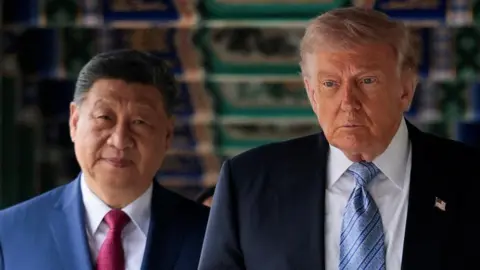
Trump's disclosure that he made "no commitment either way" on the Taiwan question suggests a deliberate strategy of strategic ambiguity, a posture that some analysts argue has long been central to American foreign policy regarding the island. This approach aims to maintain deterrence against Chinese military action while avoiding an explicit security guarantee that could be viewed as unnecessarily provocative. However, others contend that such ambiguity creates dangerous uncertainty that could lead to miscalculation during a crisis.
The significance of Trump's reported response lies in what it reveals about his negotiating style and his perspective on managing great-power competition with China. Rather than offering reassurance to Taiwan or making explicit threats toward Beijing, Trump's approach was to keep both sides guessing about his true intentions. This method reflects a transactional worldview in which leverage is derived from unpredictability and a reluctance to reveal one's hand in advance.
Throughout his presidency and in the years since leaving office, Trump has consistently advocated for a more hardline approach toward China while simultaneously maintaining the possibility of direct negotiation. His stance on Taiwan has reflected this duality, criticizing China's actions while also suggesting that the island's defense was ultimately not America's primary responsibility. This nuanced position has generated considerable debate among foreign policy professionals regarding its practical implications for regional stability.
The Taiwan defense debate has become increasingly urgent in recent years as China has pursued a more assertive military posture toward the island. Reports of escalating military exercises and the modernization of China's military capabilities have intensified concerns about potential conflict. In this context, clarity regarding American security commitments has taken on greater importance for regional allies and for Taiwan's government.
Trump's revelation of his conversation with Xi provides insight into how the former president approached one of the most consequential geopolitical questions facing the United States. His preference for maintaining strategic ambiguity on Taiwan contrasts with the clearer security commitments that other American policymakers have articulated. This difference in approach reflects broader philosophical divisions within the foreign policy community about how best to deter Chinese aggression while minimizing the risk of conflict escalation.
The implications of Trump's reported position extend beyond his personal views and potentially influence current policy discussions. Many observers have noted that the question of Taiwan defense remains unresolved despite decades of diplomatic engagement between the United States and China. Trump's refusal to commit definitively in either direction mirrors the ambiguity that has characterized much of post-Cold War American policy on the issue.
Foreign policy experts have offered varied interpretations of Trump's approach. Some argue that maintaining flexibility and refusing to telegraph intentions is a sound strategy that preserves American options and prevents China from planning its moves based on assumed American responses. Others contend that such ambiguity is increasingly untenable given the changed military balance in the region and the growing Chinese challenge to the status quo.
The broader context of Trump's statement involves the complex history of American commitments to Taiwan and the careful diplomatic language that has traditionally surrounded this relationship. Unlike NATO allies, Taiwan does not benefit from an explicit security treaty, though the United States has maintained a decades-long commitment to provide defensive weapons. Trump's refusal to go further in committing to Taiwan's defense aligns with this technically ambiguous framework while potentially signaling a greater distance from the island's security than some Taiwan supporters had hoped.
Looking forward, Trump's disclosure of his negotiating position on Taiwan provides important context for understanding how the former president viewed American interests and responsibilities in the Asia-Pacific region. His emphasis on maintaining unpredictability and avoiding explicit commitments reflects a particular school of thought within American foreign policy that prioritizes flexibility and leverage over transparency and reassurance. As tensions continue to simmer across the Taiwan Strait, such questions about American commitment to Taiwan remain highly relevant to policymakers and strategists.
The revelation also raises questions about how Trump's approach to the Taiwan question might inform any future negotiations with Chinese leadership should he return to higher office. His track record of pursuing direct negotiations with adversaries, combined with his preference for keeping options open, suggests that any future Trump administration would likely maintain similar strategic ambiguity. This approach stands in contrast to the Biden administration's increasingly explicit statements of commitment to Taiwan's defense and democratic system.
Source: BBC News


