
Trump Stokes Controversy with Pearl Harbor Comparison

President Trump faced backlash after comparing US strikes on Iran to the devastating 1941 Japanese attack on Pearl Harbor during a meeting with Japan's Prime Minister.
In a controversial move, President Trump recently drew parallels between US military strikes on Iran and the deadly 1941 Japanese attack on Pearl Harbor that led to the United States' entry into World War II. The remarks came during a meeting with Japanese Prime Minister Shinzo Abe, raising eyebrows and sparking widespread criticism.
The president's comments were made as part of a broader discussion about rising tensions with Iran following attacks on oil tankers in the Strait of Hormuz and the downing of a US drone by Iranian forces. Trump suggested that the US strikes on Iran could be viewed as a modern-day version of the Japanese assault on Pearl Harbor, which killed over 2,400 American servicemembers and propelled the US into World War II.
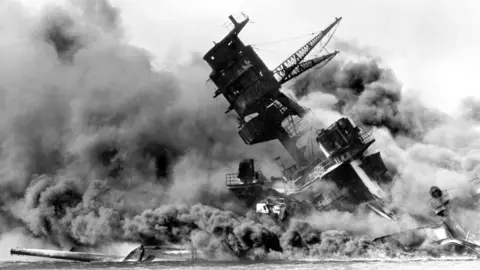
The Pearl Harbor comparison immediately drew backlash from lawmakers and foreign policy experts, who condemned the president's remarks as insensitive and historically inaccurate. Critics argued that Trump's analogy minimized the tragic loss of life at Pearl Harbor and mischaracterized the current tensions with Iran as an act of war comparable to the Japanese attack.
In response, the White House defended the president's comments, stating that Trump was simply drawing parallels between the unprovoked nature of the two events. However, many found the comparison deeply troubling, given the vastly different circumstances and the immense human toll of the Pearl Harbor attack.
The controversy surrounding Trump's Pearl Harbor remarks underscores the delicate nature of diplomatic relations and the importance of historical context when discussing international conflicts. As tensions continue to escalate between the US and Iran, the president's choice of words will likely face increased scrutiny and demand for greater sensitivity from both domestic and global audiences.

Source: BBC News


