
UAE Exit Impact: 5 Charts Show OPEC's Oil Price Future

Explore how UAE's departure from OPEC could reshape the cartel's influence over global oil prices. Data-driven analysis reveals significant implications.
The United Arab Emirates' decision to exit OPEC represents one of the most significant developments in the organization's recent history, with far-reaching implications for global energy markets and the cartel's ability to influence oil prices worldwide. As one of the world's largest oil producers and a key player within the organization for decades, the UAE's departure signals shifting dynamics within OPEC and raises critical questions about the cartel's future relevance in an increasingly complex energy landscape. Understanding the potential consequences of this historic move requires careful examination of production data, market share distributions, and the underlying factors that have shaped OPEC's influence over international petroleum markets.
The UAE has long been a cornerstone of OPEC's operational framework, contributing significantly to the cartel's collective output and strategic decision-making processes. With production capabilities that consistently rank among the highest within the organization, the Emirati withdrawal removes a substantial volume of crude oil from OPEC's coordinated production management strategy. This loss of productive capacity directly impacts the cartel's ability to manipulate supply levels, which has historically been its primary mechanism for controlling global oil market dynamics. The departure also eliminates a voice that has often advocated for production increases and more aggressive market strategies compared to other member states.
One of the most critical aspects of analyzing this departure involves examining OPEC production capacity before and after the UAE's exit. Charts tracking production volumes reveal that the organization's total output capacity experiences a meaningful reduction without the UAE's contribution. This reduction becomes particularly significant when considering OPEC's historical role in balancing global oil supply and demand. The loss of productive flexibility that the UAE provided means OPEC has fewer options when attempting to stabilize markets during periods of supply disruptions or demand fluctuations. Smaller member states, while valuable contributors, simply cannot compensate for the loss of a major producer's production flexibility and reserve capacity.
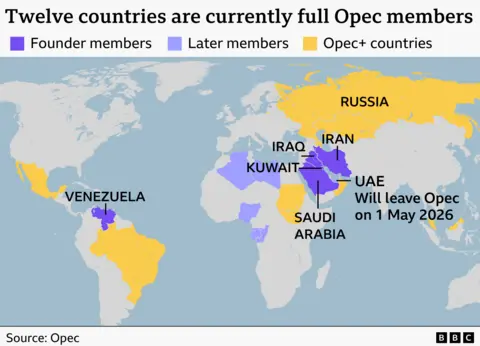
Market share analysis provides another essential lens through which to understand this development's implications. The UAE's withdrawal represents a loss of approximately 3-4% of OPEC's total production capacity, depending on current output levels and production agreements. When visualized through comparative charts, this percentage appears modest on its surface, yet the strategic implications prove far more substantial. The remaining member states will need to absorb greater responsibility for any coordinated production adjustments, increasing the political complexity of collective decision-making. Smaller producers now carry proportionally more weight in production cut decisions, potentially leading to more contentious negotiations and less unified policy implementation across the organization.
The OPEC cartel's influence over global oil prices has historically depended on its ability to act as a unified bloc capable of controlling supply quantities. This power derives directly from the combined production capacity of member states and their willingness to coordinate production decisions for collective benefit. Charts illustrating OPEC's historical influence on crude oil prices demonstrate a clear correlation between coordinated production decisions and subsequent price movements. However, without the UAE's productive capacity and political support for certain strategies, OPEC's leverage diminishes incrementally. The organization becomes less able to orchestrate the large-scale production adjustments that previously allowed it to shape global petroleum markets according to member interests.
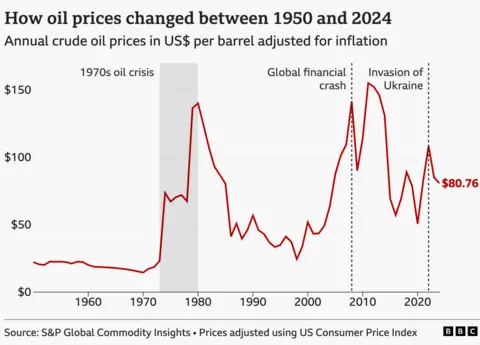
Revenue implications for remaining OPEC members emerge as another significant consideration visible through financial analysis charts. While individual member states might benefit from higher oil prices resulting from reduced overall supply, the organizational weakening threatens long-term price stability and predictability. The UAE's departure signals potential instability within OPEC, which itself can create market uncertainty and volatility. Paradoxically, this uncertainty might temporarily support higher prices as markets price in concerns about future supply disruptions and OPEC's reduced coordination capacity. However, sustained price increases become harder to achieve without the UAE's cooperation and productive capacity backing any production restriction agreements.
Geopolitical considerations add layers of complexity to this analytical framework. Charts tracking OPEC membership stability over the past fifty years show that member departures remain exceptionally rare events, making the UAE's exit particularly noteworthy from a historical perspective. The UAE's decision reflects broader tensions within OPEC regarding production quotas, revenue distributions, and strategic direction. The organization has struggled with internal discord for years, particularly between Saudi Arabia and other member states regarding appropriate output levels. The UAE's exit crystallizes these underlying tensions and demonstrates that even wealthy Gulf producers now question whether OPEC membership serves their individual national interests adequately.
Future oil market stability depends significantly on how remaining OPEC members adapt to the organization's reduced capacity and influence. Some analytical charts project potential scenarios for global crude prices under various production adjustment possibilities. Without the UAE's participation, OPEC loses a crucial moderating voice that often sought balanced approaches between aggressive production cuts and market-friendly increases. The remaining membership includes states with vastly different economic structures, fiscal requirements, and strategic objectives. Saudi Arabia's ability to anchor OPEC policy becomes even more critical, yet its authority to enforce coordination without consensus from all members faces increased challenges.
Non-OPEC producers and international energy markets will likely experience significant shifts resulting from this departure. Charts showing the relationship between OPEC and non-OPEC production illustrate how the cartel's market share has declined over recent decades due to increasing alternative supply sources. The UAE's exit accelerates this trend of declining OPEC dominance in global petroleum markets. Shale oil producers in North America, deepwater extraction operations, and renewable energy investments increasingly compete with OPEC crude for global market share. As OPEC's unified influence weakens, these alternative suppliers gain relative importance in global energy price determination, potentially fundamentally reshaping how petroleum markets operate.
The implications for global oil price forecasting models prove substantial when analyzing how this departure affects analytical frameworks. Energy economists and petroleum market analysts must revise their assumptions about OPEC's capacity to influence crude prices through coordinated action. Historical models relied heavily on assumptions about OPEC's unified decision-making and sufficient productive capacity to move global markets meaningfully. The UAE's exit requires recalibration of these models to account for reduced OPEC cohesion and lower aggregate supply control. Forecasts for long-term petroleum prices become less dependent on OPEC policy decisions and more responsive to fundamental supply-demand dynamics and geopolitical developments outside the organization's control.
Looking forward, the UAE's departure from OPEC represents a watershed moment for the organization and global energy markets. Charts examining potential evolutionary paths for the cartel suggest several possible futures, ranging from organizational reformation with renewed focus and discipline to gradual institutional irrelevance. The remaining member states face critical decisions about whether to strengthen OPEC through policy reforms or accept the organization's declining significance in global petroleum markets. The UAE's exit may ultimately prove catalytic, either prompting transformative changes within OPEC or accelerating its transition into a less influential force in international energy affairs. Energy policymakers, investors, and analysts will monitor these developments closely as the global economy continues its complex transition toward more diversified energy sources while still dependent on petroleum products for the foreseeable future.
Source: BBC News


