
Underwater Speakers Revive Jamaica's Dying Coral Reefs

Divers install waterproof speakers on Jamaica's seafloor to restore dying coral reefs. Discover how sound technology offers hope for marine conservation.
The turquoise waters of Jamaica's northern coast, once famously featured as a backdrop in the James Bond film No Time to Die, are now the setting for an innovative and unconventional marine conservation effort. Beneath the surface of these picturesque Caribbean waves, a dedicated team of divers is executing a groundbreaking mission to rescue a severely deteriorating coral reef ecosystem from complete collapse. This ambitious project represents a paradigm shift in how marine biologists approach coral restoration and reef rehabilitation.
The most striking aspect of this conservation initiative is the use of underwater speakers deployed on the seafloor—a tool that defies conventional expectations of marine biology equipment. Rather than relying solely on traditional restoration methods such as coral transplantation or water quality management, this team has embraced sound technology as a vital component of their reef recovery strategy. The unconventional nature of the approach has garnered significant attention from environmental organizations, marine scientists, and conservation advocates worldwide.
Notably, the driving force behind this innovative effort is not a traditional marine scientist, but rather a visionary who has recognized the potential of acoustic ecology in marine restoration. This leadership approach has brought fresh perspectives to the field of reef conservation, demonstrating that breakthrough solutions often come from outside the conventional scientific establishment. The team's willingness to experiment with new methodologies reflects a broader shift in environmental science toward adaptive and creative problem-solving strategies.
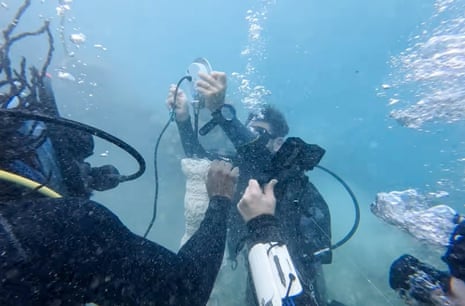
The scientific principle underlying this underwater acoustic intervention is rooted in established research about coral larvae behavior and recruitment. Studies have shown that healthy coral reef soundscapes—characterized by the crackling and popping sounds produced by snapping shrimp, fish communication, and other marine life—play a crucial role in attracting coral larvae to suitable settlement sites. When reefs degrade due to pollution, warming waters, or disease, the acoustic environment changes dramatically, creating a silent underwater landscape that fails to attract new coral growth. By reintroducing these natural sounds through waterproof speakers, the team aims to recreate the acoustic conditions that encourage coral larval settlement and reef regeneration.
Coral reef restoration has become increasingly critical as these ecosystems face unprecedented threats from climate change, ocean acidification, and human-induced pollution. The degradation of coral reefs represents one of the most pressing environmental challenges of our time, with implications for marine biodiversity, fisheries, and the livelihoods of millions of people who depend on healthy reef ecosystems. Jamaica's reefs, in particular, have suffered significant damage over the past decades, with some areas experiencing mortality rates exceeding 80 percent due to disease, algal overgrowth, and environmental stressors.
The deployment of these waterproof speakers in Jamaica represents a tangible application of acoustic restoration techniques that have shown promising results in pilot studies across other reef systems. Previous research conducted in Australia, the Maldives, and Southeast Asia demonstrated that amplifying natural reef sounds through speakers could increase coral larval settlement by up to 40 percent in treated areas compared to control zones. These encouraging findings provided the scientific foundation for scaling up acoustic restoration efforts to larger reef systems, such as the one being addressed in Jamaica.
The technical implementation of this project involves several sophisticated considerations. The speakers must be waterproof, durable enough to withstand harsh marine conditions including salt corrosion, high pressure, and strong currents, and capable of producing frequencies that match natural reef soundscapes. Additionally, the audio equipment must be carefully calibrated to avoid creating unnatural acoustic conditions that could potentially stress other marine organisms or disrupt existing communication patterns among reef inhabitants. The team has invested considerable effort in selecting and testing equipment that meets these stringent requirements.
Beyond the immediate challenge of equipment installation, the project encompasses a comprehensive approach to marine ecosystem recovery. The acoustic intervention is being implemented alongside complementary conservation strategies, including water quality monitoring, algae management, and targeted removal of invasive species that threaten coral survival. This integrated approach recognizes that while sound technology can facilitate coral larval recruitment, it cannot address the underlying environmental stressors that caused reef degradation in the first place. Tackling these root causes remains essential for long-term reef sustainability and recovery.
The funding and organizational structure supporting this initiative reflects growing recognition of the urgency surrounding coral conservation. Environmental organizations, marine research institutions, and philanthropic bodies have combined their resources to support the Jamaica project, acknowledging that innovative approaches deserve investment and experimentation. This collaborative funding model has enabled the team to deploy multiple speaker systems across different zones of the reef, creating what essentially amounts to a carefully designed acoustic intervention experiment at an unprecedented scale.
The broader context of climate change impact on coral reefs cannot be overlooked when evaluating the significance of this initiative. Rising ocean temperatures have triggered mass coral bleaching events globally, with 2023-2024 witnessing one of the most severe bleaching episodes on record. Ocean acidification—a consequence of increased atmospheric CO2 absorption—weakens coral skeletons and makes it more difficult for new corals to establish themselves. In this challenging environmental context, interventions like acoustic restoration offer a glimmer of hope, even if they cannot completely reverse the damage caused by systemic climate change.
The team's work also carries important implications for understanding how marine organisms perceive and interact with their acoustic environment. The realization that reef soundscapes function as a crucial sensory cue for coral larvae has profound implications for how we conceptualize marine ecosystems and the multiple layers of complexity within them. This acoustic dimension of reef ecology had been largely overlooked in traditional conservation approaches, making its integration into restoration efforts a meaningful evolution in marine biology practice.
Local communities in Jamaica have expressed strong support for the initiative, recognizing that healthy coral reefs provide essential ecosystem services including fish habitat, coastal protection from storms, and tourism revenue. The project has catalyzed increased public awareness about reef conservation challenges and generated enthusiasm for science-based environmental solutions. Community engagement has proven crucial for the project's success, as local support helps ensure long-term monitoring and maintenance of the underwater speaker systems.
Moving forward, the team plans to expand monitoring efforts to measure the project's effectiveness in promoting coral larval recruitment and overall reef recovery. They will track biodiversity changes, measure coral growth rates, and assess how the acoustic intervention influences the behavior and recruitment patterns of other reef-associated organisms. These comprehensive monitoring protocols will generate valuable data that can inform acoustic restoration strategies in other vulnerable reef systems worldwide.
The Jamaica coral reef project exemplifies how conservation innovation and scientific creativity can address some of our most pressing environmental challenges. By combining cutting-edge acoustic technology with deep understanding of reef ecology, the team has developed an intervention that offers genuine potential for helping this ecosystem recover. While the long-term success of this initiative remains to be determined, the project already represents a significant step forward in demonstrating that creative, science-based approaches can complement traditional conservation efforts in fighting the battle to save the world's coral reefs.
Source: The Guardian


