
Unearthing the Oldest Written Traces of Humanity

Groundbreaking discovery pushes back the origins of written communication by thousands of years, shedding new light on the evolution of human civilization.
A remarkable archaeological finding has shaken the foundations of our understanding of the origins of written language. Researchers have uncovered evidence suggesting that the first attempts at recording human thoughts and ideas may date back 40,000 years - significantly earlier than previously believed.
The discovery, made by an international team of archaeologists and linguists, centers on a collection of engraved objects found in various sites across Europe and Asia. These ancient artifacts, including tools, bones, and pieces of ivory, bear intricate markings that appear to represent the earliest forms of symbolic communication.

According to the lead researcher, Dr. Amelia Wilkins, the markings on these objects are not merely decorative but likely represent a rudimentary writing system used by Stone Age people to convey information, ideas, and even stories. "These engravings suggest a level of cognitive development and social organization that we previously thought emerged much later in human history," Wilkins explained.
The team's analysis of the artifacts has uncovered patterns and repetitions in the markings, hinting at the possibility of a proto-writing system that predates the earliest known writing systems, such as Sumerian cuneiform and Egyptian hieroglyphics, by several millennia.
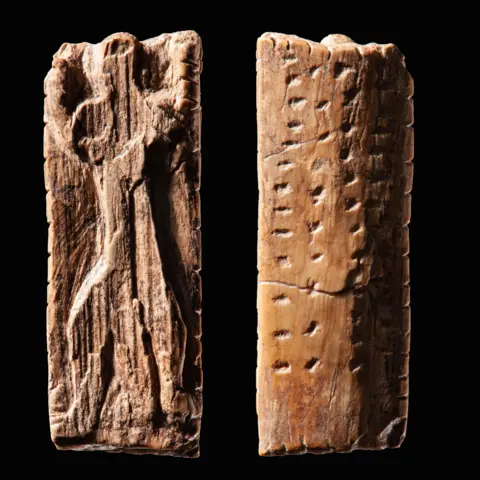
"This discovery has the potential to rewrite the history of human civilization," said Dr. Liam Donovan, a linguist and co-author of the study. "If these markings are indeed a form of written communication, it would push back the origins of literacy by tens of thousands of years, fundamentally changing our understanding of how human societies evolved and developed."
The researchers caution that further study and analysis will be necessary to definitively confirm the nature and purpose of the markings. However, the preliminary findings have already generated significant excitement and debate within the scientific community, with many eager to uncover more clues about this potentially groundbreaking development in the human story.

As the research continues, the implications of this discovery could have far-reaching consequences for our understanding of the cognitive abilities, social structures, and cultural evolution of our ancient ancestors. The possibility of a much earlier origin for written language has the potential to shed new light on the complex tapestry of human history.
Source: BBC News


