
Why US Stock Market Soars Despite War and Economic Turmoil

Wall Street shows surprising resilience amid Iran conflict, inflation concerns, and Trump tariffs. Discover why stocks keep climbing despite economic headwinds.
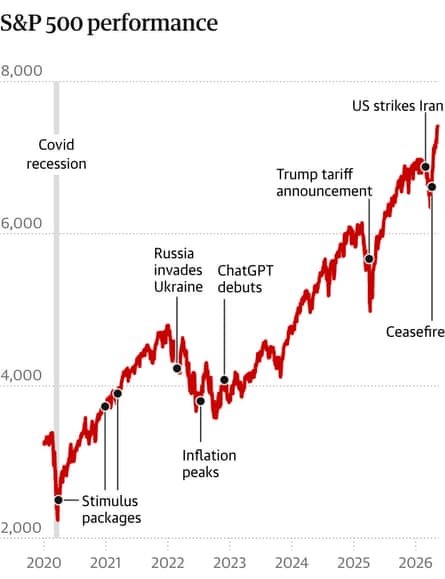
The US stock market has demonstrated remarkable resilience in the face of significant economic and geopolitical challenges that would typically trigger widespread investor panic. Despite mounting concerns about inflation, the ongoing Iran war, and the implementation of controversial tariffs, equity markets have continued their upward trajectory, confounding many financial experts and leaving analysts scrambling to explain the disconnect between troubling headlines and robust market performance.
The contrast became particularly stark on March 27th, when Wall Street experienced what appeared to be a significant selloff. Oil prices were surging amid escalating tensions with Iran, and geopolitical risk premiums were weighing heavily on investor sentiment. The Dow Jones and Nasdaq indices both slipped into correction territory, falling more than 10 percent below their previous peak valuations after a sustained month of consistent selloffs. Market watchers predicted further declines and braced for potential prolonged weakness in equity valuations.
Yet the narrative took a surprising turn just seven weeks later. By May 13th, the situation surrounding Iran had only marginally improved from an international relations perspective. Oil prices remained elevated, critical shipping routes like the Strait of Hormuz remained disrupted, and any meaningful diplomatic breakthroughs seemed increasingly unlikely. The geopolitical risks that had triggered the March correction remained firmly in place, and perhaps even intensified.

What makes this market behavior particularly noteworthy is that during this same period, President Donald Trump made explicit statements about his priorities. On Wednesday, May 13th, Trump declared publicly that he is "not even a little bit" motivated by concerns about Americans' financial situations when making decisions about the ongoing conflict with Iran. This candid admission suggested that resolution of the geopolitical tensions would not be prioritized based on domestic economic considerations, potentially extending the period of elevated uncertainty for markets.
The disconnect between traditional economic indicators and market performance raises important questions about what is actually driving equity valuations in the current environment. Consumer confidence metrics have shown notable weakness, with Americans expressing increased anxiety about their purchasing power and financial security. Surveys consistently show that households are concerned about rising prices for essentials like groceries, energy, and housing. Yet despite this erosion of consumer sentiment, institutional investors continue to deploy capital into equities at a steady pace.
This apparent paradox suggests that market dynamics in 2026 are being driven by different factors than traditional consumer-based economic models would predict. Institutional investors, corporate earnings trajectories, and monetary policy expectations appear to be outweighing the negative sentiment expressed by ordinary Americans. The stock market has become increasingly detached from Main Street economic realities, operating according to its own logic driven by large institutional investors, algorithmic trading systems, and forward-looking corporate profit expectations.
The role of corporate earnings deserves particular attention in understanding this phenomenon. Despite inflationary pressures and supply chain disruptions, many major corporations have successfully maintained or even increased their profit margins through strategic pricing power and operational efficiency improvements. Technology companies, in particular, have leveraged their market positions to maintain strong margins even as input costs have risen. This earnings resilience has provided fundamental support for equity valuations, giving investors tangible reasons to maintain their bullish positioning.
Additionally, the bond market's behavior has created an environment where stocks appear relatively attractive on a comparative basis. With interest rates elevated due to inflation concerns, the yields available in fixed income markets have become more competitive with historical standards. However, inflation expectations continue to erode the real value of bond returns, pushing many investors toward equities as a hedge against currency debasement. This flight to equities, while stocks themselves are also experiencing inflationary pressure on earnings multiples, creates complex dynamics that have produced surprisingly strong price performance.
The tariff policy announced by the Trump administration represents another layer of complexity that markets have had to price in. Initially, these tariffs created uncertainty about corporate profitability, particularly for companies with complex supply chains dependent on international trade. Some sectors, particularly manufacturing and retail, faced concerns about margin compression and reduced competitiveness. Yet the market has appeared to take a longer-term view, betting that companies would adapt to the new tariff environment through supply chain reconfiguration and negotiated trade agreements. The ability of corporations to navigate policy uncertainty has proven another source of market resilience.
Behavioral finance also offers insights into why markets continue climbing despite macroeconomic headwinds. Investor psychology tends toward extrapolation of recent trends, and the strong equity performance itself becomes a self-reinforcing narrative. Positive price momentum attracts additional capital, including passive index funds that are programmed to maintain consistent allocation percentages. These systematic flows provide price support even when fundamental news flow remains negative. The momentum itself becomes a fundamental driver of prices, independent of underlying economic conditions.
The resilience demonstrated by the stock market should not be interpreted as a sign that economic challenges do not exist or that investor complacency is entirely justified. Rather, it reflects the complex ways that different segments of the economy respond to various shocks. While consumer confidence has contracted and average Americans have expressed legitimate concerns about inflation and their purchasing power, institutional investors have identified mechanisms through which corporate profitability can be maintained or enhanced. The stock market has essentially bifurcated from the consumer economy, following its own trajectory based on institutional incentives and corporate earnings dynamics.
Looking forward, the key question for investors and policymakers becomes whether this disconnect between financial asset prices and consumer economic conditions can be sustained indefinitely. Historically, stock market valuations have reflected underlying economic fundamentals, with prolonged disconnects eventually resolving as one or the other adjusts toward equilibrium. The current environment presents investors with both opportunity and risk, as they navigate elevated geopolitical uncertainty, persistent inflation concerns, and trade policy volatility while maintaining exposure to an equity market that continues to reach new heights. The ultimate test will come when macro conditions force either a repricing of equities downward or a meaningful improvement in consumer economic conditions that would restore synchronization between Wall Street and Main Street.


%2520top%2520art%2520052026%2520SOURCE%2520Hello%2520Fresh.jpg&w=3840&q=75)