
Ancient 19-Meter Octopus Ruled Prehistoric Oceans

Fossil evidence suggests giant octopuses dominated ancient seas 100 million years ago. Discover what scientists learned about these prehistoric deep-sea creatures.
Groundbreaking fossil discoveries have revealed that giant octopuses may have dominated the world's oceans millions of years before modern marine life evolved. According to paleontological research, these massive cephalopods, measuring approximately 19 meters in length, potentially prowled ancient seas approximately 100 million years ago during the Cretaceous period. This remarkable finding challenges our understanding of prehistoric marine ecosystems and highlights the incredible diversity of life that existed in Earth's deep waters during the Mesozoic Era.
The fossil evidence for these colossal creatures provides scientists with a tantalizing window into a world vastly different from our modern oceans. Researchers have carefully examined and analyzed preserved remains that suggest these ancient cephalopods possessed extraordinary physical characteristics designed for survival in competitive marine environments. The fossils reveal creatures equipped with crushing jaws capable of breaking apart prey with tremendous force, alongside powerful muscular arms that would have made them formidable predators. These anatomical features paint a picture of apex predators that commanded respect in their underwater domains.
Perhaps most intriguingly, evidence suggests that these ancient octopuses possessed highly developed brains that likely gave them significant advantages in their ecosystems. The intelligence demonstrated by modern octopuses is already well-documented among marine biologists, but these prehistoric predecessors may have been even more cognitively sophisticated. A brain capable of supporting complex problem-solving, tool use, and adaptive hunting strategies would have positioned these giants as dominant competitors in ancient waters, allowing them to outmaneuver other formidable marine predators. This neural sophistication may explain how such enormous creatures maintained their ecological dominance for extended periods.
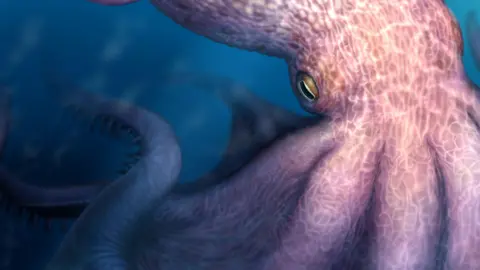
The discovery of these fossil remains adds another fascinating layer to our understanding of Cretaceous marine fauna. During this period, the oceans were home to an extraordinary array of creatures, from massive marine reptiles like plesiosaurs and mosasaurs to vast schools of fish and numerous other cephalopod species. The presence of giant octopuses in this ecosystem suggests a complex food web with multiple apex predators competing for resources in the vast ocean depths. Scientists theorize that these enormous cephalopods may have occupied specific ecological niches, perhaps hunting in deep waters where their size and intelligence provided distinct advantages over competitors.
The anatomical structure of these creatures reveals sophisticated evolutionary adaptations perfectly suited to their predatory lifestyle. Their muscular arms, studded with powerful suckers, would have been capable of manipulating and restraining large prey with remarkable precision and control. The crushing jaw mechanism discovered in the fossils suggests an evolutionary line-up of predatory specialization, indicating that these octopuses had become highly specialized for feeding on well-armored prey such as ammonites, fish, and possibly smaller marine reptiles. This level of specialization points to a successful evolutionary strategy that had refined itself over millions of years of natural selection.
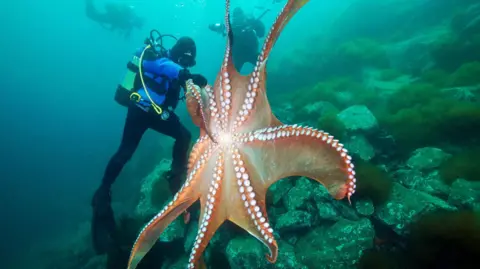
Understanding how these massive cephalopods achieved such enormous sizes provides important insights into the conditions of ancient ocean environments. The Cretaceous oceans were warmer and potentially more oxygen-rich than previously believed, creating ideal conditions for the evolution of giant marine life forms. The abundance of food sources combined with favorable environmental conditions would have allowed these octopuses to grow far larger than their modern relatives. Scientists continue to investigate how changing ocean chemistry, temperature fluctuations, and prey availability throughout the Cretaceous period may have influenced the size and distribution of these remarkable creatures.
The intelligence factor represented by the fossil evidence cannot be overstated in terms of its significance for understanding prehistoric marine ecosystems. Modern cephalopods are renowned for their problem-solving abilities, flexibility in behavior, and rapid learning capabilities. If ancient octopuses possessed similar or enhanced cognitive abilities, they would have been exceptionally formidable inhabitants of Cretaceous oceans. Their capacity to adapt hunting strategies, remember prey locations, and potentially use tools would have made them extraordinarily successful predators capable of thriving even as their environment underwent significant changes throughout this geological period.
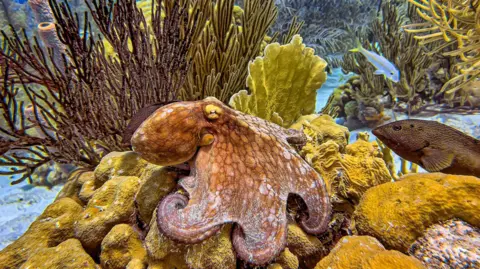
Paleontologists emphasize that while the fossil discoveries provide remarkable insights, they also present tantalizing mysteries that drive continued research efforts. Each new specimen examined offers additional clues about the size, behavior, and biological capabilities of these prehistoric giants. Researchers utilize advanced imaging techniques, comparative anatomy, and biomechanical modeling to extract maximum information from these ancient remains. The collaborative efforts of international paleontological teams continue to yield new discoveries that gradually piece together a more complete picture of how these remarkable creatures lived and interacted within their ancient marine world.
The extinction of these giant octopuses, like so many other Cretaceous marine species, likely coincided with the catastrophic environmental changes that marked the end of the Mesozoic Era. The K-Pg extinction event, which resulted in the extinction of dinosaurs and fundamentally restructured marine ecosystems, would have had profound implications for large predatory cephalopods. The changes in ocean chemistry, temperature, and food web structure would have been particularly challenging for enormous creatures dependent on abundant prey and stable environmental conditions. Understanding this extinction event helps scientists appreciate the fragility of even the most successful and dominant species when faced with dramatic environmental upheaval.
Today, the largest octopuses found in modern oceans are the Giant Pacific Octopus, which typically reach lengths of up to 9 meters, significantly smaller than their ancient predecessors. Comparing modern cephalopods to their prehistoric ancestors reveals how dramatically marine ecosystems have changed over millions of years. The absence of such enormous octopuses in contemporary oceans suggests that modern environmental conditions and evolutionary pressures have favored smaller, more adaptable species. This evolutionary trend reflects broader changes in ocean structure, temperature, predator-prey relationships, and the overall biological complexity of modern marine ecosystems compared to those of the Cretaceous period.
The research into ancient octopuses represents part of a broader scientific endeavor to understand the full scope of life that has existed on Earth throughout its history. These discoveries remind us that the modern world represents merely a snapshot in an immensely long timeline of biological evolution and environmental change. By studying the ancient seas and the creatures that inhabited them, scientists gain valuable perspective on how life adapts, evolves, and sometimes disappears in response to changing conditions. The 19-meter octopus stands as a testament to nature's creative power and the extraordinary diversity of life that has characterized Earth's oceans across geological time scales.
Source: BBC News


