
Burnham Edges Out Starmer in Labour Leadership Poll

YouGov survey shows Labour members prefer Andy Burnham over Keir Starmer. UK unemployment rises to 5% amid economic uncertainty and wage growth slowdown.
Recent YouGov polling data has revealed a significant shift in Labour Party sentiment, with party members expressing a notable preference for Andy Burnham over current Prime Minister Keir Starmer in terms of leadership credentials. The survey results have sparked considerable debate within Labour circles about the party's direction and electoral prospects heading into the next general election cycle. These findings come at a particularly sensitive moment in British politics, as the party grapples with internal divisions and external economic pressures affecting public confidence.
According to official statistics released this week, UK unemployment has unexpectedly climbed to 5%, marking a concerning upward trend for the government's economic record. Simultaneously, wage growth has decelerated, signaling potential headwinds for household finances across the nation. Economic commentator Tom Knowles reports that these figures represent the first comprehensive snapshot of how British companies are responding to the cascading effects of the Iran war and related geopolitical tensions. The combination of rising joblessness and slower wage expansion presents a challenging backdrop for the government's economic messaging.
The political landscape shifted dramatically last week when Prime Minister Keir Starmer delivered a forceful message to his cabinet colleagues, demanding loyalty with a blunt "put up or shut up" ultimatum directed at his internal critics. Health Secretary Wes Streeting, widely recognized as Starmer's primary rival within the party hierarchy, initially appeared poised to challenge the Prime Minister's authority. However, in a surprising turn of events, Streeting opted for neither open rebellion nor continued silence, instead choosing to publicly express his lack of confidence in Starmer's leadership while simultaneously resigning from his cabinet position.
The resignation of Streeting created a vacuum within Labour's upper echelon, but the situation took another dramatic twist when Andy Burnham, the Mayor of Greater Manchester and a respected figure within party ranks, discovered a viable pathway to challenge Starmer's authority. Burnham identified a potential byelection opportunity that could provide him with a parliamentary seat, effectively laying the groundwork for a potential Labour leadership challenge. This development suggests that rather than resolving the party's internal tensions, the recent cabinet drama has merely postponed an inevitable confrontation between competing visions for Labour's future.
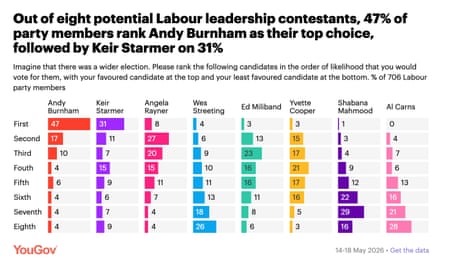
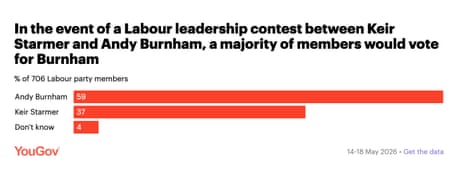
Significantly, Labour members would rather have Burnham than Starmer as leader, according to the comprehensive YouGov survey that ranked eight potential candidates for the party's top position. The polling data provides compelling evidence of growing dissatisfaction with Starmer's tenure and mounting confidence in Burnham's ability to lead the party forward. When members were presented with a range of prospective leaders and asked to express their preferences, the results demonstrated clear support for the Manchester-based politician across various demographic segments within the party's membership base.
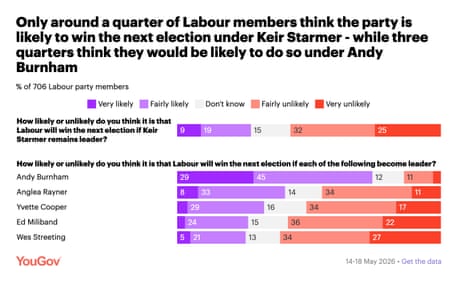
The survey findings carry significant implications for Labour's electoral prospects, with party members expressing serious doubts about Starmer's capacity to secure a second consecutive general election victory. Many members fear that the Prime Minister's current trajectory could result in substantial electoral losses, potentially reversing Labour's 2024 gains and returning the party to opposition. In contrast, respondents indicated strong confidence that Burnham could assemble a winning coalition and resonate with voters across diverse regions and demographic groups currently alienated by Starmer's leadership approach.
The broader context of these political developments involves persistent economic challenges facing the United Kingdom, including the unexpected jump in unemployment figures and the concerning deceleration of wage growth. These economic headwinds create additional pressure on the government to demonstrate competence and provide tangible improvements in living standards for ordinary Britons. The combination of internal party turmoil and external economic difficulties has created a particularly precarious situation for Starmer, who faces skepticism from both within his own party and from the general public.
The Labour Party leadership dynamics have become increasingly complex as multiple figures stake out their positions and assess their options. While Streeting's resignation signaled discontent without direct challenge, Burnham's identification of a byelection seat represents a more concrete threat to Starmer's position. The question now becomes whether Burnham will follow through on the implicit challenge suggested by his positioning, or whether he will adopt a more cautious approach designed to maintain party unity while potentially improving his standing for future opportunities.
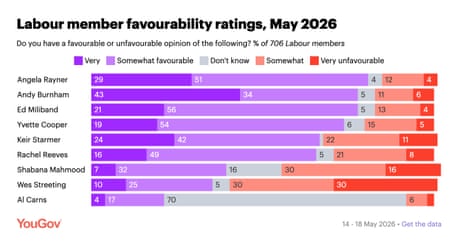
Party insiders and political analysts have noted that Labour member sentiment reflects broader concerns about electoral viability and leadership effectiveness. The preference for Burnham over Starmer among party members suggests that grassroots Labour activists believe the Manchester Mayor possesses superior qualities for leading the party into future campaigns. These members appear convinced that Burnham's regional profile, his track record as a local leader, and his perceived ability to connect with working-class voters could provide Labour with a more robust electoral platform than Starmer currently offers.
Looking forward, the trajectory of Labour's internal politics will likely depend on several interconnected factors, including whether Burnham successfully secures the byelection seat, how quickly economic conditions improve or deteriorate, and whether Starmer can stabilize his position through demonstrable policy achievements. The Prime Minister's recent cabinet message appears designed to consolidate support among colleagues who remain loyal, while simultaneously attempting to discourage potential challengers from pursuing open conflict. However, the persistence of both internal party doubts and challenging economic indicators suggests that this period of instability may extend well beyond the immediate weeks ahead.
Source: The Guardian


