
Controversy Erupts as Conservative Activist Caught Handing Checks to Wyoming Lawmakers

A conservative activist was photographed handing checks to Republican lawmakers on the Wyoming state house floor, sparking a political storm and highlighting issues of money in the state's politics.
Controversy has engulfed Wyoming's state legislature after a conservative activist was photographed handing checks to Republican lawmakers on the state house floor, in an incident that has highlighted intra-conservative divisions and the role of money in the Cowboy state's politics.
The political storm started on 9 February, when Karlee Provenza, a Democratic lawmaker, took a photo showing Rebecca Bextel, a conservative activist and committeewoman for the Teton county Republican party, handing a check to Darin McCann, a Republican representative, on the legislative floor. Marlene Brady, another Republican representative, stands in the photo's background, a similar piece of paper pinched between her fingers.
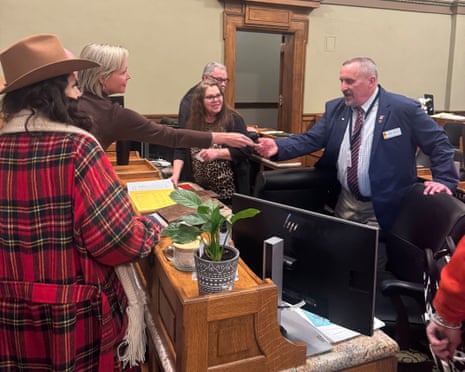
The incident has raised concerns about the influence of money in Wyoming's politics, where a small number of wealthy donors and special interest groups have long held sway. Critics argue that the exchange of checks on the legislative floor is a brazen display of this influence, undermining the principle of equal representation and open governance.
However, defenders of the practice argue that it is a common and accepted practice in the state, and that lawmakers are simply accepting contributions from their constituents and supporters. They dismiss the controversy as partisan grandstanding by the Democrats, who they claim are trying to score political points.
The incident has also highlighted the growing divide within the Republican Party in Wyoming, where a more moderate, establishment faction is facing off against a far-right, freedom caucus wing that is increasingly asserting its influence. The exchange of checks on the floor is seen by some as a symbol of this internal power struggle, with the more conservative lawmakers aligning themselves with the activist groups and donors that are challenging the party's traditional leadership.
Regardless of the broader political implications, the incident has shone a spotlight on the role of money in Wyoming's politics, and the extent to which special interests may be able to sway the decision-making of elected officials. As the state grapples with a range of pressing issues, from economic development to education and healthcare, the debate over the influence of money in the political process is likely to continue to be a central and contentious issue.


