
Micro Data Centers: The Future of AI Computing?

While tech giants build massive data centers for AI, experts argue smaller, distributed facilities could be more efficient and sustainable.
As artificial intelligence continues its rapid expansion across industries, the conventional wisdom suggests that bigger is better when it comes to data infrastructure. Tech giants like Google, Microsoft, and Amazon are constructing enormous data centers spanning hundreds of thousands of square feet, designed to accommodate the massive computational demands of AI workloads. However, a growing number of industry experts are challenging this approach, arguing that smaller, more distributed data facilities might actually represent the future of AI computing.
The current trend toward hyperscale data centers is driven by the belief that centralized, massive facilities offer economies of scale and operational efficiencies that smaller installations cannot match. These facilities, often consuming as much power as small cities, house thousands of high-performance servers and specialized AI chips designed to train and run complex machine learning models. The largest of these installations can cost billions of dollars to construct and require enormous amounts of electricity and cooling infrastructure to maintain optimal operating conditions.
Despite the apparent logic behind this massive infrastructure buildout, several technology experts and researchers are questioning whether such enormous facilities are truly necessary for effective AI deployment. Dr. Sarah Chen, a computer systems researcher at MIT, explains that the current approach may be fundamentally flawed: "We're applying 20th-century thinking to 21st-century problems. The assumption that centralization equals efficiency doesn't necessarily hold true in the age of distributed computing and edge processing."
The argument for smaller data centers rests on several compelling factors that challenge the traditional economies of scale model. First, distributed computing architectures can often achieve similar performance levels while offering greater resilience and reduced latency. When AI processing occurs closer to end users through smaller, strategically located facilities, applications can respond faster and more reliably than when dependent on distant mega-centers.

Energy efficiency represents another crucial advantage of the smaller-is-better approach to AI infrastructure. While massive data centers certainly benefit from economies of scale in terms of cooling and power distribution, they also create significant inefficiencies through the need to transport data over long distances and maintain vast amounts of idle capacity. Distributed AI processing can potentially reduce overall energy consumption by eliminating many of these transmission losses and allowing for more precise capacity matching.
Geographic distribution of AI computing resources also offers substantial benefits in terms of regulatory compliance and data sovereignty. As governments worldwide implement stricter data protection laws and local storage requirements, smaller regional facilities can more easily adapt to varying legal frameworks than massive centralized installations. This flexibility becomes particularly important as AI applications expand into sensitive sectors like healthcare, finance, and government services.
The environmental impact of AI infrastructure has become an increasingly pressing concern as these systems consume ever-greater amounts of electricity. Traditional large-scale data centers often rely on centralized power grids that may include significant fossil fuel components, while smaller distributed facilities can more easily integrate with local renewable energy sources. Solar panels, wind turbines, and other clean energy technologies can be more effectively matched to the power requirements of smaller installations.
Cost considerations also favor the distributed model in many scenarios. While the per-unit cost of computing power may be lower in massive facilities, the total cost of ownership includes factors like real estate, regulatory compliance, and risk management. Smaller data centers can often be deployed in less expensive locations and can scale more gradually with actual demand, reducing the financial risk associated with large upfront investments.

However, the transition toward smaller AI infrastructure is not without significant challenges and limitations. One of the primary obstacles is the current design of AI algorithms and models, many of which are specifically optimized for the parallel processing capabilities of large server clusters. Training advanced language models or computer vision systems often requires the coordinated effort of thousands of processors working simultaneously, something that distributed smaller facilities may struggle to achieve effectively.
The technical complexity of managing distributed AI systems also presents substantial operational challenges. While a single large data center can be monitored and maintained by a centralized team of specialists, multiple smaller facilities require more sophisticated remote management capabilities and potentially larger operational staffs. This complexity can offset some of the theoretical cost advantages of the distributed approach.
Network connectivity represents another significant technical hurdle for distributed AI infrastructure. Large-scale AI training and inference often require extremely high-bandwidth connections between processing nodes, something that may be difficult to achieve reliably across geographically distributed facilities. The latency and potential reliability issues associated with wide-area networks could significantly impact the performance of distributed AI systems.
Industry leaders are beginning to explore hybrid approaches that combine elements of both centralized and distributed AI infrastructure. Companies like NVIDIA and Intel are developing new architectures that allow AI workloads to be dynamically distributed across multiple facilities based on current demand, available resources, and performance requirements. These hybrid AI systems could potentially capture the benefits of both approaches while minimizing their respective disadvantages.
The emergence of specialized AI chips designed for edge computing is also facilitating the trend toward smaller, more distributed AI infrastructure. These processors, optimized for inference rather than training, can deliver impressive performance levels while consuming significantly less power than traditional server-based solutions. As these chips become more capable and cost-effective, they enable AI applications to run effectively in smaller facilities that would have been impractical just a few years ago.
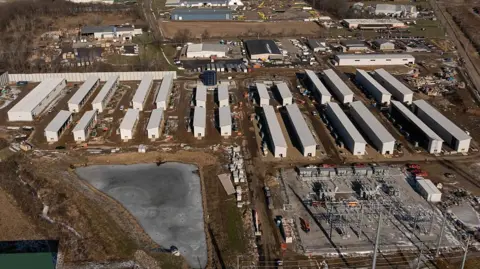
Several startups and established technology companies are already implementing distributed AI strategies with promising results. Companies like Packet (now part of Equinix) and Vapor IO are building networks of smaller, edge-focused data centers specifically designed to support distributed AI workloads. These facilities, often housed in repurposed shipping containers or small buildings, can be deployed rapidly and scaled according to local demand.
The telecommunications industry is also driving adoption of distributed AI infrastructure through the deployment of 5G networks and edge computing capabilities. As mobile carriers build out their next-generation networks, they are incorporating AI processing capabilities directly into cell towers and local network facilities. This approach enables real-time AI applications like autonomous vehicles and augmented reality systems that require extremely low latency responses.
Looking ahead, the future of AI data center architecture will likely involve a more nuanced approach than the current focus on massive centralized facilities. Different types of AI applications may require different infrastructure strategies, with some workloads benefiting from centralized processing while others perform better in distributed environments. Training large AI models may continue to require massive facilities, while inference and edge applications could shift toward smaller, more distributed architectures.
Regulatory and policy factors will also play an important role in shaping the future of AI infrastructure. Government incentives for renewable energy adoption, data localization requirements, and environmental regulations could all favor distributed approaches over centralized mega-facilities. As climate change concerns intensify, the pressure to reduce the environmental impact of AI computing will likely accelerate the adoption of more efficient, distributed architectures.
The debate over AI data center sizing ultimately reflects broader questions about the optimal architecture for next-generation computing systems. As artificial intelligence becomes increasingly integrated into everyday applications and services, the infrastructure supporting these systems will need to evolve beyond the current one-size-fits-all approach toward more flexible, adaptive solutions that can meet diverse performance, cost, and environmental requirements.
Source: BBC News


