
Putin's China Visit Signals Unity But Falls Short on Pipeline

Russia and China demonstrate strategic alignment on global affairs, yet geopolitical tensions limit concrete pipeline negotiations during Putin's state visit.
Russian President Vladimir Putin's recent state visit to China showcased the deepening diplomatic relationship between Moscow and Beijing, yet behind the ceremonial pageantry and public displays of solidarity lay a more complex reality. According to the BBC's Russia Editor, while both nations presented a unified front on the international stage, the visit revealed distinct limitations in their partnership, particularly regarding energy infrastructure deals that Moscow had hoped to advance.
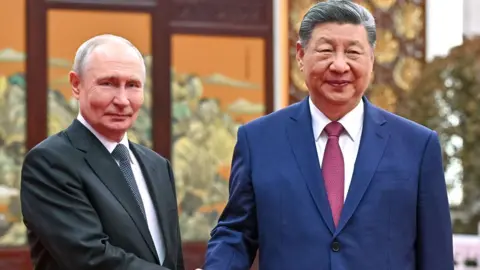
The visit itself was characterized by elaborate official ceremonies and carefully choreographed public appearances designed to reinforce the message of Russia-China alliance strength. Chinese leaders extended Xi Jinping's traditional warm welcome to Putin, featuring military honors, state banquets, and high-level diplomatic meetings. These gestures underscored the importance both countries place on their bilateral relationship amid increasing Western pressure and sanctions.
However, the absence of major pipeline deal agreements during the visit suggested that beneath the surface cordiality, practical negotiations over energy infrastructure remained fraught with complications. Russia had anticipated leveraging its relationship with China to secure commitments for expanded gas and oil pipeline projects, which would have provided Moscow with critical economic lifelines as Western nations implemented sanctions in response to geopolitical conflicts.
The geopolitical context surrounding Putin's visit cannot be understated. Russia faces unprecedented isolation in the Western world, making partnerships with Asian powers increasingly vital to its economic survival and political relevance. China, conversely, must balance its strategic partnership with Russia against its own economic interests and its complex relationship with Western nations. This balancing act has become more pronounced as global supply chains and energy markets remain volatile.
Strategic alignment between Russia and China extends beyond energy cooperation. Both nations share common interests in challenging American global dominance, advocating for a multipolar world order, and resisting what they perceive as Western interventionism. Their joint statements emphasize respect for sovereignty, opposition to sanctions regimes, and promotion of alternative international governance structures that diminish Western influence.
The limitations revealed during Putin's visit reflect China's pragmatic approach to international relations. While Beijing supports Moscow rhetorically and maintains diplomatic cooperation, it remains cautious about becoming too economically entangled with a sanctioned nation. Chinese companies face their own risks when engaging with Russia, as secondary sanctions could impact their ability to access Western markets and technology. This creates a natural constraint on how far China will go in deepening economic ties.
The pipeline negotiations specifically highlight the gap between public unity and private calculations. Russia proposed expanded energy infrastructure projects that would cement long-term economic cooperation and ensure markets for Russian fossil fuels as Europe diversifies away from Russian energy. However, China's negotiating position reflected its own leverage and concerns. The nation possesses multiple energy suppliers and can demand favorable pricing and terms, reducing its desperation to commit to major new projects with Russia.
According to analysis by the BBC's Russia Editor, Putin departed China without the transformative agreements Moscow desired, though not entirely empty-handed. The visit confirmed the existence of the Russia-China partnership, an important symbolic achievement. Yet the failure to announce significant new energy deals suggested that China's commitment has practical limits, particularly when weighed against its broader economic and geopolitical calculations.
The energy sector remains central to Russia's economic strategy. Sanctions have severely disrupted Moscow's ability to export oil and gas to Western markets, making Asian markets increasingly crucial. However, Russia's negotiating position has weakened considerably. Without Western markets and facing supply chain constraints, Russia has become more dependent on whatever terms major partners like China are willing to offer, rather than negotiating from a position of strength.
The visit also underscored the broader challenge facing Russia's international positioning. While Russia-China cooperation remains strategically important to both nations, it operates within constraints imposed by China's own interests in maintaining economic ties with the West and avoiding excessive entanglement with a heavily sanctioned state. Beijing has shown willingness to provide diplomatic support and limited economic cooperation, but has stopped short of becoming Russia's economic savior on terms Moscow might prefer.
Looking forward, Russia faces the reality that even its closest major power ally has boundaries regarding how much economic integration it will undertake. This reality shapes Moscow's strategic calculations and suggests that Russia must pursue a more diversified approach to its international economic relationships, even as Western isolation limits options. The geopolitical landscape continues to shift, with Russia and China demonstrating both shared interests and distinct limitations in their partnership.
Putin's return from China thus represents both a diplomatic success and a sobering reminder of the constraints facing Moscow. The ceremonial aspects of the visit achieved their purpose in demonstrating international support and strategic alignment against Western pressure. However, the absence of major new economic agreements suggests that transforming rhetorical partnership into substantive cooperation presents ongoing challenges that neither nation has yet fully resolved.
The implications extend beyond bilateral relations between the two nations. The visit's outcomes indicate how geopolitical isolation affects a major power's negotiating leverage, even with sympathetic partners. Russia's situation demonstrates that diplomatic solidarity and strategic alignment, while valuable, have practical limits when economic self-interest comes into play. As global tensions persist and sanctions regimes evolve, the trajectory of Russia-China relations will remain a critical factor in shaping international politics and the emerging multipolar world order both nations claim to support.
Source: BBC News


