
Trump's Beijing Summit: Spectacle Over Substance

Trump meets Xi Jinping in historic Beijing summit amid pageantry, but concrete achievements on Iran, Taiwan remain uncertain. Analysis of diplomatic outcomes.
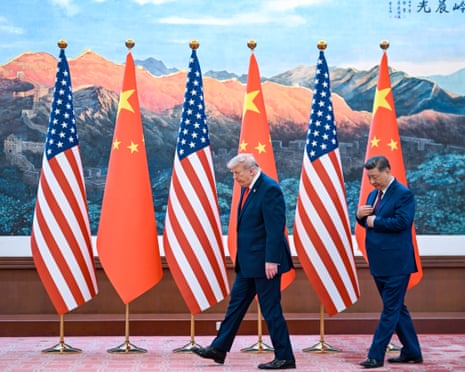
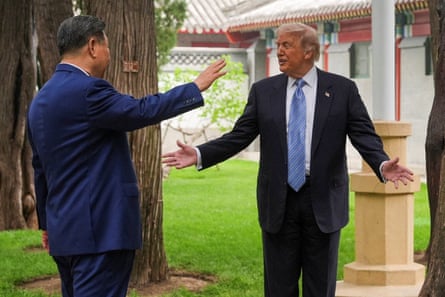
The historic encounter between Donald Trump and Xi Jinping in Beijing this week delivered moments of considerable symbolic significance, yet left observers questioning whether the elaborate ceremonial display masked a fundamental absence of substantive diplomatic progress. The carefully choreographed state visit, replete with pageantry and grandeur, presented an image of unprecedented cooperation between the world's two largest economies, but the reality behind closed doors appeared far more complicated and ambiguous than the public relations narrative suggested.
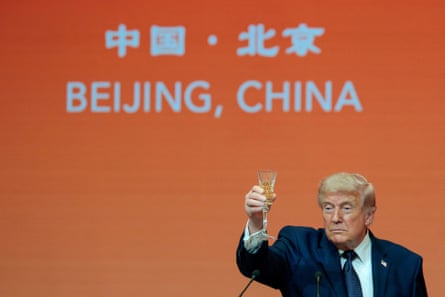
The evening's most striking tableau emerged during Thursday's lavish state banquet, where the contrast between calculated diplomacy and unexpected candor became impossible to ignore. According to eyewitness accounts, Trump, a well-known teetotaler throughout much of his public life, was observed consuming champagne following remarks from Xi Jinping about harmonizing China's "great rejuvenation" with the American president's signature campaign slogan, "Make America great again." This moment of shared toasting carried considerable symbolic weight, suggesting a convergence of national interests that many observers hoped would translate into concrete policy breakthroughs on issues ranging from trade to military tensions.
The venue itself became a character in the diplomatic narrative unfolding throughout the summit. Beneath soaring chandeliers suspended from ornate ceilings, adjacent to blue and gold balconied galleries, and framed by an imposing orange backdrop adorned with traditional pagoda-style architectural elements, the banquet hall transformed into a stage for geopolitical theater. The guest list alone reflected the extraordinary nature of the occasion, featuring attendees whose presence in such rarefied diplomatic circles would have seemed implausible merely a decade ago, signaling how dramatically the global power structure has evolved in recent years.
Among the most notable figures in attendance was Elon Musk, the visionary technology entrepreneur whose companies have become increasingly entangled in complex geopolitical considerations involving both American national security interests and Chinese technological ambitions. Also present was Pete Hegseth, the former Fox News personality now serving as Secretary of Defense, whose presence underscored the unconventional nature of the Trump administration's approach to foreign policy and diplomatic representation. These were not traditional figures from the State Department establishment, but rather entrepreneurs, media personalities, and political outsiders who have come to define the contemporary American political landscape under Trump's leadership.
Despite the impressive optics and carefully coordinated messaging, serious questions remain about what this summit actually accomplished in terms of concrete policy outcomes. Regarding the ongoing tensions in the Middle East, no clear pathway toward resolving American concerns about Iran emerged from the discussions, leaving regional stability hanging in considerable uncertainty. The Trump administration had hoped to leverage improved relations with Beijing into Chinese pressure on Iran, but the communiqué issued following the summit contained only vague references to cooperation without specific commitments or timelines for action.
The situation surrounding Taiwan proved equally ambiguous, with both sides apparently content to leave their fundamental disagreements largely unaddressed. Rather than forging a new understanding about the island's status or establishing clearer guardrails to prevent military miscalculation, the summit produced only carefully worded diplomatic language that allowed both powers to claim victory while avoiding the difficult conversations necessary for genuine crisis prevention. This approach, while politically convenient in the short term, leaves open the possibility of future confrontation given the irreconcilable positions maintained by Washington and Beijing on this existential issue.
Perhaps most tellingly, the agreements announced regarding commercial deals and trade arrangements lacked the specificity and substance that Trump administration officials had suggested would emerge from the summit. Instead of detailed contracts and binding commitments that would demonstrably benefit American workers and businesses, the documents produced contained largely aspirational language about future cooperation and vague frameworks for ongoing negotiations. Business leaders attending the summit expressed cautious optimism while privately acknowledging that meaningful movement on the most contentious trade issues remained elusive.
The musical program arranged for the evening added another layer of surrealism to the proceedings, as a Chinese military band delivered an unexpected rendition of "YMCA," the iconic Village People anthem that has become Trump's unofficial campaign anthem. While intended as a gesture of goodwill and acknowledgment of American popular culture, the performance underscored the sometimes-awkward fusion of serious geopolitical theater with elements of pop culture spectacle that increasingly characterizes diplomatic engagement in the social media age. The image of uniformed military musicians playing the disco classic captured something essential about the Trump era's approach to international relations.
Observers and foreign policy analysts have begun questioning whether the summit succeeded primarily in creating favorable optics for both leaders' domestic political audiences rather than in advancing substantive diplomatic objectives. For Trump, the visit offered an opportunity to present himself as a dealmaker capable of managing relations with America's primary strategic competitor, potentially bolstering his political standing ahead of upcoming elections. For Xi, the summit provided a chance to project confidence and stability while demonstrating that China remains capable of engaging with American leadership on its own terms, countering narratives of Chinese isolation or desperation.
The broader context for this summit cannot be ignored, as it unfolded against a backdrop of intensifying technological competition, ongoing disputes over intellectual property and industrial espionage, and fundamental disagreements about the rules governing international commerce and competition. Both nations have invested heavily in portraying their respective economic models as superior, yet finding common ground on these foundational issues has proven extraordinarily difficult. The summit appeared to represent less a breakthrough in these longstanding tensions than a temporary pause in the escalating rhetoric that has characterized the relationship in recent months.
Looking forward, observers remain divided on whether this summit represents a genuine warming of US-China relations or merely a temporary thawing in diplomatic temperature that will inevitably refreeeze as structural tensions reassert themselves. The lack of concrete achievements on issues ranging from military-to-military communication protocols to specific trade agreement frameworks suggests that while both leaders may wish to project an image of cooperation, the underlying disagreements that have animated this strategic competition remain fundamentally unresolved, leaving future friction not merely possible but highly probable.
Source: The Guardian


