
Webb Telescope Maps Cosmic Web with Unprecedented Detail

Astronomers leverage James Webb Space Telescope to create detailed cosmic web maps, enhancing our understanding of the universe's structure and evolution.
The James Webb Space Telescope continues to revolutionize our understanding of the cosmos by enabling astronomers to construct increasingly detailed maps of the cosmic web—the vast network of matter and energy that permeates the universe. Recent observations have yielded remarkable insights into galactic distributions, filamentary structures, and the intricate patterns that define our cosmos at its largest scales. This breakthrough represents a significant leap forward in mapping the universe's architecture and promises to fundamentally reshape how scientists investigate the origins and evolution of cosmic structures.
The cosmic web represents one of astronomy's most profound mysteries, consisting of interconnected filaments of dark matter, galaxies, and gas that stretch across billions of light-years. Understanding this vast network is essential for comprehending how galaxies form, evolve, and cluster throughout space. Webb's unprecedented infrared sensitivity allows astronomers to peer deeper into space and time than ever before, detecting faint signals from distant galaxies and revealing previously hidden structures within the cosmic fabric. The enhanced resolution and clarity provided by the space telescope enable researchers to trace these connections with remarkable precision.
Traditional ground-based telescopes and earlier space observatories faced significant limitations when attempting to map the cosmic web due to dust obscuration and limited sensitivity to distant objects. The infrared capabilities of the Webb telescope overcome these obstacles by detecting light that has been shifted into the infrared spectrum due to cosmic expansion. This allows scientists to observe galaxies as they existed billions of years ago, effectively creating a time machine that reveals how the cosmic web has evolved over cosmic time. The improved detail in these maps directly translates to more accurate models of galactic evolution and structure formation.
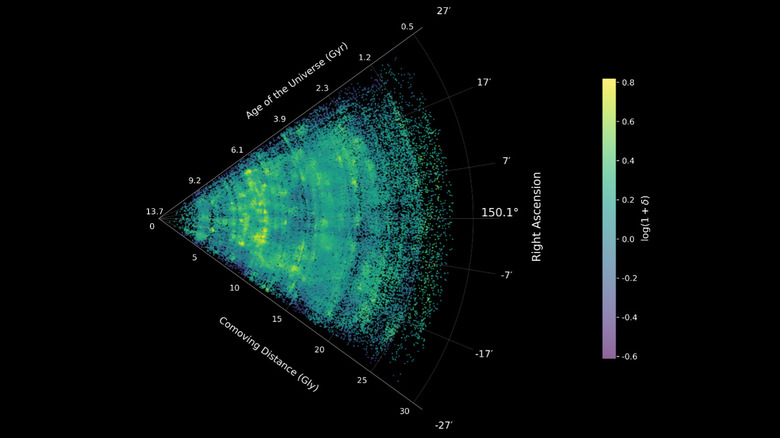
The implications of improved cosmic web mapping extend far beyond academic interest, as these detailed frameworks enable astronomers to test fundamental theories about the universe's composition and behavior. Scientists can now examine how dark matter distribution correlates with visible galaxy clustering, providing crucial constraints on dark matter models and modified gravity theories. The enhanced maps reveal subtle asymmetries and unexpected features that challenge existing assumptions about cosmic homogeneity and isotropy. Additionally, these observations help researchers understand how gravitational interactions shaped the universe's large-scale structure over billions of years.
Webb's observations have already revealed surprising details about the early universe's structure, including the rapid assembly of massive galaxies in the first billion years after the Big Bang. These findings necessitate refinements to existing models of galaxy formation and suggest that galaxies may have evolved more quickly than previously thought. The cosmic web's role in channeling matter toward galaxy clusters has become increasingly apparent through these detailed observations, demonstrating how filamentary structures act as cosmic highways for gas and matter. Understanding these pathways is crucial for explaining the observed diversity in galactic properties and evolutionary histories.
The process of creating comprehensive cosmic web maps involves analyzing vast quantities of data from multiple observations, each targeting specific regions of sky and redshift ranges. Astronomers combine spectroscopic data—which reveals the wavelength signatures that indicate object distances—with imaging data to construct three-dimensional models of cosmic structures. Machine learning algorithms increasingly assist in identifying filaments and voids, automating pattern recognition across millions of galaxies. This computational approach enables the processing of data volumes that would be impossible to analyze manually, accelerating the pace of discovery.
International collaborations have become essential for maximizing the scientific return from Webb observations, with research teams from dozens of institutions working together to analyze data and develop theoretical interpretations. These collaborative efforts pool expertise in observational astronomy, computational analysis, and theoretical astrophysics to extract maximum insight from each observation. Data from Webb is made publicly available to the broader scientific community, democratizing access to these revolutionary observations and enabling researchers worldwide to conduct independent analyses. This open-science approach accelerates progress and enables innovations that individual institutions might not achieve independently.
Looking forward, continued observations with the Webb telescope promise even more detailed cosmic web maps that will enable unprecedented investigations into the universe's history and structure. Future observations may reveal previously undetected populations of galaxies, including extremely distant objects that pushed the boundaries of early cosmic epochs. Combining Webb data with observations from other facilities, including ground-based telescopes and complementary space missions, will create comprehensive multi-wavelength pictures of cosmic structures. These integrated datasets will provide the foundation for understanding how the universe evolved from the smooth, nearly uniform conditions following the Big Bang to the complex, structured cosmos we observe today.
The refinement of cosmic web maps also has practical applications for future astronomical surveys and observation strategies. By identifying density variations and structural features, astronomers can optimize the placement of telescopes and design observation programs that maximize scientific discovery potential. Educational institutions and public outreach programs utilize these visualizations to inspire interest in astronomy and explain the universe's grand-scale architecture. As Webb continues its mission, the accumulating wealth of data will ensure that researchers have the resources needed to address fundamental questions about cosmic evolution, dark matter, and the ultimate fate of the universe.
The achievement of detailed cosmic structure mapping represents the culmination of decades of technological development, theoretical work, and observational planning. Thousands of scientists and engineers contributed to bringing Webb into orbit and optimizing its performance, investments that now yield extraordinary scientific returns. The success of these mapping efforts validates the enormous resources devoted to space-based astronomy and demonstrates the continuing importance of advancing observational capabilities. As humanity's understanding of the cosmos deepens through improved maps and observations, the Webb telescope stands as a testament to scientific ambition and the power of innovation to expand human knowledge of our place in the universe.
Source: Engadget


