
xAI Launches Grok Build: AI Coding Agent

xAI introduces Grok Build, an advanced coding agent currently in early beta. Exclusive access available to SuperGrok Heavy subscribers.
xAI has unveiled its latest innovation in artificial intelligence: Grok Build, a sophisticated coding agent designed to streamline software development workflows. This new tool represents a significant expansion of xAI's capabilities in the competitive field of AI-powered development, positioning the company alongside other major players investing heavily in intelligent coding assistants.
The launch of Grok Build marks an important milestone for xAI, demonstrating the company's commitment to providing developers with cutting-edge tools that leverage advanced artificial intelligence. The coding agent harnesses the power of machine learning and natural language processing to help developers write, debug, and optimize code more efficiently. By integrating Grok Build into their development stack, programmers can potentially reduce time spent on routine coding tasks and focus on more complex architectural decisions.
Currently, Grok Build exists in an early beta phase, meaning it is still undergoing rigorous testing and refinement before a broader public release. This staged approach allows xAI to gather valuable feedback from initial users, identify potential issues, and make necessary improvements before expanding access to a larger audience. The beta period is crucial for ensuring that the coding agent performs reliably across diverse use cases and programming scenarios.
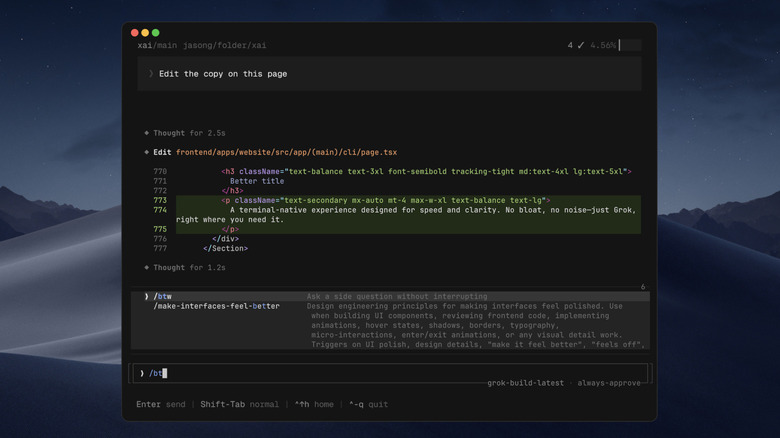
Access to Grok Build is currently restricted to SuperGrok Heavy subscribers, xAI's premium tier of users. This exclusivity strategy allows the company to maintain quality control and gather insights from highly engaged users who are most likely to provide detailed feedback. SuperGrok Heavy subscribers are typically the most demanding users, with sophisticated needs that push the boundaries of what these tools can accomplish. By starting with this exclusive group, xAI can refine the product iteratively based on real-world usage patterns and specific developer requirements.
The decision to limit initial availability to premium subscribers reflects a common industry practice among tech companies developing advanced AI tools. This approach provides several advantages: it creates a sense of exclusivity and value for premium users, allows for controlled scaling of computational resources, and enables rapid iteration based on focused user feedback. SuperGrok Heavy subscribers gain early access to innovations, which enhances the value proposition of their subscription and fosters loyalty within xAI's user base.
Grok Build represents xAI's entry into the AI development tools market, a rapidly expanding sector attracting significant investment and competition. Other companies, including GitHub with Copilot and Anthropic with Claude-based coding features, have already established strong positions in this space. xAI's version aims to differentiate itself through unique architectural choices and integration with the broader Grok ecosystem, potentially offering features or capabilities that set it apart from existing solutions.
The technical architecture of Grok Build likely leverages xAI's underlying language models and computational infrastructure. These models are trained on vast amounts of programming code, documentation, and development best practices, enabling the agent to understand context, suggest improvements, and generate functional code snippets. The agent can presumably handle multiple programming languages and frameworks, though specific capabilities may vary depending on the languages most prevalent in its training data.
For developers considering Grok Build, the tool promises to enhance productivity through intelligent code completion, bug detection, and optimization suggestions. The coding agent can analyze incomplete code segments and provide contextually appropriate completions, significantly accelerating the coding process. Additionally, it may offer refactoring suggestions, help identify potential performance bottlenecks, and provide documentation or explanation for complex code segments. These features combine to create a more comprehensive development assistance experience compared to simple autocomplete tools.
The integration of Grok Build into the xAI ecosystem creates an opportunity for synergistic benefits. Users already familiar with Grok's conversational capabilities can extend that familiarity to the coding agent, creating a seamless experience. The underlying language models powering both tools share similar training approaches and architectural principles, potentially allowing knowledge transfer and consistent behavior across different applications. This unified approach may provide advantages in terms of user experience and system coherence.
Looking ahead, xAI's roadmap for Grok Build likely includes expanding access beyond SuperGrok Heavy subscribers to other user tiers and eventually to the general public. The beta phase serves as both a testing ground and a marketing opportunity, allowing the company to demonstrate capabilities to potential users and gather testimonials from early adopters. Success during this phase could accelerate the company's timeline for broader rollout, while any significant issues discovered might necessitate additional refinement work.
The competitive landscape for AI coding agents continues to evolve rapidly, with improvements in model accuracy, latency reduction, and feature richness becoming key differentiators. xAI's entry into this market with Grok Build suggests the company believes it has developed a compelling offering worthy of competing with established players. The coming months will reveal how well Grok Build resonates with the developer community and whether it can establish a significant market presence in the competitive world of AI-assisted development tools.
As Grok Build progresses through beta and eventually reaches broader availability, developers will have another powerful option for accelerating their coding workflows. The tool's success will depend not only on technical capabilities but also on factors such as ease of use, reliability, integration with popular development environments, and cost-effectiveness compared to alternatives. xAI's commitment to iterative improvement through the beta phase suggests a thoughtful approach to product development that prioritizes quality and user satisfaction.
Source: Engadget


